
Your Service Truck Is Your Lifeline
Autosphere » Tires »
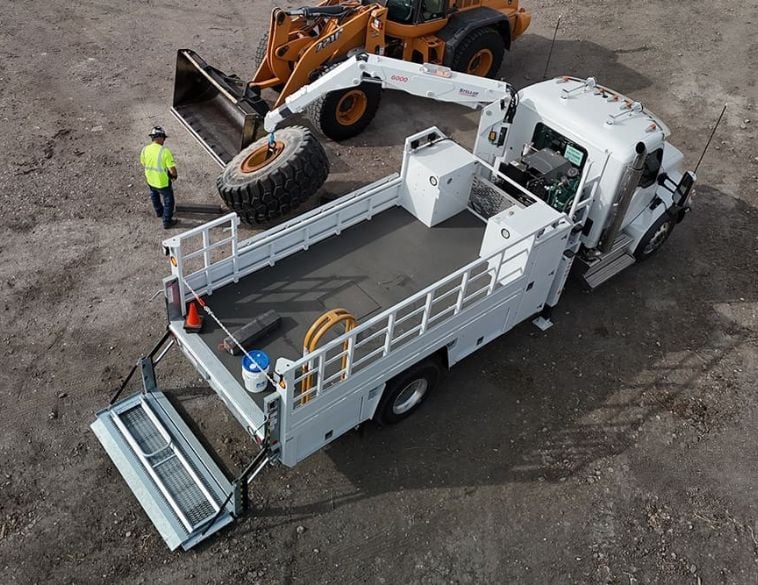
Properly maintaining your service truck is a critical part of your business. Credit: Stella Industries
Regular maintenance, inspections and proper lubrication can help keep roadside and off-road tire service operations running reliably.
For many tire dealers and service providers, the service truck is the backbone of a successful roadside service program. It carries the equipment technicians need to respond to customers, handle demanding jobs and keep vehicles moving.
That said, there is an important reality that can sometimes be overlooked: The truck that keeps your business busy also needs regular attention.
Maintaining a service truck is easier said than done, particularly when schedules are packed and the vehicle is constantly on the road. However, building preventive maintenance into the daily, monthly and annual routine can help avoid unexpected breakdowns, reduce costly repairs and keep the road service operation productive.
“Take care of your service truck, and it will take care of you.”
– Matt White
Start with the manufacturer’s schedule
A good place to start is with the manufacturer’s recommended maintenance schedule. It identifies required inspections and service intervals, lubrication points and the correct fluids and lubricants to use.
Daily inspections are particularly important, and a clean, organized service truck makes it easier to identify potential problems, and ensure equipment is ready when the next call comes in. Technicians should take pride in their trucks and make cleaning and organizing part of the end-of-day routine.
Regular inspections should include the truck’s tires, fluid levels, windshield wipers and other basic operating components. These checks may seem routine, but staying on top of small issues can prevent them from becoming major problems at the worst possible time.
Don’t overlook lubrication
Lubrication is another area that is sometimes overlooked. While some trucks may have relatively few grease fittings, boom trucks and vehicles equipped with tire manipulators can have numerous components requiring regular lubrication. In some cases, fittings need attention weekly.
This is where having the manufacturer’s manual available is critical. It will identify where the grease fittings are located, and specify the correct lubricant for each component.
Using the wrong grease can create unnecessary wear and equipment problems. For example, an open gear on a mini boom may require molybdenum grease, while other fittings on the same piece of equipment may require EP-2 grease. Yet, during training visits, it is not uncommon to find a single grease gun on a truck filled with a general-purpose or wheel-bearing grease and being used for everything.
The same attention should be given to hydraulic systems. Failing to change hydraulic fluid on PTO-driven equipment can contribute to breakdowns and expensive repairs.
Many service truck manufacturers recommend changing hydraulic fluid at least annually. For trucks operating in particularly demanding, high-use applications, more frequent changes (potentially twice per year) may be appropriate, depending on the manufacturer’s recommendations and operating conditions.
Inspect equipment before it fails
Annual inspections by qualified or certified inspectors are also an important consideration, particularly for boom trucks and tire manipulators. These inspections can help identify wear, damage or safety concerns before they lead to equipment failures or put technicians at risk.
The key is to make service truck maintenance part of the operation, rather than something that happens only when time allows. A maintenance schedule, daily inspections, proper lubrication, fluid changes, regular cleaning and professional inspections all contribute to reliability.
Road service customers depend on tire professionals to show up ready to work. That is difficult to do when the service truck itself is out of commission. The message is simple: Take care of your service truck, and it will take care of you. And, above all, be safe out there.



JOBS
 |  LASALLE LASALLE Full time Full time |
 | STE-AGATHE-DES-MONTS Full time |
 | SAINT-LÉONARD Full time |
 | MONTRÉAL Permanent |
 | JOLIETTE Full time |