
Assembled in Canada, Made in China: The Reality of EV Battery Manufacturing Dependency
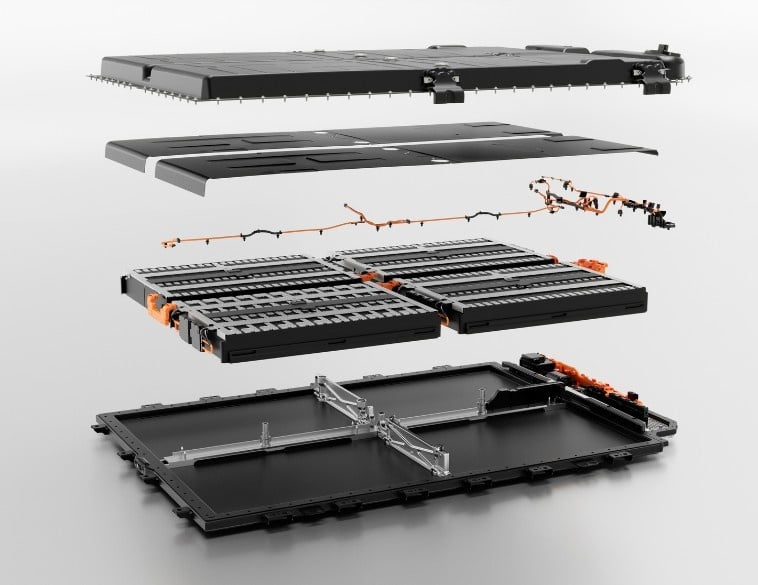
Critical EV battery components often need to be sourced from China. Credit : Daimler AG
Sleep walking into a future where we are not in control of our mobility.
Let’s look at what EVs contribute to our manufacturing base. In Ontario and in Quebec there has been a lot of money given out to develop battery manufacturing for EVs. We have seen one dramatic failure, Northvolt, launched in Europe and then in Canada to much fanfare, and seen as the great Western hope in battery manufacturing, only to collapse in a few years.
Change of direction
In Ontario, NextStar Energy (https://www.cbc.ca/news/canada/windsor/province-federal-government-grand-opening-windsor-nextstar-9.7115783) started producing battery cells last November but had a setback and a change of direction. Stellantis recently sold its 49% stake to LG and focus shifted to energy storage systems because of a slumping EV market.
The Volkswagen EV battery plant is progressing towards completion, but with Volkswagen’s EV troubles (https://www.theguardian.com/business/2026/mar/10/vw-cut-jobs-trump-tariffs-chinese-sales-audi-porsche) we are not sure if the plant will reach full production capacity and meet employment targets.
Both plants are beneficiaries of billions of dollars in support provided by various levels of Government. Who will all this expenditure also benefit? One party will be the key beneficiary of all our billions of expenditures…China.
To manufacture a Lithium-Ion battery, 4 critical components are required, a cathode, an anode, a separator, and electrolyte. Most battery assembly plants depend on suppliers in one country for these components…China.
China dominates global cathode production. It enjoys a near monopoly on production of LFP (lithium iron phosphate) cathode material. Chinese firms, heavily supported by government subsidies, that cannot be matched in the West, dominate the midstream processing of raw materials into cathodes, making it virtually impossible for Western companies to compete.
Dangerous signal
China dominates global anode production, including 99% of all graphite anode production. China has even enacted export controls to reinforce their dominance over the market. This is a dangerous signal to the West.
Battery separator production is heavily controlled by Chinese companies with over 70% of global market share.
China dominates global battery electrolyte production, producing over 80% of the world’s battery electrolytes and more than 90% the essential salt used in lithium-ion battery electrolytes.
Most of the above components require massive amounts of electricity to fuel production. China’s huge and numerous coal fired power plants are a source of cheap electricity that cannot be matched by the West.
Battery manufacturing in Canada? It is really the assembly of batteries with key components made in China. Canada is not alone in this situation; it is already the reality in Europe.
Harsh truth
The harsh truth is you cannot build EV batteries at any large scale without significant dependency on China. This situation will not change significantly in the foreseeable future and may never change enough to stop China from playing a controlling role in a world that becomes dependent on EVs for mobility. For example, China’s market share of global cathode production is projected to decrease by only 3%, by 2030, as alternative supply options emerge.
The harsh truth is you cannot build EV batteries at any large scale without significant dependency on China. – Peter-James Gregory
Building an alternative supply chain for these components to effect any significant reduction in China’s dominance requires huge amounts of capital, including massive government subsidies and grants, along with a high volume of cheap and reliable electricity. This makes it very difficult for Western nations to compete as many are already running huge deficits and so cannot match China for subsidies, and Western green and net zero polices make it impossible to supply the required amount of cheap and reliable electricity.
Some of us are old enough, or have paid enough attention to history, to remember and understand the danger the West experienced with the 1970s oil crisis, triggered by the October 1973 Arab oil embargo (https://www.federalreservehistory.org/essays/oil-shock-of-1973-74). Why are we going down a road to a similar crisis with EVs with a far more dangerous opponent than the Arab nations in the 1970s, or OPEC? This is the question we should ask ourselves.
We are slow walking into a future where China will control the keys to our mobility…and we are paying for our future subservience with our own money.
Bio: Peter-James Gregory is an Entrepreneur, Car Guy and retired tire industry professional with a history of driving growth and creating value in the tire and automotive sectors. You can reach him at [email protected]


JOBS
 |  DORVAL DORVAL Full time Full time |
| ST-HUBERT Full time |
 | MONTRÉAL Permanent |
 | SASKATOON Full time |
| MONTRÉAL-NORD Permanent |