
Is Electronics Better Than Mechanics in Auto Parts?
Autosphere » Mechanical »
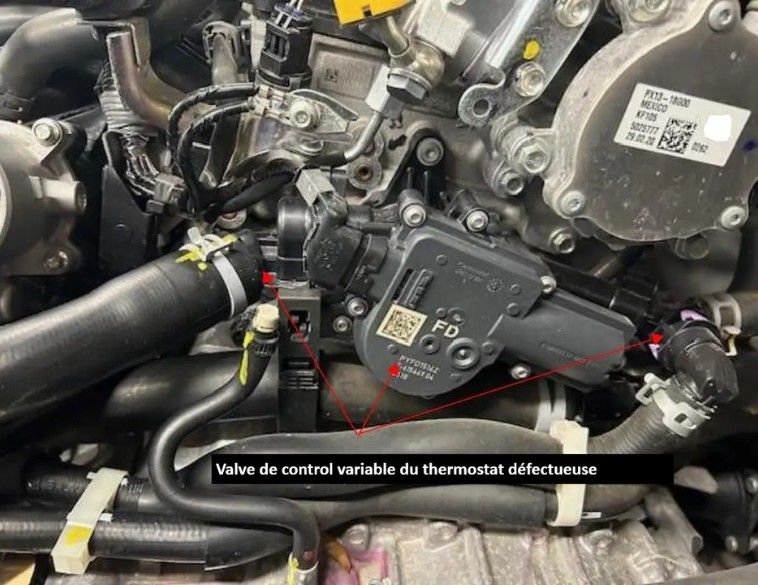
The variable thermostat is a source of problems in our industry. Source: Mark Potvin
The technology found in today’s vehicles has come a long way from what was used in the past, particularly when it comes to fuel consumption performance.
Over the past 10 years or so, automakers have introduced new technologies aimed at improving efficiency and fuel economy in certain vehicles. Unfortunately, these advancements sometimes fail to deliver the expected results and end up being replaced by tried-and-true methods of the past.
I recently witnessed one such attempt at technological improvement that caused nothing but headaches for the owners of these vehicles. I won’t name the two manufacturers that use it, but for those who have seen this component firsthand, it will come as no surprise that the variable thermostat, in my opinion, never should have existed and has proven to be a failure in our industry.
Temperature management
Thermostat issues (or coolant control valve — CCV) are a common complaint on certain 2018–2025 models. The valve often gets stuck in the open position, resulting in poor heat output and slow warm-up, and triggers error codes such as P0126 (temperature too low), P0128 (temperature takes too long to reach operating level) or P0125 (insufficient coolant temperature for fuel closed-loop). Left unaddressed, these issues lead to poor fuel management, excessive fuel consumption and rough idling.
The main manufacturer involved is offering a warranty extension (SSPD8) covering this defect for up to 15 years or 240,000 km. Imagine being in -25°C weather with no heat even after several hours of driving. I wouldn’t want to be caught in that situation given our winter climate.
In summer as well, the engine must reach the proper operating temperature to run cleanly and perform at its best. The core difference between the two thermostats is mechanical versus electronic. The good old mechanical thermostat has proven its reliability for over a hundred years, having first been installed in vehicles in the 1920s.
As for the electronic thermostat, it has since been removed from newer models by these manufacturers, as it was causing too many problems.
Sometimes it is necessary to take the vehicle for a road test, since the problem may not appear with the engine idling in park. While driving, the airflow reaching the radiator through an open thermostat is automatically cooled, meaning no heat is produced.
Take the time to carry out your checks thoroughly with the appropriate equipment. Happy diagnosing, everyone!



JOBS
 |  DORVAL DORVAL Full time Full time |
| ST-HUBERT Full time |
 | MONTRÉAL Permanent |
 | SASKATOON Full time |
| MONTRÉAL-NORD Permanent |