
Navigating Artificial Intelligence
Autosphere » Mechanical »
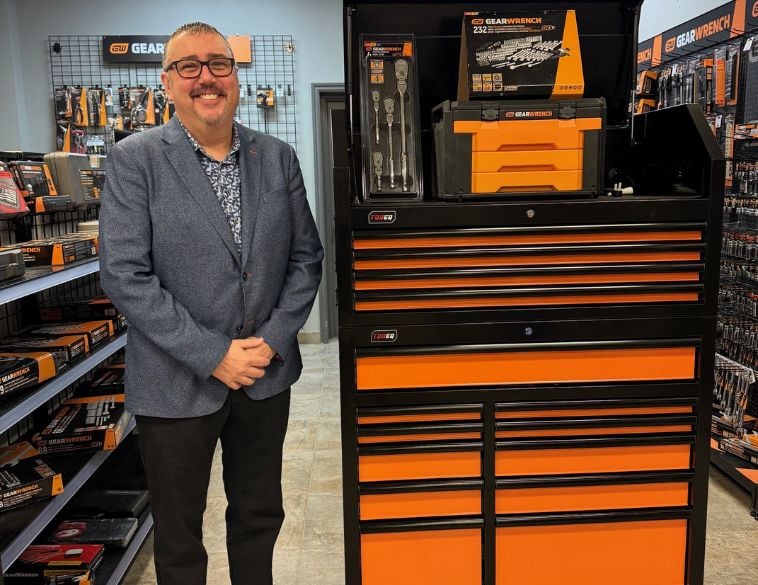
Kenton Switzer, President of Pat’s Auto Supply, says he does see the benefits of leveraging AI in his business. Credit: Pat’s Auto Supply
For the aftermarket, AI seems to promise faster, more efficient processes, but there are still caveats
There’s plenty of excitement about the possibilities of AI in the automotive parts and repair sectors. But uncertainty is also weighing on the industry. These divergent responses are perhaps a reflection of the bipolar gyrations ranging from over-the-top optimism to severe pessimism that this new computing technology has been engendering in the wider worlds of business, trade, healthcare, government, energy, and the technology sector.
Many industries within AI are expected to see compound annual growth rates (CAGR) from around 12-30% over the next seven to 10 years. There is anxiety amid the projected growth bonanzas, however. The current surging demand for data centres across the continent to help power and support AI growth is not only causing concerns among environmentalists but has already been worrying some consumer groups in the U.S., wary of a looming possible conjunction of new data centres’ enormous energy requirements and surging power bills in the context of finite electricity grids.
Resource intensive
Canada isn’t immune. According to current tabulations, Alberta recently had a line-up of applicants for enough data centres to require about 20 Gigawatts of electrical power, dwarfing the provincial power system’s load capacity of about 12 Gigawatts. The Alberta Electrical System Operator (AESO) is said to expect short-term higher electricity prices before new data centres have gas-turbine-sourced generation up and running. (The bring-your-own-generation idea aligns with the province’s aim of doubling production of oil and gas in the near future.) Another worry is mass lay-offs. An April 2026 article in Fortune magazine cites a report from investment bank Goldman Sachs saying that 16,000 U.S. jobs a month are being lost to AI, with Gen Z bearing the brunt. The forecasts of doom don’t stop there, with projections of possible job losses in the millions. On the other hand, a Stanford University-based institute forecasts only a modest AI impact on employment.
When it comes to AI, uncertainty, it would seem, reigns just about everywhere. Some definite patches of blue, however, have emerged, recently. A case in point is a software called the Gold Standard Program, unveiled in May this year by Tromml, an AI and sales intelligence company. This occurred a few days before the Automotive Parts Services Group’s (APSG) national conference in Orlando, Florida, where Tromml made a presentation on AI adoption for the aftermarket.
Tromml’s Gold Standard Program was created for independent aftermarket firms that compete on speed, relationships, and customer knowledge, but often lack the technology infrastructure of larger competitors. “It’s a 12-month program designed to help independent jobbers and distributors capture what their sales teams already know, and turn it into a lasting competitive advantage,” says Lauren McCullough, CEO and founder of Tromml.
Capturing the intelligence
“The companies spending the most on AI are trying to learn what great reps already know. They have the budgets. Independents have the intelligence. It is sitting in their reps’ heads, in hand-written notes and in customer conversations that disappear by Friday. The Gold Standard Program is built to capture that intelligence and turn it into action,” McCullough says.
With a five-year background in automotive e-commerce, Tromml is set to continue its commitment to the independent aftermarket, McCullough, a recent Auto Care Under 40 Impact Award recipient, says. In 2025, Tromml’s activity intelligence software, Minecart, won the MEMA innovation award.
To help existing and prospective clients get maximum value from its products, Tromml is launching an AI boot camp for individuals and smaller teams that want to begin building AI confidence before adopting the full Gold Standard Program. It gives participants practical training on how to use AI tools effectively in after-market workflows – with a focus on real-use cases, not generic AI theory.
“Our software and AI tools can help reduce the administrative burden and allow reps to spend more time with their customers. The AI component can advise a rep on setting priorities regarding customers and which one to call next,” McCullough says.
The Tromml offer is designed to provide the seamless experience of a platform. After a meeting with a client, a rep can begin the process of flipping roadblocks into opportunities by reporting into a cell phone, the meeting’s key takeaways. “We build our software to be simple enough for busy aftermarket teams to use in the real world. But lasting AI adoption takes more than access to the right tools. Teams need to understand where AI fits, how to use it effectively, and how to build it into the way they already work. We want to give independent jobbers and distributors a partner that can help with AI,” McCullough says.
Fear of the unknown
It seems, though, we’re still in the early days in the roll-out of programs and platforms like those from Tromml, so the hesitation out there is understandable. “There doesn’t seem to be any one specific concern, mostly just a big fear of the unknown,” says Kenton Switzer, President of Pat’s Auto Supply, based in Grande Prairie, with outlets in northeast B.C. and northwest Alberta.
“For the most part, so far, AI has been helping with diagnosis,” explains Switzer. One particularly tough diagnostic nut to crack, he says, turned up recently when a gas-fired furnace intermittently ceased heating the house on cold northern Alberta nights in the middle of winter. The furnace technician was stumped. Data and photos were fed to an AI tool, which came back with a diagnosis: loose wire. This, along with other components, presumably shrank when the temperature dropped at night, thus depriving the furnace with proper grounding, shutting down the system.
On the jobber front, Switzer sees AI as a potential boon to the sector. “With about 500,000 parts in stock, we do a good job already. But with the help of AI, this could free up some inventory team time for work on other tasks,” he says.
On another front, AI has already made a difference. It dramatically cut the time needed for an analysis of what factors and attributes went into making the best outside sales team, a critical source of company income. “AI helped me sort out the optimum (attributes of the sales team). It gave me a summary and a list of all the desirable attributes in 45 seconds instead of two days,” Switzer says.
Legal documents are another area where AI is helping at Pat’s Auto, simply by providing decent summaries for management, significantly cutting the reading time required.
Brennan Plante, a partner at Vernon BC-based Gilbert Parts Depot, also expects benefits to the parts sector will accrue as AI advances. “We’re dabbling in it, but we’re finding it’s not quite ready for our business. The data scale is too large in our business. But at some point in the future, I think there will be a way to manage inventory with AI.”
Recent advances
He believes that some of this could change within a year or two and points to recent advances in chat bots for ordering parts. Around 2018, basic decision-tree web widgets showed up to handle mostly simple re-orders and tracking; then, in the last year, dealerships and parts networks introduced advanced digital assistants that factor in a host of bits of information around a user request, including past conversations and background data. Called context-aware AI helpers, they function more like a smart teammate than a robot reacting to an isolated prompt.
For service technicians like Rod Bettcher, owner of Double J Automotives Ltd., a Calgary auto repair shop, software programs like Identifix helpfully relate the issue of a repair job to the experience of other shops. “It looks for a trouble code and it shows what others have done and indicates a path of repair,” Bettcher says.
While Identifix relies on a massive proprietary database and shows exact metrics like “confirmed fixes count” for specific trouble codes, a lower-cost alternative like an AI app tends to rank probabilities and generate conversational troubleshooting paths, which can sometimes misinterpret complex mechanical edge-cases. Bettcher says that AI can work—“If you ask a very specific question.” Otherwise, he suggests, a DIYer can be led seriously astray using an AI tool.
The most effective strategy then for service centres [at least for now] seems to be staying with the database system you have learned to use and trust; as well as updating it with information and clarifications. Doing so should lead to the right repair path—and the parts needed for it, all the while maintaining strong relationships with jobbers and parts suppliers.
Tags : Gilbert Parts Depot


JOBS
 |  DORVAL DORVAL Full time Full time |
| ST-HUBERT Full time |
 | MONTRÉAL Permanent |
 | SASKATOON Full time |
| MONTRÉAL-NORD Permanent |