
Best of Both Worlds?
Autosphere » Mechanical »
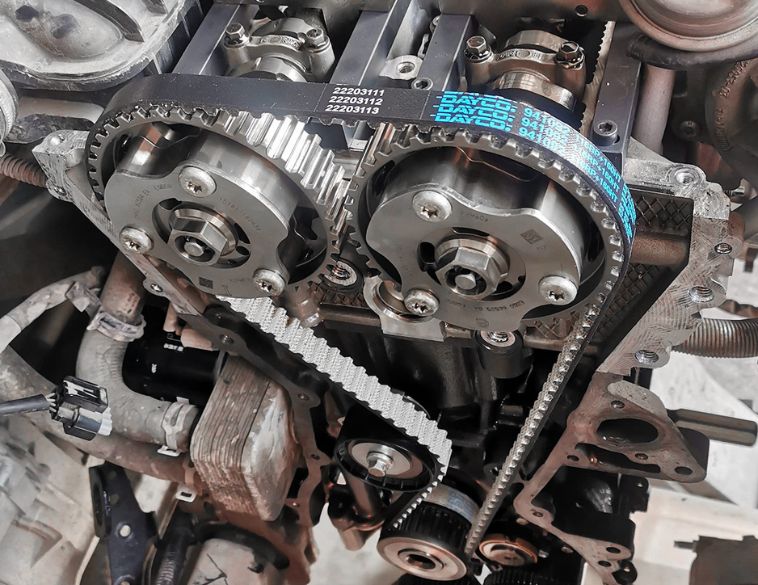
Dayco’s patented Belt in Oil technology is a game changer for the industry. (Credit : Dayco)
New service opportunities are emerging via advancing timing belt and engine technology.
In Canada and the U.S., the average age of vehicles on the road continues to increase. According to data from S&P Global, in Canada it is up to 10.5 years, in the U.S., vehicles in use are on average, even older, at 12.6 years.
This aging vehicle parc, combined with the fact that more consumers are choosing to hold onto their existing vehicles for longer, means more opportunities for the aftermarket auto care sector.
Smoother and quieter
And for many late-model vehicles, this will include servicing parts such as the engine timing belt system. Timing belts originally gained popularity during the 1960s and 1970s with the introduction of smaller displacement, overhead cam engines. By using a belt instead of a chain, OEMs could offer a smoother, quieter valvetrain that was also more cost-effective to produce.
Yet while they are noted for their smoothness and efficiency, timing belts need to be regularly inspected, since these belts tend to degrade over time and will eventually need replacing. OEM vehicle manufacturers recommend a specific interval for inspecting and replacing the belt, usually between 5-7 years and at 96,000 km (60,000 miles) to 160,000 km (100,000 miles), whichever comes first.
Major issues
Without performing regular inspections, timing belt failure can result, causing catastrophic issues including damaged pistons and bent valves. Yet, with many consumers today being highly conscious regarding household budgets, and a timing belt replacement being a labour-intensive repair, service centres need to be careful in how they approach this type of work.
“It really starts with education,” explains Jerry Reeves, Head of Product Development for Dayco in North America. He notes that it’s important for service centres to ensure their customers understand the value and importance of preventative maintenance when it comes to timing belt and chain systems. “Trying to save a few dollars today by skipping a service today and cost significantly more in the long run.”


While we have seen a resurgence in timing chain systems since the 1990s and generally, steel timing chains tend to last longer than rubber timing belts, they will eventually need maintenance. Furthermore, while the timing chain itself is often durable, the chain guides or tensioner can fail, causing damage and stretching. Timing chain wear tends to manifest itself in rougher running, poor throttle response and excessive noise. Also, as Reeves, notes most OEMs did not design timing chain systems for regular service, so replacing them can take “dozens of hours,” proving not only labour intensive, but costly for consumers.
With belts failure can occur suddenly and unexpectedly, which is why regular inspection is crucial, especially as the vehicle ages and mileage accrues.
Proper information
As Tom Lee, Marketing Manager for Automotive Aftermarket Products at Continental notes, while quality and durability improvements have seen replacement rates for timing belts decline overall, significant issues can still result when lack of proper information and education leads to delayed maintenance. This is why service centres need to proactively work with their customers and develop preventative maintenance plans.
This includes understanding why components need to replace and when and how performing the work now will save the customer in the long run, improving not only the overall value proposition but also increasing transparency and trust between the client and the automotive service centre.
Lee also notes that when a vehicle is in for a timing belt inspection and service, having other wear items inspected and replaced at the same interval, including the gears, water pump, gasket, pulleys, bearings, bolts, screws and fasteners, will go a long way to optimizing reliability since any engine or vehicle system is only as strong as its weakest link.
Today, most manufacturers of timing belts and related accessories provide complete kits, ensuring all components can be replaced simultaneously adding peace of mind for the technician, the shop and the customer, as well as saving time and reducing labour costs.
Belt in Oil technology
Dayco, which has long been an advocate of complete system replacement as well as an OEM supplier, has also brought new products to market, including specific Belt in Oil technology as original OEM and aftermarket replacement timing belt kits.
Belt in Oil technology has becoming increasingly common being employed on engines used in vehicles manufactured by the likes of Stellantis, Ford and General Motors. Unlike traditional “dry” timing belts, this technology features a belt that’s bathed in oil on the “wet” side of the engine. The aim was to combine the best attributes of both timing belt and chain technology, with the end goals being reduced friction for better fuel economy, less vibration and quieter operation, plus better durability and heat resistance compared with dry belt systems.
Popular applications
At AAPEX 2025 in Las Vegas, Dayco showcased its new proprietary Timing Belt in Oil technology (TBIO) for the North American market. The initial product launch comprised over 2 million Ford and Lincoln vehicles, including kits for popular engines such as the 2.7-litre and 3.0-litre EcoBoost V6 units.
Jerry Reeves notes that Dayco’s Timing Belt in Oil technology, utilizes belts that are precision engineered for superior strength and wear resistance, in order to optimize performance, reduce noise and ensure highly accurate valvetrain timing.
Reeves notes that the growing number of engines utilizing Belt in Oil Technology “will ultimately impact how vehicles are serviced, providing distributors, jobbers and shops with a new revenue and education opportunity as these belts do have specific service intervals.” He does note however that, for the aftermarket and service providers to really capitalize on these service opportunities, proper education among customers will be critical. “Consumers may not even be aware that their vehicle has this type of timing belt technology,” he says, “so the education piece is essential.”


JOBS
 |  LASALLE LASALLE Full time Full time |
 | STE-AGATHE-DES-MONTS Full time |
 | SAINT-LÉONARD Full time |
 | MONTRÉAL Permanent |
 | JOLIETTE Full time |