
Where Do End-of-Life EV Batteries Go?
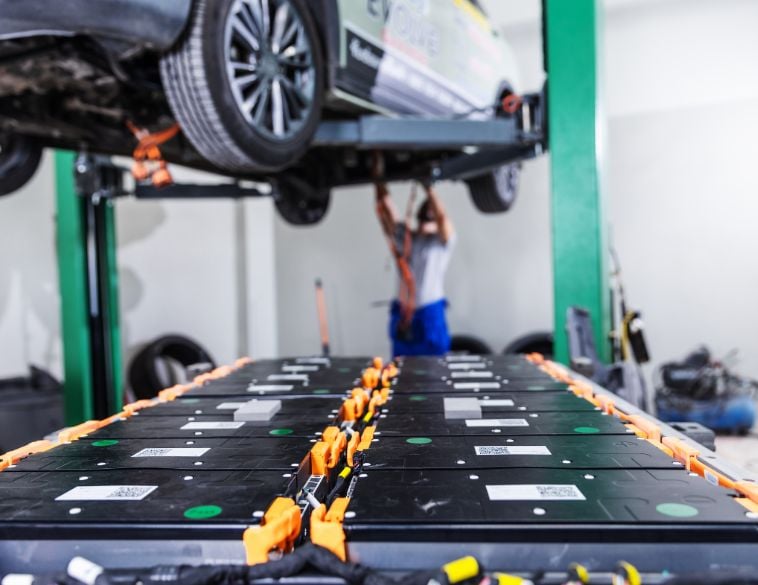
Even when unusable, a high-voltage battery is far too valuable to be discarded without processing. Credit: Envato
Rest assured, high-voltage electric vehicle batteries do not end up in landfills. The metals they contain are far too valuable.
Motorists considering switching to electric vehicles need not worry: their choice will not contribute to piling hazardous materials into our landfills. However, they might be disappointed to learn that these high-voltage batteries are sent to American recyclers at the end of their useful lives. U.S. processors are only too pleased to acquire such a treasure trove of critical minerals—nickel, cobalt, and lithium—which they can process and feed back into strategically critical American manufacturing supply chains. Returning this sensitive raw material to Canada is completely off the table; the U.S. understands its importance all too well.
“What is most frustrating right now is that the subsidies encouraging consumers to buy an electric vehicle essentially pay for the high-voltage battery—the very component that drives up the cost of an EV compared to its gas counterpart,” laments Daniel Breton, President and CEO of Electric Mobility Canada. “And these batteries, funded by our taxpayers and governments, are heading south of the border where those critical minerals are put back on the market.” Mr. Breton estimates the annual value of these strategic resources shipped to the United States in the form of end-of-life high-voltage batteries at more than $1 billion.

Why Not Here?
The CEO of Electric Mobility Canada believes Quebec possesses the expertise needed to recover and process EV batteries locally when they can no longer be used for other purposes. “We are working hard to make our elected officials understand how strategically vital it is for our economy to recycle and refine this resource at home.” He welcomed the election pledge by the Parti Québécois, recently elected to govern Quebec, to “fully integrate battery recycling into Quebec’s critical minerals strategy.”
The environmental organization Équiterre, which champions public transit for sustainable mobility, nonetheless views the personal vehicle as a necessary evil, particularly outside major urban centers.
Équiterre oversees the Running on Electric (Roulons électrique) campaign, aimed at accelerating full EV adoption to curb the environmental footprint of road transport. “We have to be realistic—we aren’t going to pull Quebec out of car culture overnight,” says Daniel Rochefort, sustainable mobility advisor at Équiterre, while noting his organization’s goal of cutting the number of personal vehicles on Quebec roads by half.
Well-versed in the ins and outs of electrification, Mr. Rochefort makes several observations. “We would prefer a fiscal balance—a feebate approach—rather than straight purchase subsidies for EVs. For example, revenue generated from fees on gas-powered vehicles could be redistributed to drivers making the transition to electric. In my view, public funds should primarily serve to finance public transit.”
Urban Mines
That said, echoing Mr. Breton, he is convinced that no battery will ever end up in a landfill. “We know that these urban mines are currently being tapped by the Americans because of a lack of processing volume here. It is obvious that we need to secure this resource and even support domestic mining projects, carried out under strict environmental standards, to extract these critical metals right here.”
Another observation from the Équiterre specialist is that high-voltage batteries last far longer than originally expected, often outlasting the vehicles they power. This partly explains the lack of battery feedstock volume required to sustain a viable, domestic recycling loop in Quebec today.
Expanding on the topic, Daniel Rochefort looks favourably upon the arrival of Chinese electric vehicles on our market. “Their pricing is lower because they use LFP (lithium iron phosphate) battery chemistry, which is cheaper to manufacture. That will force the hand of other automakers in our market. On the other hand, the serviceability and repairability of these vehicles coming from China must be clearly defined.” Crucially, he points out that these newer battery chemistries will be just as recyclable as lithium, cobalt, and nickel packs.
A Dedicated Recovery Network
Canada does have an established network dedicated to retrieving damaged, defective, or end-of-life batteries. Call2Recycle Canada maintains agreements with automakers operating across Canada to handle end-of-life batteries.
Joseph Chung, Vice-President of Account Management at Call2Recycle Canada, which administers the program, explains that participating automotive OEMs fund the collection and recycling of eligible, unmodified, out-of-warranty end-of-life batteries.
“The automaker-led EV battery recovery program will support the collection, transport, and recycling of all eligible out-of-warranty, end-of-life batteries.” Full details are available online here. Automakers continue to manage recalled or defective units directly through their established dealer networks.
In reality, very few batteries have reached the end-of-life recycling stage in Canada so far. Their lifespan is remarkable, easily hitting 15 to 20 years, even when factoring in an expected, relatively minor loss of capacity. Consequently, the vast majority of current processing volume comes from units damaged in collisions.
Mr. Chung is well aware of shops giving EV batteries a second lease on life. “We advise against anyone trying to improvise as a high-voltage battery technician,” he adds. “Any business that has an end-of-life battery can go online to confirm eligibility and request a pickup through the program.”
In short, if the battery remains untouched, the automaker absorbs the cost. If a business has dismantled it for parts or reconditioned it for sale, that business covers the fees for collection and processing.
Marc-André Fugère of Véhicules électriques Simon André in Trois-Rivières confirms this workflow: “We simply fill out the online form and they invoice us for pickup.” It was a brief conversation, as this pioneering independent facility has no shortage of work.
Industry experts consulted for this report note that the current low volume of retired batteries needed to sustain full industrial processing capacity explains why building out domestic processing infrastructure remains difficult. The recent collapse of Lithion Technologies in Quebec serves as a stark reminder of that challenge.
Still, calls to revive a dedicated battery recycling pipeline in Quebec, and across Canada, are not going away anytime soon. It remains to be seen whether political resolve and critical mineral strategies can bridge the gap created by the low volumes currently available for processing.
The Electron Wizards
When a high-voltage battery pack is damaged in a collision, the replacement cost is often so exorbitant that the vehicle is declared a total loss. It is a costly, counterproductive outcome for a vehicle intended to be environmentally friendly. Fortunately, specialized repair facilities are stepping up with a viable alternative: replacing the damaged unit with a reconditioned, fully tested battery pack.
Tags : Electric Vehicle Batteries


JOBS
 |  LAVAL  Permanent |
 | VAL-DAVID Full time |
 | BLAINVILLE Full time |
 | LAVAL Full time |
 | BROSSARD Full time |