
AI, Humans, and HR: Towards a Hybrid Interaction Model
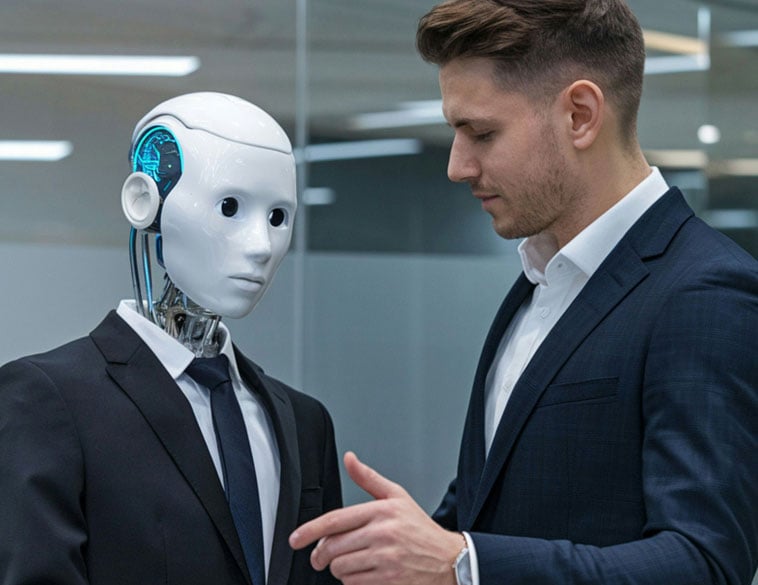
Customer service can be automated, but only to a certain point. Credit: Unsplash
With the rapid evolution of skills, technology, and artificial intelligence, continuous staff training is essential to remaining competitive. In Quebec and elsewhere, many organizations are facing a shortage of qualified employees, and we know it is more cost-effective to train existing staff than to hire new ones.
Employees want to grow, and investing in their development is key to increasing motivation and reducing turnover. A skilled workforce remains a competitive advantage, leading to better performance and productivity.
The primary mandate of the Human Resources department is to support existing staff and provide ongoing guidance. Training is and will always be a strategic investment, while HR acts as a driver for growth. As we know, customers are very well-informed before arriving at the dealership and expect fast service and, above all, a high degree of personalization.
Adapting to New Realities
High customer expectations, the digitalization of processes, personalization, CRM tools… The HR department is vital for managing change and supporting staff. HR’s mandate is to oversee personnel, invest in employees, structure training needs, and orchestrate targeted strategies to optimize work teams.
All dealerships must provide professional service with consistency. Let’s talk about consistency in the face of labor shortages. It builds customer trust, protects the company’s reputation, increases sales, and fosters loyalty: offering the same service and quality every time a customer visits the dealership. Is it possible?
Basic and repetitive tasks are expected to be automated by 2030. However, complex or emotional issues will be difficult to automate because a robot can never show empathy. According to experts and current trends, a large portion of customer support tasks will be automated by the end of the decade. AI will work and collaborate alongside humans. For complex and transactional cases, the human element will always be present. Here is a brief report from Gartner, a leading authority in IT, on the impact of AI on customer service:
- 91% of customer support managers report internal pressure to implement AI by 2026;
- 42% of organizations are recruiting for AI-specialized roles;
- 80% of organizations plan to redefine human agent roles to focus on complex issues;
- 50% of companies that reduced staff due to AI could rehire by 2027, as robotization fails to maintain service quality;
- AI could handle up to 80% of simple requests by 2029 without human intervention.
In short, AI will automate certain simple and repetitive customer support tasks, but humans will remain indispensable for cases requiring empathy. Customer service is moving toward a hybrid model of AI and humans. As seen in the chart, we are referring here to customer support rather than the customer experience. “The projections are a bit daunting, but it is clear that by 2026, we are already chatting with AI. However, when it comes to the customer experience, we will continue to talk to humans.”



JOBS
 |  DORVAL DORVAL Full time Full time |
| ST-HUBERT Full time |
 | MONTRÉAL Permanent |
 | SASKATOON Full time |
| MONTRÉAL-NORD Permanent |