
The Path Forward
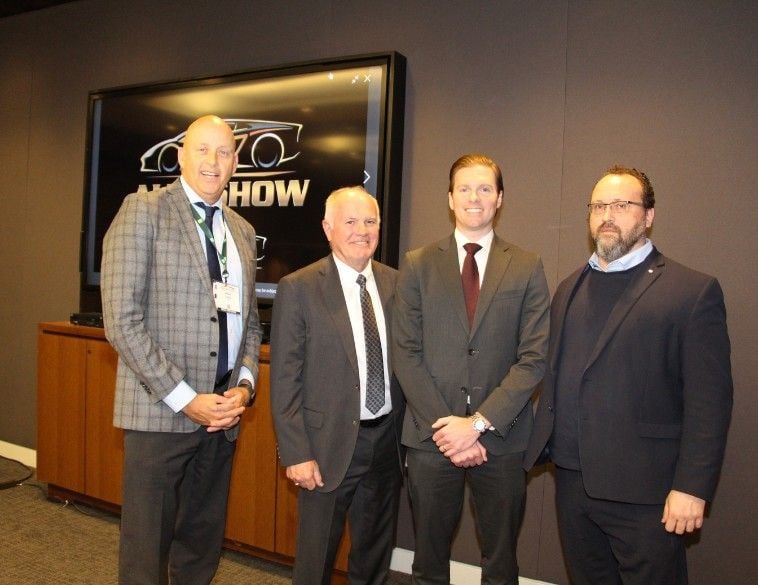
(L-R) Huw Williams, David Adams, Brian Kingston and Flavio Volpe, during a press conference at the Canadian International AutoShow in 2026. Credit: Huw Evans
A significant range of challenges are currently facing Canada’s automotive industry
There have been lots of questions around the future of Canada’s auto sector, particularly given the shift in policy south of the border, as well as changes taking place here at home. Trade disputes with United States and tariffs for components and vehicles entering that country have complicated the Canada/U.S. relationship for many industries, including automotive manufacturing. During a press conference at the Canadian International AutoShow in February, Brian Kingston, President of the Canadian Vehicle Manufacturers Association (CVMA), said that with the current Canada-U.S.-Mexico (CUSMA) free trade agreement up for renewal this July, noted that it is imperative that if the auto manufacturing sector is going to survive long term in Canada, having unrestricted access to the U.S. market is essential.
Beneficial arrangement
He notes that currently, 90% of all vehicles manufactured in Canada are shipped to the U.S. and, “if we are going to continue having a thriving industry here, it will be because we get a free trade agreement with the Americans and eliminate the Section 232 tariffs.” Furthermore, with U.S. built vehicles constituting around 40% of the Canadian new vehicle market, the current arrangement significantly benefits the United States.
Flavio Volpe, President of the Automotive Parts Manufacturers Association (AMPA) noted that given the auto sector is multi-faceted, requiring raw materials, tooling and dies to make parts and vehicles, plus the manufacturing of those parts and vehicles, along with the sales, marketing, service, repairs and recycling, there is a strong case for a continued, integrated North American supply chain. Volpe noted that if tariffs had been applied here, the industry would have shut down almost immediately, since a daily tariff bill of $75 million would simply make operations unfeasible.
Although exemptions were granted under CUSMA, the fact is that OEMs are still facing billions of dollars in tariff costs, plus with U.S. mid-terms coming this year, and a good number of congressional districts groaning under the weight of these tariffs, there needs to be hard conversations about the rules of origin, especially for those jurisdictions that are heavily reliant on trade with Canada and Mexico.
Adding further complexity to the industry at present, is the divergence in policy between Canada and the U.S. South of the border, the Trump administration has focused on rolling back emissions and fuel economy targets, as well as eliminating EV incentives. The administration also continues to institute a 100% tariff on Chinese vehicle imports to the United States. In Canada, the federal government has taken a different approach and this adds further complications as we edge further toward the Canada-U.S.-Mexico (CUSMA) free trade agreement renewal in July.
While industry in Canada has lauded the federal government’s decision to scrap the controversial EV mandate and instead focus on a market-driven approach for vehicle emissions reduction, including reintroducing incentives for consumers to purchase EVs, the announcement of allowing in 49,000 Chinese electric vehicles annually at a tariff rate of 6.1%, is further complicating matters.
Dealer network essential
Huw Williams, President of Impact Public Affairs, representing the Canadian Automobile Dealers Association (CADA) and member interests in Ottawa, explained that currently, the Government of Canada is an difficult position when it comes to trade, one reason why it is seeking to expand trading partnerships with other countries beyond the U.S. “The Prime Minister and his trade officials have been forthcoming on that,” said Williams who noted that regarding the decision to bring in those 49,000 Chinese EVs annually—this should only happen if the vehicles are sold through an established dealer network and are supported by local investment. “Our discussions with the government have been very clear on that,” said Williams.
In Vancouver, in April, the CADA, CVMA and the Global Automakers of Canada, had another opportunity to discuss the latest developments around the auto sector, including British Columbia’s approach to vehicle electrification. B.C.’s provincial EV mandate has and continues to be seen as a major obstacle in efforts to improve the competitiveness of the automotive industry in this country.
“Canada is navigating a trade rupture, with consumers facing uncertainty and growing affordability pressures,” stated Tim Reuss, President & CEO of CADA. “Ending province-specific EV mandates in favour of one national approach to greenhouse gases is the right path forward.” Reuss noted that by keeping the mandate in force, B.C. Premier David Eby is “creating an interprovincial trade barrier and an affordability cliff for consumers by clinging to this outdated policy.”
Brian Kingston added: “The provincial economy is stuck in low gear, with worsening affordability challenges facing British Columbians.” He noted that “punitive regulations like the ZEV mandate limit consumer choice, drive up prices, reduce investment and job creation, and deliver limited environmental benefits.”
David Adams, President of the Global Automakers of Canada (GAC), stated that “not that long ago the Prime Minister and all Canadian Premiers gathered in the face of an ongoing and serious economic threat from the United States and agreed that they should be doing anything and everything possible to eliminate redundant and duplicative regulations across provincial borders that only increase cost and complexity for Canadian businesses – large and small.” To date, that has not been the case.
While the government of British Columbia recently agreed to cut down its EV mandate target from 100% down to 75%, it still represents a significant barrier to competitiveness in Canada’s automotive sector, while unnecessarily adding costs, complexity and bureaucracy. All this comes at a time when economic and policy unity across the country is critical and market-driven policies are essential to ensure the long-term viability of the automotive industry in Canada. Government mandates, on the other hand, are simply divisive policies that promote inefficiency, increase costs and represent a major barrier standing in the way of progress.
Tags : AMPA, Automotive Parts Manufacturers Association, Canadian International AutoShow, Canadian Vehicle Manufacturers Association, CUSMA, CVMA, EV mandate, federal government, GAC, Global Automakers of Canada, Government of Canada, Impact Public Affairs, Policy, Supply Chain, tariff, trade, U.S. market, ZEV mandate



JOBS
 |  DORVAL DORVAL Full time Full time |
| ST-HUBERT Full time |
 | MONTRÉAL Permanent |
 | SASKATOON Full time |
| MONTRÉAL-NORD Permanent |