
EVs, Spin Doctors and The Numbers Game
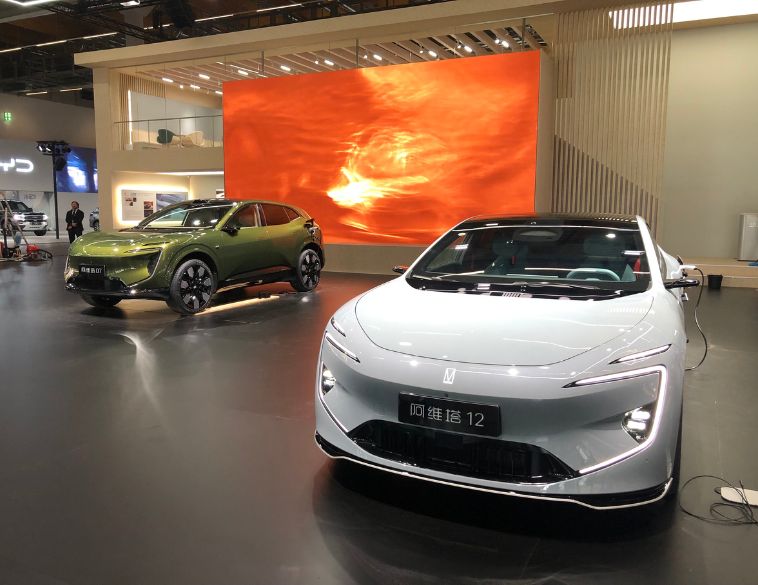
China’s EV market is very different to other countries. (Credit : Huw Evans)
A closer analysis at EV sales reveals that all is not as it seems.
The IEA (International Energy Agency) continues to paint a picture of hope for EV domination. An online article, dated May 2025, shouts “More than 1 in 4 cars sold worldwide this year is set to be electric as EV sales continue to grow.” It supports this by stating “Sales exceeded 17 million globally in 2024, putting EVs’ share of the global car market above 20% for the first time.”
Early buying
In addition, it says “in the first three months of 2025, electric car sales were up 35% year-on-year.” It does not say how much of that growth was generated by China, or how much was future sales brought forward by early buying, to get ahead of the cancellation of Government rebates, in some markets.
While the basic statement about 2024 EV sales and market share is true, a close analysis of the data shows a wider truth that does not paint such a rosy picture for EVs. 2024 global car sales totalled 74.6 million units as per the European Automobile Manufacturers’ Association (ACEA). 17 million, 23%, were EVs. However, 11 million, or 65% of the 17 million EVs were sold in China. China is the world’s largest market for EVs, but China is radically different from the rest of the world.
Low-cost
In China, EVs are cheaper to buy than ICE vehicles. The average EV is priced 3% below the average ICE vehicle. This is driven by heated competition to make low-cost EVs, with the heads of different provinces, and the factories in their jurisdictions, vying for sales leadership. Labour and battery costs are lower in China, thanks to its domestic supply chains. Factory operating costs are lower with cheap power from coal fired power plants that China continues to build at a rapid pace. Many cheap Chinese EVs cannot meet strict standards for the North American and European markets. Also, many of China’s numerous EV makers are not profitable, and are supported by state funds. They are losing money fighting for market share with low prices. Intense competition has made China a market with few winners.
In 2024, China’s overall new car sales totalled 23 million units, 31% of global car sales, with EVs being 48% of the market, or 11 million units.
Removing China and its unique market from the equation, global car sales, excluding China, were 51.6 million units. Of this, 6 million were EVs. Thus, EVs were only 12% of the market, outside of China.
Flat demand
The ACEA states the global car market grew by 2.5% in 2024 over 2023. Let’s say this modest growth repeats in 2025 and the EV share remains the same. Global sales will grow from 74.6 million units to 76.5 million units and if EVs remain at 23% they will grow from 17 million to 17.6 million units. However, the EV spin doctors will shout “EV sales grew by 3.5%, some 40% higher than overall market growth”, when, in fact, the EV market share remained flat.
The EV spin doctors play a numbers game. As the 100% EV fantasy cracks and crumbles, the EV spin doctors will ramp up the numbers game. Unfortunately, this EV fantasy and the numbers game have cost the public purse (the taxpayers’ pocket) billions of dollars. It is time to focus on reality, before more billions go down the drain.
One important number published by the IAE is the global EV fleet (global EV car park) is 4% of the overall global car fleet (global car park). Only 4% of the cars in operation globally today are EVs. You can’t spin that number to show a huge win.



JOBS
 |  DORVAL DORVAL Full time Full time |
| ST-HUBERT Full time |
 | MONTRÉAL Permanent |
 | SASKATOON Full time |
| MONTRÉAL-NORD Permanent |