
Beating the Bottlenecks
Autosphere » Collision »
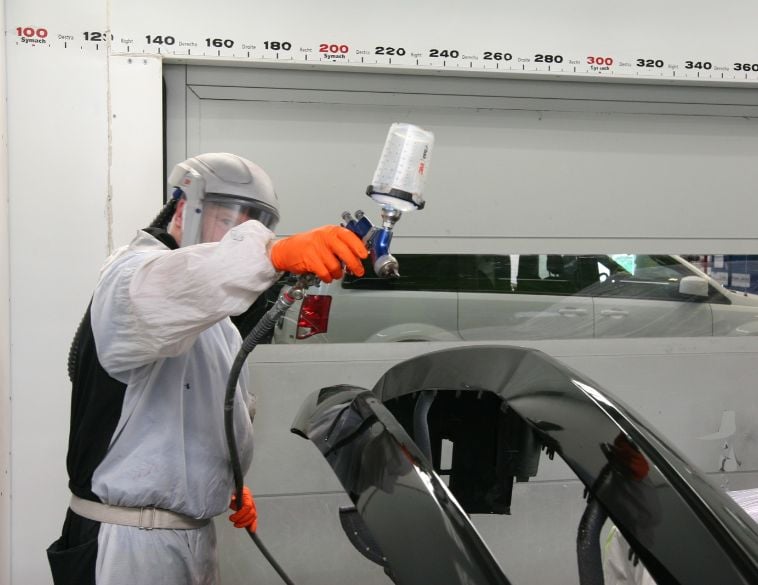
Training and support are key in maximizing efficiency when it comes to refinishing. Credit: Huw Evans
Tips to enhance refinishing practices in the collision centre.
Traditionally, the refinishing process was often one of the biggest bottlenecks during the collision repair process and one where the most reworks and comebacks were generated. Whether it was the time required to let paint finishes cure, or inconsistencies with the paint and application, or other factors such as inadequate or incorrect mixing or equipment issues, many shops had to contend with consistent problems in the paint department.
Challenges remain
While things have improved significantly over the last few decades, there are still challenges facing collision centres when it comes to refinishing. One of them concerns colour matching. “It continues to be an issue,” explains Andrew Robinson, Application Engineer for 3M Automotive Aftermarket. While he acknowledges that a painter’s experience and skill often impacts matching consistency and ability, some of the colours that OEMs are using on their vehicles are becoming more challenging for painters and collision shops.
“Finer ground metallics, mica-based pearls, synthetic mica pearls, glass flake, and inference pigments can make colour matching extremely challenging,” he says. That’s why, stresses Robinson, it’s critical to have the exact colour ready well before the vehicle or components enter the spray booth.
Finer ground metallics, mica-based pearls, synthetic mica pearls, glass flake, and inference pigments can make colour matching extremely challenging.
– Andrew Robinson, Application Engineer, 3M Automotive Aftermarket
Delays and repaints
Difficulties in blending can cause delays or require repaints, while problems with the tint can cause issues with the appearance of the blend, face, specification and side tone. Even when it comes to solid colours—particularly pastel shades—it can be difficult to blend properly, causing uneven appearance and a greater likelihood of rework.
In these cases, Robinson says it’s essential for a collision centre to talk with their refinish supplier. “If you are seeing challenges in this area your paint manufacturer can help your painters by walking them through Standard Operating Procedures of the application to help identify where the real issue is.”
At Chavez Auto Group, which operates multiple CARSTAR and Uniglass locations in Southwestern Ontario, Vice President Kenneth Chavez explains that one of the most effective strategies they’ve found in terms of delivering consistent quality and efficiency in refinishing, has been working with paint suppliers and the training programs they offer. “Trainers can come on-site to our locations to instruct, and/or we can send our painters and apprentices to their training facilities,” Chavez explains. He notes that annual refresher courses are also a big part in maintaining efficiency when it comes to refinishing.
Methodic planning
At 3M, Andrew Robinson says that one of the most effective ways of avoiding bottlenecks in the refinishing department comes down to methodically planning your days in advance and loading the booth properly. “Painters should meet with the production manager first thing in the morning to plan the day or meet in the evening to plan the next day,” he explains. Key tips to maximizing efficiency include being able to identify jobs that can be simplified or condensed, saving both time and space in the booth. Furthermore, by removing panels and placing all the parts that require painting on stands, shops can often free up more space in the booth enabling another job to take place, improving efficiency.
Most production managers, general managers, or collision centre owners see the value in doing so even if paying the technician an extra hour is needed and is not on the estimate,” says Robinson.
Communication counts
At Chavez Auto Group, Kenneth Chavez says that ultimately, consistency is key to having a successful refinishing department. “Ensuring we are following standard operating procedures, OEM guidelines, and overall best practices is essential,” states Chavez. “Communication between technicians, estimators, and management staff can help improve processes as well.” Additionally, he explains, shops should always strive toward continuous improvement. “There is never one process set in stone,” says Chavez. Rather, it’s about building upon a solid foundation and always being open to new technology, concepts and ideas— particularly in view of the changes taking place in both vehicle design, engineering and technology, and the processes required to fix them.
Tags : Enterprise Mobility


JOBS
 |  LAVAL  Full time |
 | BROSSARD Full time |
 | SAINT-LÉONARD Full time |
 | DORVAL Permanent |
 | LAVAL Full time |