
Mitigating Against Cost Increases
Autosphere » Collision »
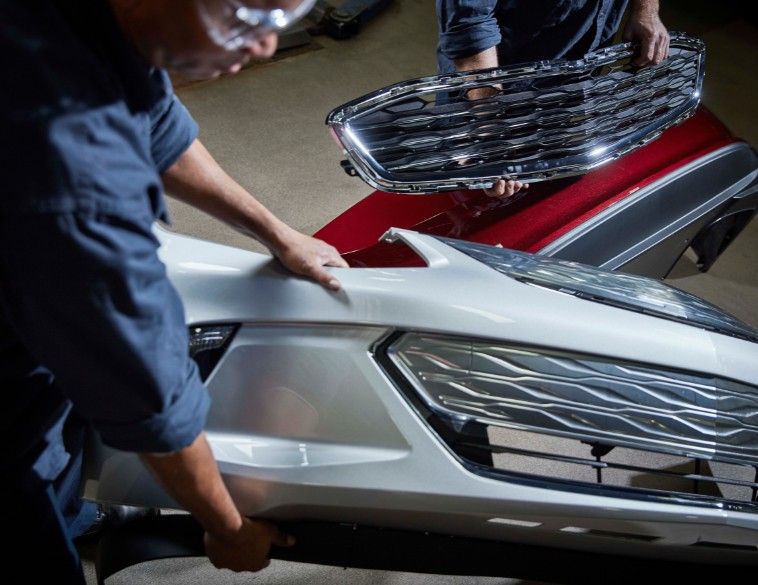
Parts inflation, particularly on items such as bumper covers is a reality in 2026. Credit: General Motors
Supply chain disruptions and parts inflation are key trends impacting the way repairers operate.
When we look at trends currently shaping the collision repair industry, there is a good amount to consider. One is parts inflation. While we touched upon this topic previously (Autosphere Mag, Feb/March 2026) and it’s something that continues to be worth mentioning.
Currently, there isn’t a great deal of evidence to show that parts costs are increasing in any kind of significantly fashion in Canada. That however, is likely to change. In the U.S., inflation has been accelerating since the summer of 2025. You’re seeing that inflation happening across different types of replacement parts. Perhaps the most notable are bumper covers and headlight assemblies.
With shops seeing lower volume, there is real opportunity to increase earnings through repairing parts as opposed to replacing them. – Ryan Mandell
Raw materials
A lot of this is driven by raw materials and for bumper covers and headlights, a good deal of the plastics and polymers used to manufacture them comes from China. This, exposing exposes them to significant tariffs when imported into the U.S. While Canada hasn’t enacted tariffs like the U.S., it is likely that here, we will see parts costs here will increase as manufacturers look to absorb offset these higher manufacturing production and distribution costs, spreading those increases across their entire global product portfolios.
When we look at parts versus complete vehicles, less competition and a more captive audience for parts means there is less incentive to limit price increases in the same way as OEMs would for complete vehicles.
Another trend that’s shaping the way in which collision centres and other key shareholders operate are the rising frequency of total losses. While severity hasn’t been increasing as much recently, as it did during the higher inflationary years of 2022 through 2024, we are seeing total loss frequency at an all-time high. Part of this can be attributed to a reduction in vehicle values, pushing once borderline repairable vehicles into total loss territory. Another trend that illustrates this, are the robust returns that insurers are getting for total loss vehicles at salvage auctions.
This impacts collision repairers, because they aren’t seeing the same number of bigger hits coming into their facilities. Furthermore, these heavy hits, when they do come in, frequently aren’t as profitable as smaller jobs because they are more complex and take longer. Additionally, with insurance deductibles rising in recent years, due to higher insurance premiums, more consumers are choosing not to file claims when it comes to smaller, single single-vehicle collisions. This is significantly impacting overall repair volume for collision centres, requiring them to make changes in the way in which they operate.
Efficiency and accuracy
This means that not only does efficiency of operations need to be factored into the decision decision-making process, but also the accuracy of that decision making. While quality standards must be maintained for every repair, each case needs should be determined as to its cost effectiveness. For example, will it be cost-effective for a price-sensitive consumer that’s paying out of pocket? And/or, what’s required to properly repair that vehicle as opposed to having it written-off?
This is where a repair-first strategy really comes into play. With shops seeing lower volume, there is real opportunity to increase earnings through repairing parts as opposed to replacing them. Margin on labour is significantly higher than margin on parts, and given current economic conditions, including rising replacement parts costs, as well as the conflict in the Middle East [which could, once again, create significant supply chain disruptions as well as add to those costs], there is a real opportunity for the collision repair sector to capitalize on these current market conditions.
While cost increases are inevitable, by carefully scrutinizing how they make decisions, individual collision centres, networks, insurers and other key stakeholders, including insurers—can carefully scrutinize how they make decisions. They can then develop a strategy and mindset that increases profitability and repair efficiency, while at the same time, helping them hedge against rising replacement costs and supply chain disruptions. This will help ensure that only are vehicles are repaired correctly and safely as well as, but those repairs are done efficiently and ultimately, cost-effectively.
Bio: Ryan Mandell is Vice President of Strategy and Market Intelligence at Mitchell International Inc., an Enlyte Company. You can reach him at [email protected]


JOBS
 |  DORVAL DORVAL Full time Full time |
| ST-HUBERT Full time |
 | MONTRÉAL Permanent |
 | SASKATOON Full time |
| MONTRÉAL-NORD Permanent |