
Understanding the Air Requirements of Spray Guns
Autosphere » Collision »
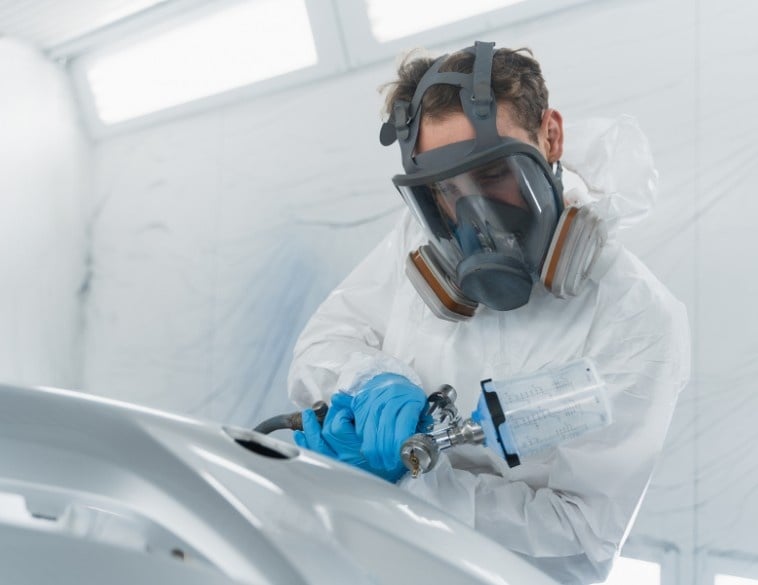
Proper diameter is essential to achieve adequate air pressure and volume for spray guns.
In automotive refinishing, compressed air plays a critical role. However, this aspect is sometimes overlooked. You only need to look at the problems amateur painters share on social media to realize that the use of compressed air is often misunderstood.
Pressure vs. volume
Pressure is measured in PSI (pounds per square inch), while volume is measured in CFM (cubic feet per minute). In Europe, newtons are used to measure pressure and newtons per metre to measure volume.
Pressure represents the force required for a device to perform a task at any given moment. If the manufacturer of a spray gun recommends 29 PSI for optimal performance, that is the pressure needed to properly atomize the product.
Volume represents the constant quantity of air that must reach the spray gun in order to maintain the steady 29 PSI required for the gun to perform as intended.
Say I have a spray gun that requires 15 CFM to operate correctly. If, while I am using it, two other technicians in the finishing department are each using a sander that requires 10 CFM, and two more technicians in the body repair department are using pneumatic grinders that also consume 10 CFM each, I will need a compressor capable of delivering at least 55 CFM to meet the demands of all the tools in use. Ideally, a capacity 30% higher is recommended (70 CFM in this case) to prevent the compressor from running non-stop.
If the compressor cannot deliver sufficient CFM, the pressure will gradually drop during application, causing a visible defect, typically orange peel. There is simply not enough air pressure to properly atomize the material.
The Air Line
The air supply should be distributed through a loop running around the perimeter of the facility. This eliminates the problem created by a dead-end line, where the last technician often ends up with insufficient air if those working upstream are consuming most of the compressor’s output. A loop allows all workstations to be supplied evenly.
The Fittings
The fittings used to connect the spray gun are also critically important.
Far too often, technicians are still using 1/4-inch fittings. The inside diameter of hoses is generally 3/8 of an inch. Using a smaller fitting creates a choking effect and restricts airflow. Even though the pressure gauge at the gun reads 29 PSI, the volume of air is insufficient for proper operation. It is much like trying to drink a liquid through an extremely narrow straw: you can apply the same level of suction, but the amount of liquid that comes through will be far less.
In Conclusion
Do not hesitate to contact a specialist if you suspect you are experiencing compressed air issues!


JOBS
 |  MONTRÉAL MONTRÉAL Permanent Permanent |
 | MONTRÉAL Permanent |
 | MIRABEL Full time |
 | MONTRÉAL Permanent |
 | SAINTE-AGATHE-DES-MONTS Full time |