
Protecting Surfaces From Rust in Collision Repair
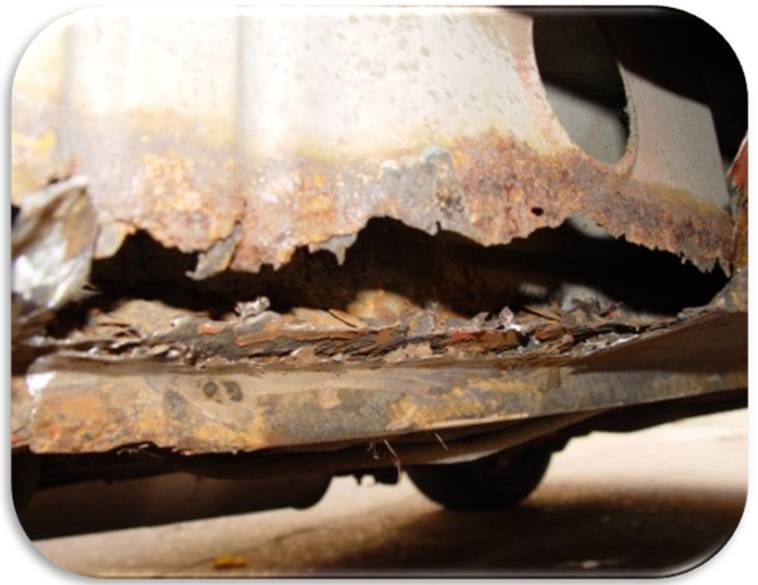
Corrosion aggressively attacks exposed metal surfaces. Credit: Axalta
Modern vehicles in the North American market offer a multitude of refinements and cutting-edge technologies, but one element continues to attack components: corrosion.
What is corrosion?
Corrosion is a natural phenomenon resulting from an electrochemical reaction with metal. Three elements are necessary to cause corrosion: oxygen, water, and a metal, such as iron.
In the body shop, metals must be coated as quickly as possible once exposed, for example after sanding.
There is increasingly more aluminum present in modern vehicles. In this case, corrosion is called oxidation. The electrochemical reaction is identical to that of iron but occurs in the presence of salt, which we have in abundance on our roads in winter. Aluminum seeks to “protect itself” and creates a thin layer of alumina on the surface to stop oxidation. When sanding an aluminum part, the metal becomes shiny silver, but you can observe it “whitening” over time. This is the protective layer forming. Coating adhesion to this film is not very good; that’s why it’s imperative to apply primer to aluminum as quickly as possible after sanding.
How to stop corrosion?
Once the reaction is underway, it’s impossible to stop corrosion. It must be completely removed from affected elements, either by abrasion, sandblasting, or outright parts replacement. According to the Society of Protective Coatings, corrosion treatment costs amount to $276 billion annually worldwide.
Prevention is key. Three things are necessary to prevent corrosion: using high-quality products adapted to needs, having proper training and information such as technical data sheets to use them adequately, and repairing any visible corrosion-related defects as soon as possible, following manufacturer recommendations before the problem expands.
Primers with epoxy resins are generally recommended to offer the best protection against corrosion. Their excellent adhesion helps eliminate the risk of moisture formation between the primer and the metal. Additionally, the pigments used in these primers, such as zinc, offer additional metal protection. There are urethane products (primers or topcoats) on the market that are designated as direct-to-metal, but it must be understood that these products don’t offer the same degree of protection as epoxies. Moreover, the required dry film thickness of the coating must be greater to provide comparable protection. As a comparison, the recommended thickness of an epoxy sealer primer is about 1 mil, while the thickness of a direct-to-metal single-stage urethane topcoat is 4 to 5 mils.
As Neil Young said: “Rust never sleeps.”
Tags : corrosion


JOBS
 |  MASCOUCHE MASCOUCHE Full time Full time |
 | LASALLE Full time |
 | STE-AGATHE-DES-MONTS Full time |
 | SAINT-LÉONARD Full time |
 | MONTRÉAL Permanent |