
Man vs. Machine
Autosphere » Tires »
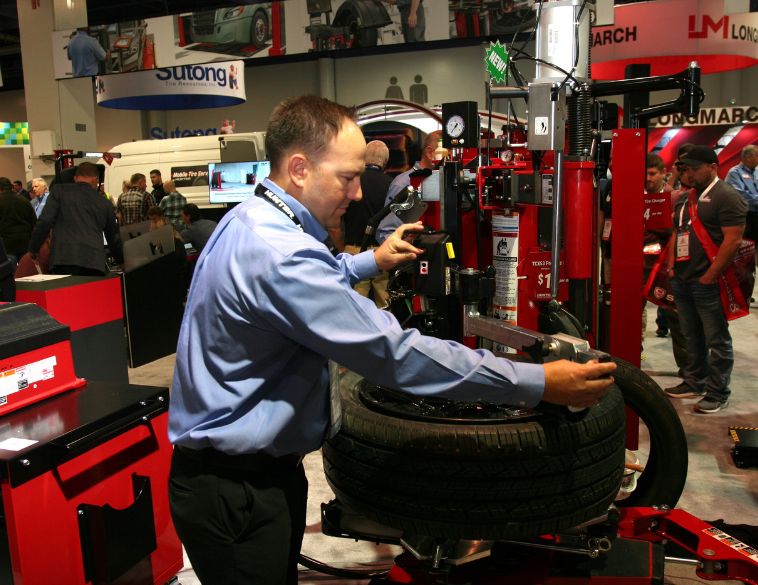
Advanced tire changes combined with skilled technicians offer the best of both worlds. (Credit : Huw Evans)
The key ingredients to boosting efficiencies and maximizing the number of customers your shop will be able to service during this fall/winter changeover season are well-trained technicians and quality equipment. The questions is, which is more important?
In other words, can a really good tire technician work wonders with outdated equipment? And can quality equipment make up for any skills gap if you have an inexperienced technician on your team?
“I’d say you need both,” explains Jim Hudson, Product Manager for Tire Changers at Hunter Engineering Company. “The right equipment naturally allows techs to work faster and easier, so they are not as fatigued at the end of a shift. Taking it a step further, machines that offer autonomous operation, like the Revolution and Road Force balancer, allow technicians to perform multiple tasks simultaneously, maximizing efficiency.”
Ken Borg, General Manager at Oakville Tire & Auto in Oakville, Ontario says that the key to efficiency is excellent staff. “We always lean towards the quality of people, because you can always upgrade equipment, but you can’t upgrade people,” he explains. “So, once you find and hire really good tire guys, you’ll want to hold on to them, and then train them on new equipment as you invest in it. So, I would say that you’d want to invest in people rather than equipment.”
He points to the example of some retailers who have all the latest and greatest equipment, but they hire people with very little experience, know-how or training, and that’s a recipe for disaster. “That’s when the wheels come off,” he adds.
Reducing the learning curve
Modern tire changers and balancers are complex pieces of computer-controlled equipment that take time to master. However, since time is money, the quicker a tech can get the hang of a new piece of equipment, the better.
“Reducing the learning curve starts with technician training at the time the equipment is installed,” explains Hunter’s Jim Hudson. “Here, the product experts train and certify technicians on every new piece. This can take anywhere from an hour to a few days, depending on the number of technicians in the shop, and the amount of new equipment that needs to be covered.”
Zach Christman, Training Specialist – North American Equipment at Snap-on says that advanced equipment is great to have, but don’t forget the fundamentals. “When it comes to tire changers, don’t forget the basics,” he says. “Even new equipment still tends to operate based on these principles.”
The fundamentals apply to wheel balancers too, he adds. “Despite the differences in operating software and user interfaces across brands, nothing will ever replace the need for the assembly to be mounted to the balancer the same way it goes on the vehicle. Using new equipment sometimes comes with software or data entry differences. It is important to understand how to enter data and position wheels correctly for weight application. I recommend reading and understanding the new machines’ user manuals and software integration. These basics will absolutely help reduce the learning curve.”
Old vs. new equipment
There are a number of solid reasons to invest in new machines. “Older machines often lack the functionality and controls that newer ones have,” explains Hunter’s Jim Hudson. “Wheel service equipment advances, like any technology. It also advances to handle current trends in tire and wheel design. Older machines very often lack the features to service difficult assemblies, forcing technicians to use poor practices, just to get the job done.”
Zach Christman from Snap-on agrees that new equipment can make a difference. “Most modern balancers are offered with features that take the user subjectivity out of the equation,” he says. “This helps eliminate errors caused by incorrect data, or accidental data entry errors, that can have a dramatic effect on the outcome. Tire changers such as centre-post, lever-less or dual-bead breaker rollers/discs also have advantages. These machines tend to eliminate or lessen the chances of contacting the wheel, leading to scratches or damage.”
Despite the benefits however, you can’t assume that new equipment will automatically boost productivity in your shop. “Investing in newer changers and balancers doesn’t necessarily make a shop more efficient,” Christman adds. “Things such as volume, manpower and the capabilities of existing equipment all weigh in on just how much more efficient you may become with the new equipment.”
Jim Hudson from Hunter agrees. “Efficiency on new equipment isn’t necessarily automatic,” he says. “Going back to training, there is usually a learning curve with new stuff. Getting techs comfortable with the equipment early is our goal, and that helps to realize those efficiency gains early on. New equipment does no good if it isn’t used, that’s why we put such an emphasis on consultation before and after new installs. This allows shop owners, and techs, to realize the benefits faster.”
Signs that an upgrade is a must
Whether or not your shop would benefit from an upgrade in equipment boils down to a few key considerations. “Every shop is different, so there isn’t a single telltale indicator,” Hudson says. “Take into consideration the vehicles you service, wheel & and tire technology trends, and where you want to take your business.”
One of the quickest ways to audit your “equipment readiness” is to survey the technicians, Hudson explains. “They may be having difficulties with certain assemblies or even turning business away due to equipment problems. Worse yet, they could have safety concerns due to outdated/worn tire changers and balancers.”
Snap-on’s Zach Christman adds the following considerations: “Upgrades tend to be driven by repair costs, volume needs, loss prevention and capability restraints.”
Clearly, an efficient and productive shop is one where the tire techs are well-trained and comfortable with the equipment they have. Furthermore, while new equipment can boost your capabilities and improve the quality of the service you provide your customers, it’s not going to change things overnight. Quality takes time and training.

JOBS
 |  RIVE-SUD DE MONTRÉAL RIVE-SUD DE MONTRÉAL Full time Full time |
 | MONTRÉAL Full time |
| MONTRÉAL Permanent |
 | BROSSARD Full time |
 | SAINT-BRUNO Full time |