
The Spray Gun: Key to a Flawless Finish in Automotive Painting
Autosphere » Collision » Editorial »
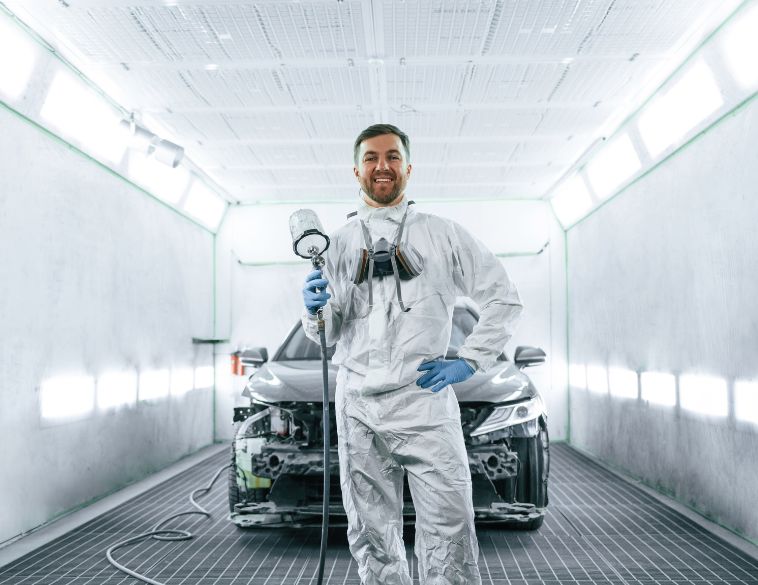
Selecting, adjusting, and maintaining the spray gun are critical steps in achieving a flawless automotive finish. (Credit : Envato)
The gravity feed spray gun is the refinishing painter’s signature tool, essential for delivering a finish indistinguishable from the original factory paint.
Automakers are constantly rolling out new models in a wide range of colours and finishes to attract buyers. Paint manufacturers, often involved in developing these coatings, provide refinishing products body shops rely on when vehicles require collision repair. Paint companies face a major challenge. Because body shops cannot fully replicate factory conditions, manufacturers have developed primers, basecoats, and clearcoats for refinishing. When applied correctly, these products can restore a vehicle’s appearance and blend seamlessly with the untouched panels. Most painters own their spray guns, although some shops provide them. In either case, shops must ensure the tool being used meets the requirements of the application process.
A critical choice
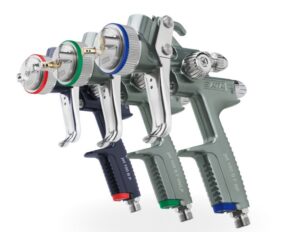
We asked Normand Cormier, Columnist for our publication and Training Director for the Americas at Axalta Coating Systems, to explain why the choice of spray gun is so critical. In a process where even a small misstep can lead to costly rework, getting it right is essential. In body shops, gravity feed spray guns remain by far the most common. “Since the spray gun is the painter’s primary tool, the ideal situation is to test it before buying,” says Cormier. “Suppliers are usually willing to let painters test a spray gun for a trial period before committing to a purchase.” Paint suppliers and equipment distributors often provide the same option. “Spray guns are relatively expensive, and it would be a waste to buy one that ends up gathering dust because it doesn’t truly meet the need.”
The right tool for each job
Cormier also challenges the notion that a single spray gun can flawlessly apply primers, basecoats, and clearcoats. According to him, one-size-fits-all doesn’t work. “For instance, I prefer one spray gun with specific settings for applying our waterborne basecoat, but I prefer another manufacturer’s gun for spraying our high-production clearcoat.” This underscores the importance of basing the decision on paint manufacturer recommendations rather than personal preference alone. Of course, the painter has to feel comfortable with the tool, but technical requirements come first. “Ergonomics, weight, nozzle and air cap options, spray pattern, and material flow rate (grams per minute) all affect how efficiently and effectively a painter can work with a spray gun,” adds Cormier.
Technical requirements first
Christian Roy, Technical Territory Manager with distributor NAPA/CMAX, goes a step further, insisting that the choice of spray gun must be dictated by the product’s technical data sheet. “I understand that painters have preferences,” he explains, “but if a gun sprays a sealer coat too thick, it takes too long to dry and can cause delamination. Guns can be adjusted, but with the variations in viscosity we’ve seen over the years, it’s unrealistic to expect one spray gun to handle every stage with the necessary precision.”
Paint suppliers are also less receptive to complaints when coatings are applied with guns that don’t meet their specifications. And if the finish has to be redone because the wrong gun was used, nobody wins. That’s something to keep in mind when buying new spray guns or when a new painter arrives with his own equipment.
Put them to the test
Even when several spray guns meet manufacturer requirements, Roy recommends testing them to identify which models perform best and to gather as much insight as possible. “Some spray guns are known to use more paint than others,” he notes. Roughly one-third of the material is lost to overspray during atomization. Roy stresses the need to follow product data sheets carefully. “Some painters still insist on setting up their spray guns by ear, even though certain models now display real-time air pressure fluctuations to ensure constant flow and even coverage.” Manufacturers are competing to reduce waste, and their results are worth comparing. That naturally raises the issue of cost. Because a well-maintained spray gun can last for decades, quality should not be overlooked, even if paying extra for a brand name is not always justified. Maintenance, however, is critical.
The importance of maintenance
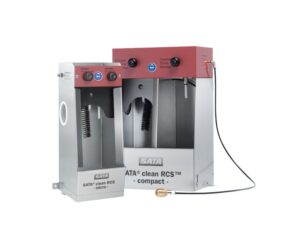
As Cormier puts it: “Good maintenance is the key to consistent performance. I wouldn’t choose a surgeon who doesn’t disinfect his scalpels after surgery. Soaking a spray gun in a bucket of solvent at the end of the day is definitely not the right way to keep it clean.” This treatment can dry out rubber seals and compromise their tightness. Solvent residue can also contaminate the next application. Spray gun manufacturers provide maintenance kits and clear recommendations. Specialized cleaning machines can restore a gun in seconds. Experts insist on cleaning after every product or colour change. Mechanisms should also be lubricated regularly to extend service life. Replacement parts can be expensive enough that painters sometimes end up buying a new gun instead. Like his colleagues, Roy recommends periodic full disassembly and test spraying on a sheet to check for consistency in the spray cone. The major brands on the market all offer spray guns with similar main components and adjustment features. While new spray heads and digital pressure monitors have appeared, the biggest change in recent years has been the switch to waterborne paints.
Word from the suppliers
Patrick Creany, Business Development Manager at SATA, says the manufacturer he represents works closely with paint suppliers to keep up with evolving products. “The challenge is balancing atomization quality with transfer efficiency. Painters want consistency, while shops want to minimize waste,” Creany explains. To meet these needs, the German manufacturer offers a full range of spray guns and spray heads, since each application has their own requirements. Digital displays are also available to show real-time air pressure at the gun inlet. SATA has built a strong reputation for precision and long-term reliability. “Our products are constantly evolving, but I know painters who have used the same spray gun for 25 years. Such longevity is the result of meticulous maintenance ” Michel Barette, Technical Representative for Iwata, suggests that shops should ideally supply spray guns to their painters through gradual financing programs. This ensures that technicians get the tools they prefer. The Japanese manufacturer continues to emphasize a simple principle: the right tool for the right job. “Iwata offers a wide range of spray guns designed for every type of coating and every stage of the finishing process,” says Barette. He adds that finishing has become more science than art. The real challenge, he explains, is to boost efficiency while replicating increasingly complex OEM finishes, all within budget constraints. “If choosing one application technology reduces paint consumption by 20 %, why not compare the different solutions on the market?” he concludes confidently. Yannick Auger, who represents DeVilbiss in this market, points out that the company offers spray guns specialized for primers, basecoats, and clearcoats. He encourages shops to take advantage of the trial periods offered by manufacturers, distributors, or paint companies. “A shop may favour a certain type of spray gun to meet their paint supplier’s requirements. But if the painter dislikes it, the gun will just sit in a cabinet.” It’s hard to convince a painter to switch brands once they’ve grown attached to a particular gun. Still, because coatings are constantly evolving, that alone is a good reason to encourage painters to switch to more modern, higher-performing tools. While discussing the need to have several spray guns on hand depending on the product, Christian Toubia, Sales Representative at 3M, brought up the Performance Spray Gun 2, a new multipurpose model with interchangeable spray heads. “The body is made of carbon fibre, which may surprise some people until they try it…” The gun is extremely light, and the interchangeable heads cover the full range of viscosities. Each disposable tip can be used for up to 100 hours.
Sources of information
Spray gun manufacturers often indicate on their websites which tools are best suited to specific paint brands or even specific products. Paint equipment distributors and paint companies also have technical advisors who work directly with shops, helping painters choose the right tool with their preferences in mind, since they are usually the ones making the purchase. In many cases, depending on the program, a spray gun can be tested in the shop for several days or weeks.



JOBS
 |  MONT-ROYAL MONT-ROYAL Permanent Permanent |
 | LAVAL Full time |
 | BROSSARD Temporary |
| JOLIETTE Full time |
 | MONTRÉAL Full time |