
Stud On, Stud Off
Autosphere » Tires »
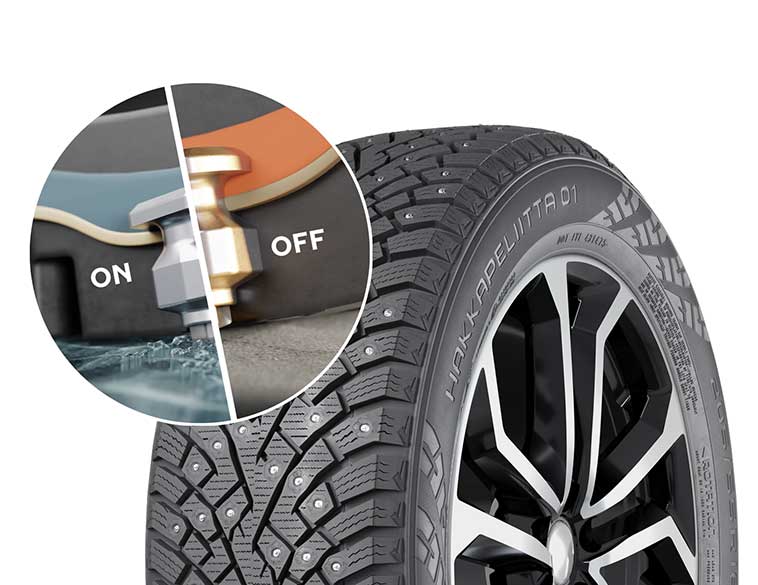
Nokian Tyres’ Hakkapeliitta 01 is the world’s first winter tire with on-demand grip.
Nokian Tyres reinvents the studded winter tire.
What was once impossible is now a reality—a studded winter tire with stud on/stud off capabilities: the all-new Hakkapeliitta 01.
Nokian Tyres invited the world’s automotive media to their testing facilities in northern Finland, 250 km above the Arctic Circle, for the unveiling of this revolutionary new tire technology. Autosphere Mag had a front-row seat at the technical presentation, as well as plenty of opportunities to test drive and experience the new tire in a variety of winter conditions.
According to Mikko Liukkula, Nokian Tyre’s Development Manager, he and his engineering team have been working on a tire that could deploy studs on demand for many years.
“In 2014 we came out with a concept tire where you could press a button to activate and deactivate the studs,” he explained. “But the technology was so complicated that it would never reach production, and each tire was so expensive that it cost more than the Porsche we used to test it.”
Nonetheless, since the concept tire received so much media and consumer attention at the time, Nokian Tyres was determined to find a way to bring this technology to market. “We tried so many different ways to make this concept tire into reality,” he added, “but most of our attempts were a dead end, and we had to start all over again.”
Finally, Liukkula and his team came up with the idea of a special rubber compound layer within the tire—known as the “adaptive base layer”—that would house the bottom flange of each stud. This layer would get hard when temperatures dropped, and remain soft and pliable when temperatures rose. When hard, the layer would keep the studs in the “On” position. When soft, it would allow each stud to sink into the tread, essentially switching the studs “Off.”
In other words, when ambient temperatures are cold enough for ice to form on road surfaces, the adaptive base layer is hard enough to keep the studs in the “On” position. When temperatures rise to the point where ice melts, the adaptive base layer gets soft enough to keep the studs in the “Off” position.
Although Nokian Tyres wouldn’t specify the exact ambient temperature at which the adaptive base layer makes the switch from hard to soft, and vice versa, their technical presentation, as well as our own testing during the “lab” portion of the program, seemed to suggest that the studs stay in the “On” position at and below -5 degrees Celsius, and in the “Off” position when temperatures rise above 5 degrees Celsius.
That leads to another interesting technical question: What happens when the ambient temperature is cold enough to keep the studs “On,” but they’re no longer needed because you’re driving on dry pavement?
Liukkula offered the following explanation: “If you are driving on a bare road in -20 degree weather at 100 km/hr, each stud hits the road 14 times per second, which causes the stud to be pushed in every time it hits the road. That small repetitive movement warms up the adaptive base layer, which softens it, allowing the studs to sink into the tire and stay there.”
According to Nokian Tyres, the transition from “On” to “Off,” and vice versa, takes very little time: “We have tested the tire by driving it out from a warm garage directly to ice grip tests, and it adapts immediately even in that circumstance,” the company explained in one of their technical FAQ handouts.
Between the adaptive base layer and the tread compound is another key component, known as the “lock compound.” It has been engineered to hold each stud firmly in place.
New tread, new compound
In addition to the stud on/stud off technology, the Hakkapeliitta 01 boasts a new tread design and a new compound. This tire was engineered with smaller tread blocks than the brand’s flagship winter tire, the Hakkapeliitta 10, in order to deliver better snow grip and more biting edges. It also comes with two different self-locking 3D sipes: shoulder and middle. The shoulder sipes improve steering precision and snow grip, while the middle sipes provide more stability.
Furthermore, the tread compound was engineered specifically to improve wet grip, and according to Hans Dyhrman, Director of Marketing at Nokian Tyres North America, the Hakkapeliitta 01 delivers 5% better wet grip than the Hakkapeliitta 10.
Stud layout for the Hakkapeliitta 01 has been computer optimized, with middle studs positioned to maximize both braking and acceleration capabilities, while the shoulder studs are positioned to maximize lateral grip, which significantly improves cornering.
The studs are the same as those used in the Hakkapeliitta 10, Dyhrman explained, but with a notable modification. “The pin is the same as the one we use in the Hakkapeliitta 10,” he added, “but we changed the collar to give it more of a biting edge.”
Aramid fibers (used in bullet-resistant vests) are incorporated into the sidewalls of the Hakkapeliitta 01 on all tires 18 inches and above, Dyhrman added. Aramid adds mechanical strength to the sidewalls for added durability, and improves resistance to cuts and impact from road hazards, like potholes.
Key features
Nokian Tyres has incorporated a number of notable features into the new Hakkapeliitta 01, including a wear indicator, which makes it easy for consumers to tell at a glance how much tread is left: 8, 6 or 4mm.
Each tire also comes with the brand’s Electric Fit emblem. “It tells consumers that we have tested this tire on many different electric vehicles,” Dyhrman said. “We’ve been testing for over a decade on electric vehicles.”
The Hakkapeliitta 01 proudly displays the Three-Peak Mountain Snowflake (3PMS) symbol on the sidewall, right beside the Ice Grip symbol. “The 3PMS signifies snow acceleration, while the Ice Grip symbol signifies great braking on ice,” Dyhrman added.
Finally, since no one wants a noisy winter tire, Nokian Tyres has added their SilentDrive technology to 24 leading EV sizes of the Hakkapeliitta 01. According to the company, this layer of acoustic foam, attached to the inside of the tire, results in an “up to seven-decibel reduction in road noise.” In addition, the fact that the studs retract when driving on dry pavement, makes these tires much quieter than typical studded tires.
Consumer education and government regulations
The new Hakkapeliitta 01 was engineered to deploy studs only when they’re needed, and according to the company, “this helps decrease road
wear by ensuring gentler, more efficient road contact when maximum stud grip is not required.”
In other words, the Hakkapeliitta 01 shouldn’t damage bare pavement the same way traditional studded tires can. So in theory, these tires should be permitted in places where traditional studded tires are currently forbidden—on public roadways in certain provinces, and in some private garages.
However, as Wes Boling, Senior Communications and Content Manager for Nokian Tyres explained, “these are still considered to be studded tires.” This means that many Canadian drivers still won’t be able to purchase these tires for their personal vehicles without risking a fine.
The Hakkapeliitta 01 represents a bold step forward in winter tire innovation, transforming a once impossible concept into a real world solution. By automatically deploying studs when icy conditions demand maximum grip, and retracting them when they’re not needed, Nokian Tyres has created a tire that promises improved safety, reduced road wear and quieter operation.
While broader adoption may ultimately depend on regulatory updates and consumer education, the technology behind the Hakkapeliitta 01 clearly signals a new direction for winter mobility—one where intelligent tire design adapts seamlessly to the ever-changing realities of winter driving.
Tags : Nokian Tyres


JOBS
 |  DORVAL DORVAL Full time Full time |
| ST-HUBERT Full time |
 | MONTRÉAL Permanent |
 | SASKATOON Full time |
| MONTRÉAL-NORD Permanent |