
Brakes, Profits and Retention
Autosphere » Mechanical »
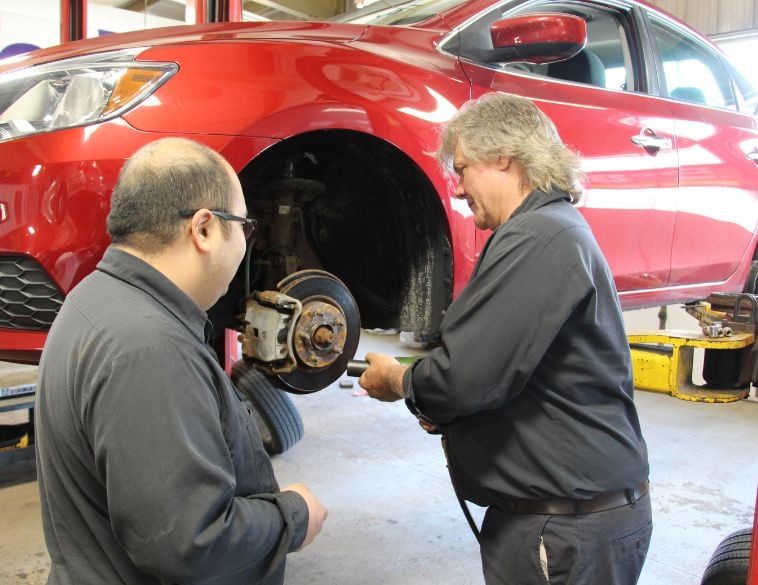
How a shop approaches brake servicing with the customer and the parts used, has a major impact on revenue and future opportunities. Credit: Huw Evans
How you approach this regular maintenance work can have a big impact on your business.
Whether or not a mechanical repair shop specializes in brake jobs, the frequency and demand for this regular type of maintenance work and the options available, can make it a very profitable source of revenue. On some days, in small independent shops, brake jobs can account for more than half of the maintenance and repair work performed.
For service centres, managing customers’ expectations can be an important part of the process, both in assuring their satisfaction for the particular job in hand and in retaining them as customers for future work. Beyond brake work, the customer might want to have another issue with their vehicle addressed.
It can often make sense to give the customer a clear choice between economy, standard and OE-specified brake parts. The customer might or might not need to be reminded of the old adage – you get what you pay for! At the same time, the customer should at least be informed about what to expect. “I don’t use cheap parts unless the customer specifically asks for them” explains Lewis Williams, owner of High Country Auto & Propane Ltd. Williams always suggests direct OE replacement parts or high quality aftermarket offerings by companies that also supply OEMs. Instead of focusing on bargain-basement bare-minimum pad replacements, Williams looks at brake servicing as a full safety package that includes replacing and/or servicing pads, rotors and caliper hardware.
“With today’s late models, ask (the customer) lots of questions about what was going on when the symptom or problem appeared. Look at every corner of the vehicle.”
– John Douglas, Owner, Ideal Auto & Tire
Seized sliding pins
Williams says that one of the first things when it comes to performing a brake job, is to check the calipers for seized sliding pins, noting that on a 2020 Ford F-150 (in the shop when we visited), all four calipers were seized. “If, say, only three were seized, we would do the remaining one. With 200,000 km on each of them, it could seize any time if left alone. If a pin is seized it will wear the brakes faster. It’s not fair to the customer if the calipers are not fixed. So, at a minimum – take the calipers apart, and if not seized, clean and re-lube with new silicon lube. It keeps the water out, makes the calipers move easily and the brake pads will last longer,” says Williams.
Noting that the caliper replacements for that F-150 were currently available only from a Ford dealer, caliper costs were high. But Williams says that doing the work well with attention to all the details meant more revenue for the shop—and “a better result for the customer.”
Also, many shops overlook the parking brake mechanism on vehicles with automatic transmissions. By law, these are supposed to work, regardless of the transmission system. Making sure parking brakes work can protect customers and their vehicles, reassure fleet clients and keep insurance companies happy. “With one half to two hours’ work per vehicle, it also means more revenue for the shop,” Williams says.
Photos and retention
As is now common, given the widespread use of smartphones, Williams uses photos to inform customers clearly about what the problem is and what repairs should be done. This can add revenue to the shop as it shows a customer why a little more money should be spent and helps retention by building trust and transparency with the client.
Making sure everything is done to give customers reasons to trust the shop is also a big part of the approach at Edmonton-based Ideal Auto & Tire, says business owner John Douglas.
Among other things, making sure technicians follow guidelines and the use of resources like Techmetric and Shop Monkey can have a role in both streamlining processes and building trust, he says. “Direct Hit can help a lot with diagnostics, but it’s also important to pay attention to the whole problem and get as much information as possible. A little extra time spent on gathering information can mean big savings at the actual repair stage,” Douglas says.
Focusing on the right diagnostics is also critical. Besides its potential for building customer trust, it should improve revenue by saving time—and money—at the repair stage. “With today’s late models, ask (the customer) lots of questions about what was going on when the symptom or problem appeared. Look at every corner of the vehicle. Electronic scanners are great but they can miss stuff. Make sure you get as much information as possible,” Douglas says.
Weighing the options
Clearly, shops often have more than a few options to weigh when planning a brake job. Occasions can occur when the technician might consider the prospect of a greater profit on a job against increased risk of a dissatisfied customer coming back because of a strange noise on the front end of their vehicle that lingers and annoys. Suppose two new rotors cost a shop $75, which retail at $125. Replacing with new ones yields a $50 profit and just about guarantees customer satisfaction, while resurfacing yields almost an hour of badly needed labour revenue. So, which option would you choose? For the rotors in this example, most shops would likely be wise to opt for replacing the rotors, as opposed to resurfacing them, since in this age of social media and online reviews, no service centre wants a comeback, especially if it can be avoided in the first place.
Tags : High Country Auto



JOBS
 |  DORVAL DORVAL Full time Full time |
| ST-HUBERT Full time |
 | MONTRÉAL Permanent |
 | SASKATOON Full time |
| MONTRÉAL-NORD Permanent |