
Advanced and Aligned
Autosphere » Mechanical »
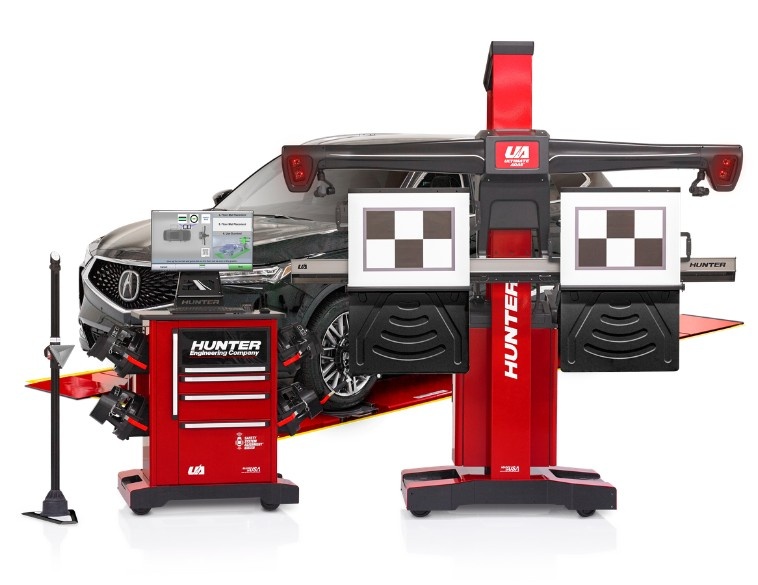
Equipment Systems like Hunter’s Ultimate ADAS are redefining modern wheel alignments. Credit: Hunter Engineering Company
ADAS calibrations are an integral part of modern wheel and tire adjustments
There was a time when performing wheel alignments on light vehicles was relatively straightforward and the prime focus was getting the toe and camber properly aligned and the steering wheel centred. Today, a wheel alignment on a late-model vehicle is far more complex, often requiring sensor and ADAS calibrations. How it’s performed, significantly impacts vehicle safety, performance and reliability. “Service centres that treat modern day wheel alignments the same way they did in the 1980s and 1990s often see comebacks, unhappy customers and potential liability, particularly if ADAS features don’t perform correctly,” explains Ryan Gerber, Product Specialist at Hunter Engineering Company.
If you’re running a service centre today, investing in proper ADAS-capable alignment bays and following vehicle OEM procedures can pay off big time, and significantly reduce potential comebacks. – Ryan Gerber, Product Specialist, Hunter Engineering Company
Integrated service
In order to properly perform wheel alignments today and do it accurately and on a consistent basis, Gerber says that service centres must view the alignment process, not as a standalone service but rather an integrated process that includes ADAS workflow. He notes that modern ADAS systems rely on precise vehicle geometry in order to function properly and even the most minor camber/toe adjustments will require ADAS calibration in order for the vehicle to operate safely and correctly.
Gerber suggests that to ensure wheel alignments and ADAS calibrations are done properly and accurately, technicians should begin the process with a full 4-wheel Thrust-Line Alignment. “Determine ADAS Recalibration requirements by each individual vehicle and never assume that requirements have not changed,” Gerber explains.
He stresses that it is essential today that shops make investments in the right equipment in order to do this, including a full range of alignment and ADAS equipment. There’s also the question of where to perform calibration work within the shop environment.
Using existing space
Dynamic ADAS calibrations don’t require any additional shop space and he notes that even when it comes to static calibrations, most forward facing ADAS calibration sensors can be recalibrated within existing shop space.
If the service centre plans to offer complete, around the vehicle static ADAS calibrations, that will require additional space within the shop, though Gerber notes that equipment such as Hunter’s Ultimate ADAS can be moved around to maximize efficiency and profitability within the existing shop footprint.
At Upper James NAPA AUTO PRO in Hamilton, Ontario, owner/operator Andrew Ackers says that especially when it comes to static ADAS calibrations, service centre staff need to having conversations with their customers. He notes that often the biggest friction between service advisors and shop customers is due to lack of training and understanding, and if the advisor isn’t able to explain how or why the vehicle needs ADAS calibrations, it can come across as a blatant up-sell tactic since the customer may not understand what ADAS is and why their vehicle needs these sensors calibrated, especially for something they perceive as “simple” such as a wheel alignment.
Training considerations
Ackers says that in reality, it can be tough to implement training for service advisors, since they represent the front line of the business, and as a result, there are shop owners that aren’t willing to make the investment or can’t see that sending advisors to training will reap big benefits, even though they might send technicians for training a specific vehicle or system for up to a week in some cases.
Besides having the right training for both advisors and technicians, along with the right equipment from day one, Ackers says it’s important to be having conversations with customers about performing vehicle maintenance alongside ADAS calibrations. “Do we need to perform ADAS calibrations every time? Not necessarily,” states Ackers, “but if your customer has a four-year old SUV and it’s never had an ADAS calibration that’s a conversation you probably want to have with them, particularly if the vehicle is requiring maintenance.”
Real gains
Back at Hunter Engineering, Ryan Gerber notes that those service centres who embrace and fully leverage systems like Hunter’s Ultimate ADAS have seen “real gains in consistency, accuracy and especially profitability.” He notes that by combining alignment and calibration in a single location, with automated and faster target placement, shops see significant time savings. Additionally, with laser-guided precision and error-proof monitoring, ADAS calibration results are accurate and consistent, which delivers better results for the shop and its customers and reinforces the level of trust between them.
Additionally, when done correctly, ADAS calibrations represent a high-margin profit centre for service shops, which can bundle them with alignments—significantly increasing the average repair order value for both the shop and the customer.
Error proofing your ADAS
As ADAS calibrations become a more regular component of mechanical and service repair work, shops need to ensure they take the necessary steps to error-proof the process as much as possible, since poorly performed or inaccurate calibrations can compromise vehicle safety and performance.
Ryan Gerber notes that most errors related to ADAS calibrations often stem from manual target placement using tape measures, plumb bobs or strings. “It’s both error prone and time consuming,” he says. Gerber notes that systems like Hunter’s Ultimate ADAS use laser-guided, vision-assisted or camera-monitored placement. The lasers within these systems can paint exact positions and flag errors to force corrections.
They can also automatically compensate for uneven floor surfaces and roll, pitch and yaw. In addition, step-by-step on screen guidance delivers intuitive instruction and prevents skipping any steps in the process. “This reduces setup time dramatically, while making the process nearly foolproof,” says Gerber.



JOBS
 |  LASALLE LASALLE Full time Full time |
 | STE-AGATHE-DES-MONTS Full time |
 | SAINT-LÉONARD Full time |
 | MONTRÉAL Permanent |
 | JOLIETTE Full time |