
Low Charge Transit
Autosphere » Mechanical »

Ford Transit
Voltage issues led to investigation of the generator circuits
We recently had the opportunity to do a diagnosis on a 2017 Ford Transit equipped with the 3.5L GDI V6 engine. In this case it was regarding a charging system concern. The vehicle was charging at 13.2 V with the Battery and Check Engine Lights on in the dash.
Upon arriving at the vehicle, a code scan was performed and several charging system codes were found
Important codes
The important codes to note here are P0620, P0625 and P065B. These codes all relate to some sort of charging system problem and in this case had to be further investigated. The P0620 code is a general charging system fault indicating that the system cannot deliver the desired charge rate. The P0625 code indicates that the generator field circuit is low and the P065B code indicates a problem with the Generator Control Circuit. By looking into the code descriptions there were two faults indicated. The generator monitor (GENMON) circuit was open or shorted, and the Generator Command (GENCOM) circuit was not functioning as expected.
Circuit tests
At this point the trouble tree in the service manual calls for a number of circuit tests performed with a DVOM. This seemed like a lot of unnecessary work without knowing where the actual problem lay. These circuits are monitored by the PCM, and they can be viewed in scan data. Once the data can be examined it should provide a better idea of where the actual problem is, otherwise following the code chart will require testing all circuits.
A quick check of the scan data confirmed that problem lay with the GENMON circuit and that the generator was operating in default mode. The data showed the commanded voltage at 14.6 and the system battery voltage at 13.5. This generator has a backup circuit that defaults to 13.5 volts if the PCM looses command of the generator which was clearly the mode the generator was operating in. The data also shows a problem with the GENMON circuit.
A quick recap of how this system works. The PCM sets the charging voltage by sending a digital message to the generator on the GENCOM circuit. The generator carries out the command and sends the PCM information on how hard the generator is working via the GENMON circuit.
Contact issues
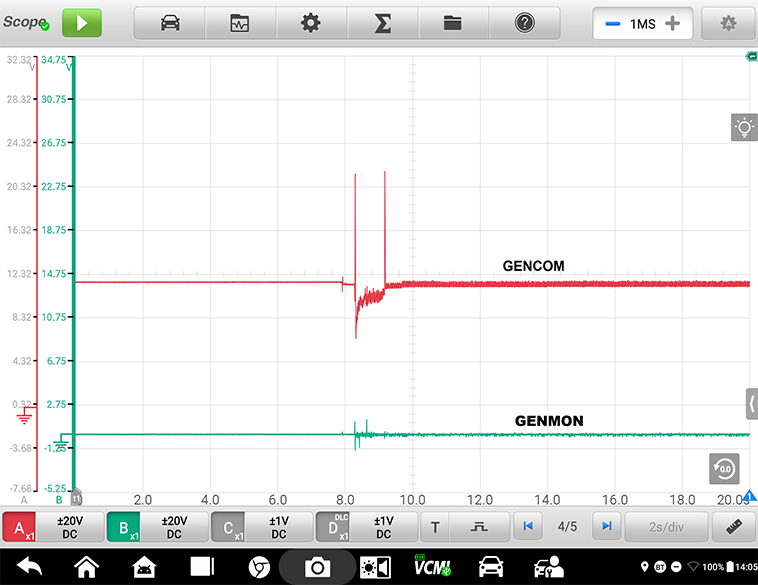
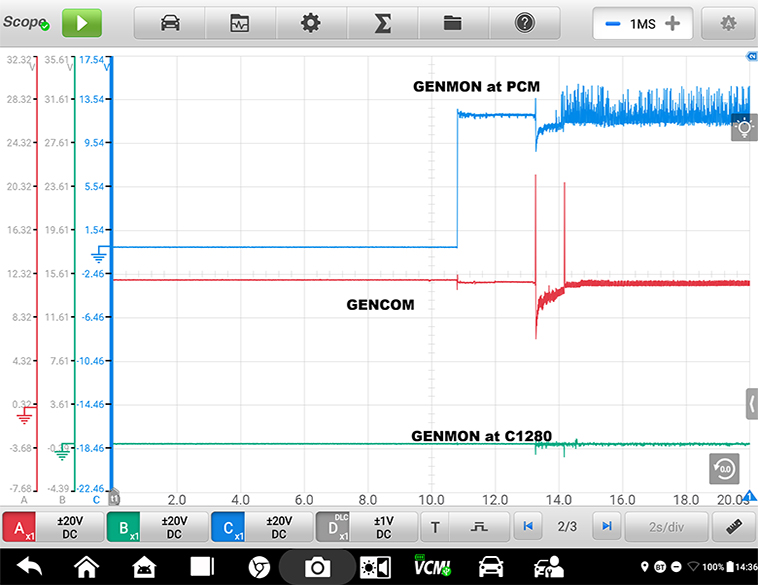
At this point, it was time to check the GENMON circuit. A lab scope was hooked up to both the GENMON and GENCOM circuits at connector C1280 (closest I could get to the generator). The results are shown if Fig 1. There should be battery voltage on this circuit. The PCM supplies a 12 volt signal which the generator ground at a changing duty cycle to inform the PCM of generator load. Having found low voltage, the circuit was checked at the PCM (Fig 2). The circuit voltage was good at the PCM but bad at C1280. Clearly there was a problem between the two test points of the GENMON circuit. Further investigation revealed that contacts in the C1280 connector itself were the problem. The circuit was repaired and retested and the results are shown in Fig 3. The vehicle was now operating normally, and the warning lights were no longer illuminated.



JOBS
 |  BROSSARD BROSSARD Temporary Temporary |
| JOLIETTE Full time |
 | MONTRÉAL Full time |
 | MONTRÉAL Permanent |