
Collective Focus, Optimal Outcomes
Autosphere » Mechanical »
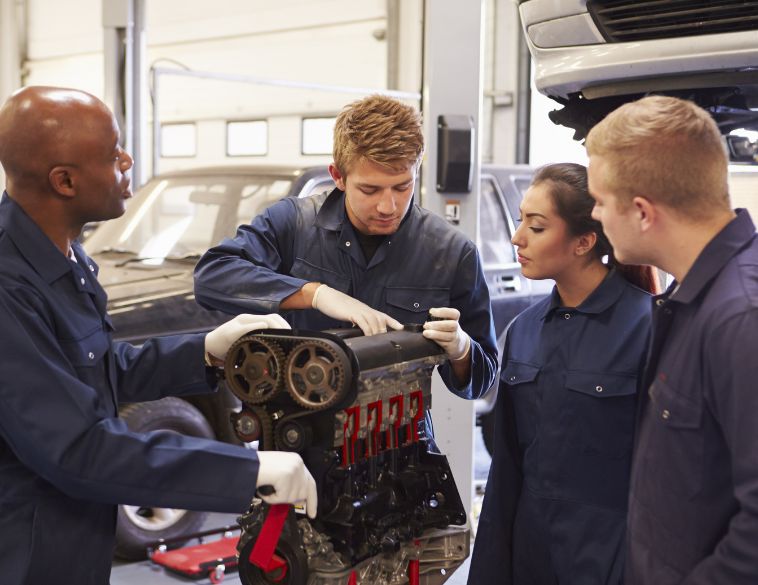
Effective mentorship and training is a key part in addressing labour shortages. (Credit : Shutterstock)
An Interview with AIA Canada’s Incoming President, Emily Chung.

A big announcement in 2025 was that Jean-Francois Champagne announced his decision to step down as President of AIA Canada in 2026, paving the way for a new successor. Taking over the role in 2026 is Emily Chung. Emily is familiar to many in Canada’s automotive aftermarket sector, having owned and operated a service repair facility in Markham, Ontario, as well as being a licensed automotive technician, industry advocate, journalist; professor at the Automotive Business School of Canada and past industry association board member. We recently caught up with Emily to congratulate her on the appointment and her thoughts on the state of the industry and AIA Canada’s focus moving forward.
Autosphere: Congratulations on the new role. Tell us what it means for you in being named President of AIA Canada?
Emily Chung: It feels incredible, and I am both honoured and humbled to accept this position. In some ways, I’ve come full circle, since I’m now representing the interests of the businesses that make this industry what it is. Coming from an industry background myself, having run my own repair shop and seen the challenges and opportunities firsthand, as well as being a technician and working with my father in his own aftermarket parts business, I feel that taking on this role provides unique insight and benefits in representing the interests of the automotive aftermarket sector at a national level.
AS: Can give us a little background on how you got involved with the industry and your career journey in the aftermarket?
EC: Having graduated from university in psychology and business, I worked for a while in the private sector. I then joined my father, working in his aftermarket parts business. By that stage, I was old enough to understand the issues he wrestled with including warehousing and distribution. I then felt called by my faith to open an auto repair business and become a licensed automotive service technician. I owned and operated the shop for many years, and got into advocacy, journalism and teaching, becoming a professor in the aftermarket studies program at the Automotive Business School of Canada at Georgian College. It’s been an interesting journey, and I feel privileged in learning about and being exposed to many different facets of this industry.
AS: What do you see are some of the most pressing issues facing the aftermarket auto care sector in Canada right now?
EC: When we look at 2025, it was a challenging year for many in our sector. We have and continue to see consolidation, and I feel that it adds to the underlying tone and uncertainty of things, including larger macroeconomic issues. We’re also seeing changes in trade policy including our federal government’s announcement of bringing in Chinese EVs to Canada, as well as the ongoing issues surrounding tariffs. This is all creating uncertainty both for businesses and consumers and there is a sense that the market is tightening, which could have implications for our industry over the next several years, even though we have seen that the aftermarket auto care sector tends to be resilient, even during economic downturns.
AS: What are some of the key factors the association is looking to focus on in 2026 and beyond and why?
EC: From my perspective, I feel that we have opportunity at the association level to bridge the gap between workforce development and operations at the shop level. There are a lot training programs out there, and where I feel the association can help is bridging the gap between awareness of training programs, and funding that’s available for them. As an association representing the interests of aftermarket auto care, we are brand agnostic, so it doesn’t matter who is providing this training, as long as the objective is for the betterment of the industry. Also the issue around Right to Repair is a big one, and it’s tied into the workforce and contributes to the labour shortage our industry is currently facing. While Right to Repair and the labour shortage are often viewed as separate issues, we need greater awareness to demonstrate how both these issues are connected, particularly among consumers and government. If we don’t have fair Right to Repair legislation, then how do we train people?
Furthermore, how do technical colleges train the next generation of aftermarket auto care professionals? This issue further exacerbates this labour shortage that everybody’s concerned about. Therefore, helping governments and different stakeholders see the relationship between different things is a big benefit. Shifting specifically to the labor shortage issue, there is the aspect of recruiting people at a younger age, while they are still in elementary or high school. It is great having the focus and support via college and trade school programs, but if we are able to engage with students when they are younger, before their minds are made up, that is critical in showing them that the auto care sector is a viable career, even while they are still in the early stages of thinking about what they want to do as a profession. Ultimately, our goal at AIA Canada is to serve the industry and engage and provide awareness on issues that impact our sector of the economy.
AS: Related specifically to members and involvement with the association and industry initiatives, is there anything you’d like to share at this time?
EC: I think a key one is for members to provide feedback about how we can have a meaningful impact on industry wide issues. Good, honest feedback will help us move forward, not only as an association and its members but as an industry sector overall, so that’s something I’m actively focused on. Ultimately, an association is only effective if it is properly addressing the concerns and needs of its members, and clear and concise feedback and communication is essential for that to work.
AS: Is there anything else you’d like to mention?
EC: There is the thought that, as of late, membership has been about “What is AIA Canada doing for me?” And while I understand why that question has come up—after all, individual value is very important—the more meaningful question is “What is AIA Canada doing for our industry?”
I believe that long-term value is created when the industry is stronger, together. When standards, credibility, and trust move across the profession, everyone benefits, and that is where AIA Canada’s focus sits—advancing the collective interests of the industry, not just individual outcomes.
Membership, at its core, is about contributing to a shared effort that lifts the industry as a whole. When some members feel disconnected from that, I see it less as a problem and more as an opportunity to reconnect people toward purpose, impact, and the bigger picture of why the association exists in the first place.

JOBS
 |  DORVAL DORVAL Full time Full time |
| ST-HUBERT Full time |
 | MONTRÉAL Permanent |
 | SASKATOON Full time |
| MONTRÉAL-NORD Permanent |