
Accuracy, Transparency and Retention
Autosphere » Mechanical »
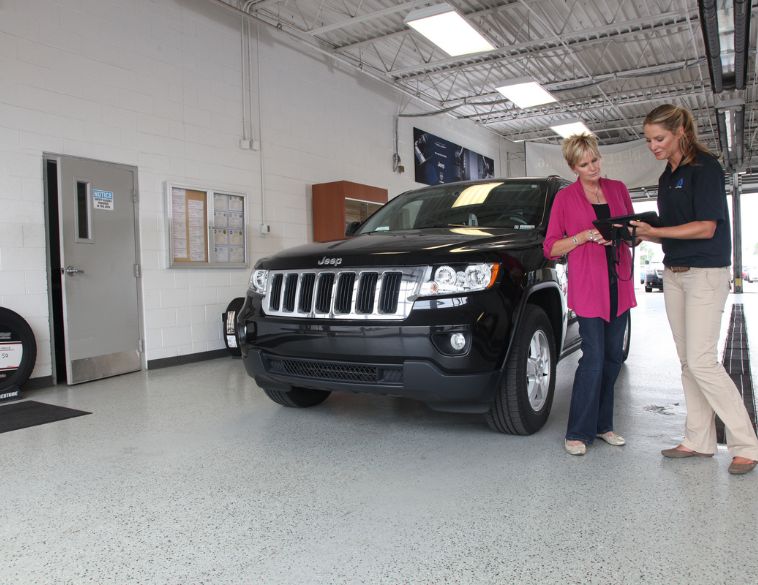
Communication and accuracy are key for service advisors when it comes to building client trust and retention. (Credit : Mopar)
Technology is enhancing trust and opportunity for service providers, provided it’s leveraged properly.
There was a time, when service centres often struggled to build retention with customers. A lot of it came down to the way in which the shop interacted with those people coming in and, who needed vehicle repairs and service work. The customer often didn’t understand what was required and it took a skilled service advisor and a well-run facility to effectively communicate that since estimates were often hard to decipher for most consumers and there was often this notion that the shop was going to do work that wasn’t required or not properly listed on the estimate.
Game changer
Today, things are different. The advent of digital vehicle inspection (DVI) technology has been a game changer for many automotive service providers. Andrew Ackers, who owns and operates Upper James NAPA AUTOPRO in Hamilton, Ont., knows fully well how this technology can really make a difference. “When we started six years ago, we had to build our book of business from scratch,” he says. “We were brand new, so building trust was crucial for us.”
Fast forward and today, the business has a deserved reputation for quality service and has developed a loyal clientele. “It creates much less friction when you’re properly relaying all the information to the client and you can take pictures and provide really transparent information regarding their vehicle,” says Ackers.
Yet while DVI is common today, Ackers explains that it’s still important [and the shop’s responsibility] to leverage this technology properly and it’s more than just about asking technicians to take their old paper checklists and transfer them to a digital format.
Fullest extent
“When we relay information about a customer’s vehicle [using DVI] we, as a shop, should be explaining to the fullest extent what the client is looking at when we send pictures or video to them,” states Ackers.
He acknowledges that clients should be able to read through and decipher the inspection report clearly and easily and not have to pick up the phone, call and/or message the shop saying, “what exactly is this my vehicle needs and am supposed to pay for, as I’m not sure about it?”
When we’re looking at the concept of building long-term customer retention for automotive service providers, the process actually begins long before the technician or service advisor hands the customer the tablet or prints off the report.
“It starts with a conversation at the front counter and reshaping the service process,” says Ackers. He explains that it’s critical for service advisors to explain the digital inspection process so that all expectations for both the customer and the shop are properly established. This is particularly important for new customers, since the shop isn’t familiar with their vehicle and will need time to go over and document the car or truck’s condition. Ackers also stresses that when talking with the customer, the service advisor needs to establish a timeline on when the inspection report will be sent to the client and what it will look like.
Transparency and control
A big advantage of digital inspections is that they truly reveal a vehicle’s overall condition and enable customers to see which aspects need immediate attention and which will require service, repair or replacement further down the road. This not only amplifies transparency, it also puts the customer fully in control of their money so they can allocate funds based on the immediate and longer-term service needs.
Yet while digital, transparent reports are a big factor in building trust with customers and bolstering service retention, an effective estimating process is also critical to making that happen consistently and on a long-term basis.
If a shop cannot write good estimates, then it will struggle to build trust with its customers. Nick DiVerde, Senior Director of Product Management at Mitchell 1, notes that a big reason why estimates can still be a major pain point for both shops and customers is because estimating tools have not kept pace with advances in vehicle technology.
And, “because of that,” he says, “service advisors can only be as successful as their experience allows them to be.”
Multiple sources
DiVerde stresses that in order to create an accurate estimate, service writers have often found themselves having to utilize multiple data sources, including labour time guides, parts catalogues, repair information, maintenance schedules and vehicle inspection reports. The trouble is, all of this takes time, and the result isn’t always entirely accurate for a particular vehicle or R/O.
It’s something that’s been a key focus at Mitchell 1, which has sought to remedy this problem by bringing all these data sources together within a single platform.
“By providing [service writers] with an estimating platform that leverages more than three billion repair records, we’re giving them the ability to tap into the experience of tens of thousands of service advisors who have estimated the same job before them,” says DiVerde.
Additionally, DVI technology can enable service advisors to deliver faster estimates, since when the customer sees that a control arm or tie-rod bushing is worn, or the brakes need servicing, the advisor can quickly estimate the parts and labour required to fix that problem. The DVI aspect allows the customer to visually see what’s wrong and make a faster decision in approving the estimate. As a result, says DiVerde, the shop now has a greater chance of making a sale, and over time, those sale opportunities grow exponentially.
Clarity and communication
While modern technology is changing the automotive service process and dynamic between service centre and customer, there are some aspects to consider. DVI is great, but in order to really win customers over, you also need to have the right people working the front counter. At Upper James NAPA AUTOPRO, Andrew Ackers and his team came up with a plan for service advisors who were tailored to specific roles. “One advisor has a high priority list which their personality works best for—things such as workflow and communicating with clients regarding pricing and handling technical issues,” says Ackers, “while the other focuses on the client experience and is diligent when it comes to communication, ensuring that customers receive a seamless experience from start to finish.” Ackers notes that this complementing of skill sets has proved very effective for the business and that as part of the client experience, customers receive updates during the repair, showing the work that has been done, what’s needed to complete the job and how long it will take before the repair is finished—with a follow up message and update, once the vehicle is close to being ready for pickup by the client.
On the estimate side, Nick DiVerde explains that when shops are looking to advance and improve their process, they should consider established suppliers to partner with. “Many companies can use the latest data technologies to develop intriguing solutions,” he says, “but without proper context, the results can be misleading.” A good example is making sure advisors know what related parts and labour operations are required to perform a particular repair, such as not only replacing the alternator, but needing to remove the engine intake manifold and replacing the gasket to do the job properly. Here, established vendors like Mitchell 1 can make a difference, since they’re able to leverage tools like the Snap-on Digital Search engine which blends technical capability with deep insights and decades of expertise. The result is a solution that saves time, improves accuracy and maximizes service opportunities and reputation for the shop.



JOBS
 |  LASALLE LASALLE Full time Full time |
 | STE-AGATHE-DES-MONTS Full time |
 | SAINT-LÉONARD Full time |
 | MONTRÉAL Permanent |
 | JOLIETTE Full time |