Bosch Mobility Aftermarket: Legacy, Choice and Future Success
Autosphere » Mechanical »
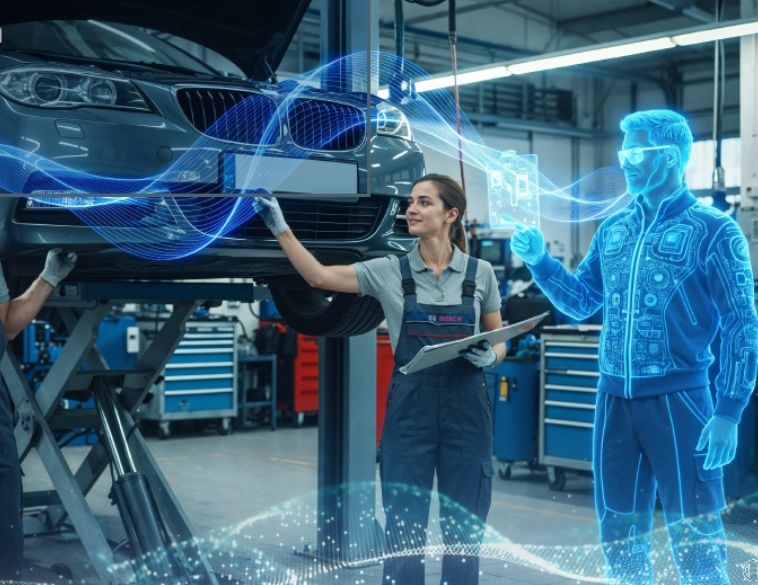
Bosch’s new Super Technician leverages AI and Virtual Reality, to find fast efficient diagnostic solutions in the service bay. (Credit : Bosch Mobility Aftermarket)
With AAPEX 2025 upon us, gaining real insights into the state of the aftermarket and trends taking place is essential, including vehicle components, powertrain focus, technology, tools, training and equipment. Autosphere interviewed Todd Hertzler, North American Regional President of Bosch Mobility Aftermarket to gain insights into what Bosch has been focused on and some of the new tools, equipment and solutions it is showcasing during industry week.
Autosphere: Can you tell us about Bosch’s approach to the automotive aftermarket, what you see as the way forward and how this reflects what we’re seeing at AAPEX and SEMA this year?

Todd Hertzler: From our perspective, there are some interesting dynamics happening in the automotive marketplace. First there’s legacy technology. At Bosch Mobility Aftermarket, we’ve been at the forefront of not only supplying but designing and patenting some of the most importance legacy technology in our industry. Some examples include fuel injection, including gasoline direct injection technology and diesel pumps. What we’ve seen, is that as consolidation continues in the automotive sector, there has been angst in the community about suppliers and their commitment to critical legacy technology. For us, continuing to focus on gasoline and diesel legacy technology and leveraging our past and expertise to build for the future is essential. At Bosch, we are powertrain agnostic, and our mission is to help people and vehicles get from point A to point B, regardless of what powertrain they use, whether its traditional gasoline, diesel, synthetic fuels, hydrogen, battery electric or whatever the next wave may be. We are fully committed to this philosophy, and we feel this is important to emphasize for our customers, especially when there has been a lot of focus in recent years on software, electrification and new technologies and services.
AS: How does this translate to what’s on display at AAPEX and SEMA in 2025?
TH: Our booths at AAPEX and SEMA in 2025 show that we’re innovating not just on the latest and flashiest things but in areas that are still crucially important for the aftermarket and the automotive industry. This includes the previously mentioned gasoline and diesel technology, as well as fast-moving replacement items like wipers, brake system components, spark plugs, filters, starters and alternators. There is still a huge demand for these kinds of products, which represent a major part of the aftermarket and an area that’s growing, particularly when you look at it from a dollar percentage perspective, so that’s a major theme for us this year.
Additionally, there is the new technology we’re showing. A key one is diagnostics. When we look at things like ADAS calibrations, this represents a huge opportunity for the automotive aftermarket. And, as more vehicles come standard from the factory with ADAS features, the ability to perform calibrations on these systems and do it safely and economically is hugely important for a business like ours. Another key area we’re focused on from an aftermarket standpoint is remote diagnostics. Today’s technicians need to have the ability to properly diagnose vehicles by not only utilizing what’s available on the scan tools they’re using but also having access to remote diagnostics solutions and experts. Our goal is to help our customers diagnose vehicles with the latest and greatest information and we’re partnering with OEMs to obtain that information, so technicians get access to what they need so they can perform diagnostic services effectively and efficiently.
AS: Tell us a little about your approach to training and technician development, which is crucial to the future of the automotive aftermarket industry?
TH: For us, this is a critical and very passionate subject. We currently have a major technician shortage here in North America, and we’ve seen CEOs of various OEMs voice their concerns about this. At Bosch, we are a lifetime trustee of the University of the Aftermarket Foundation. We’ve continuously increased our level of contribution and engagement in the University of the Aftermarket Foundation, because it is a fantastic pipeline for encouraging and developing young talent in our industry. In a world where you can be anything, and technology is developing so rapidly, we want people to understand that some of the most rapidly evolving technology is within the automotive sector. Technicians don’t just need to turn wrenches anymore; they also need to be able to program advanced ECUs and diagnose and repair today’s, and tomorrow’s complex vehicles. This requires the right training, and it takes commitment and talent in order to execute successfully. This is one area where I, personally, feel a strong sense of responsibility and one where we are energized and focused on supporting the next generation of technicians and automotive professionals.
AS: Can you share with us some examples?
TH: There is an automotive service centre owner that’s part of our Bosch Module Program [enhanced loyalty program] He’s located close to our headquarters in the western suburbs of Chicago and runs a very successful all makes/all models service and repair facility. He’s also teaching at the local tech institute for automotive aftermarket repair and bringing people from the institute into his shop, and helping them understand not just the technology, but also about running a business. It’s exciting and inspiring to see shop owners engaged like this in the development of the next generation of industry professionals, whether that be technicians or other roles. It’s been interesting to watch, not only from our perspective, but also from our partners who are looking at us as a valued supplier of tools, equipment, services and solutions that are needed to ensure a shop runs successfully.
AS: When we look at AAPEX specifically, what are your thoughts in terms of what this event represents for Bosch and the industry?
TH: I think a key part of AAPEX is showcasing industry trends and providing an opportunity for organizations like ours to provide a real, 360-degree view of the North American vehicle parc. It’s important to showcase what got us to where we are today and how we’re building for the future. Ultimately, it’s about trust. It is the trust we’ve earned from our customers and the commitment we have in preserving and supporting technology from the past and leveraging that to build a strong future. As I’ve said previously, there are concerns from the industry and suppliers that choices are diminishing and we want to make sure that our customers understand, that we will continue to offer a variety of choices for all of our product lines in the market and support them whatever their technology or powertrain focus happens to be.
AS: On a final note, can you tell us a little about Bosch’s focus on tools, equipment and the “Super Technician.”
TH: Bosch is very focused on improving our value proposition around tools and workshop equipment. For us, it’s about taking a critical look at new technologies and future customer needs and how we can align our product offering to provide exactly what the technicians need when it comes to the right workshop tools and equipment. If we look at it in terms of time savings, roughly 75% of professional automotive technicians get paid on a flat rate. Therefore, it’s important that our tools are designed in a way that helps the technician get the job done faster and done right the first time. We talk about unique solutions such as new ways to remove and replace wheel hubs and bearings and other suspension tools, as well as engine and general service tools that make technicians’ lives easier. On the equipment side of it, there’s a huge focus for us on safety, quality and reliability with our limited lifetime warranty, which extends to a whole host of products including jacks, pullers and presses. In terms of the “Super Technician,” this is where we go past even remote diagnostics and start talking about AI in the service bay. The Bosch super technician uses a new AI platform to really transform shop operations in the aftermarket industry. It’s a breakthrough tool and one that combines AI with virtual reality, and is designed to help technicians work smarter, diagnose faster and stay ahead of the curve when it comes to new vehicles and the technology within them. Technicians can upload files and basic information, and then, the super technician will expedite a diagnosis. Diagnostics results can be generated instantly, with the tool sifting through data and aligning some of the issues with known diagnosis and illuminating the problem to develop a fast, and efficient fix. This is groundbreaking technology that Bosch is uniquely designed to provide because of not only our rich history in automotive aftermarket, but the level of R&D we’re putting into advanced technologies like AI. We debuted this at CES in January 2025 and have received some great feedback in response to it. As a result, we’re very excited to talk more about it at AAPEX in 2025.

JOBS
 |  RIVE-SUD DE MONTRÉAL RIVE-SUD DE MONTRÉAL Full time Full time |
 | MONTRÉAL Full time |
| MONTRÉAL Permanent |
 | BROSSARD Full time |
 | SAINT-BRUNO Full time |