
A New Generation
Autosphere » Mechanical »
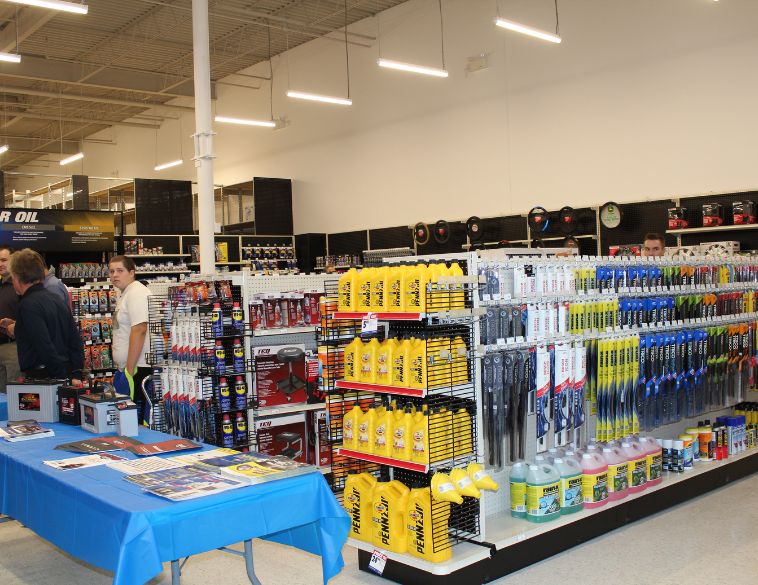
There are still great opportunities in the auto parts distribution business. (Credit : Shirley G. Brown)
An interview with Colonial Group’s Stephen Squires, CPA

Recently, the Colonial Group named Stephen Squires, CPA as Vice President for both company divisions—Colonial Auto Parts and APM Limited. A graduate of Memorial University of Newfoundland, Stephen holds two Bachelor’s degrees—Commerce Cooperative and French as well as being a Chartered Professional Accountant (CPA).
Squires started working with the Colonial Group in July 2022 as Manager, Special Projects where he was involved in the review and assessment of system documentation, policy programs as well as new projects planned for the Colonial Group. With the recent retirement of Philip Murphy, the Colonial Group’s Vice President, Stephen has taken over duties previously handled by Philip. Now part of the Colonial Group’s Executive Management team, Stephen operates out of Colonial’s head office in St. John’s. Recently Autosphere had the opportunity to interview Stephen, asking him about getting involved in the industry, his thoughts about where the businesses is headed, what advice he would give to young people considering a career in the aftermarket as well as some of the realities versus myths surrounding the business.
Autosphere: Can you tell us a little about how you got involved in this industry?
Stephen Squires: While I was by no means forced into the industry; avoiding it completely was not exactly possible with my grandfather and both of my parents being involved in the family business. As I grew up, time was often spent at the store and travel often had business elements where I would meet industry partners. Once I was old enough, summer breaks meant working in the warehouse or out delivering parts to garages. So, while I was not forced into the industry it was probably a bit preordained.
AS: Was there anything in particular that drew you to the aftermarket and the distribution side?
SS: Growing up I saw many positive aspects of the industry which I still see today. The industry is much more relationship driven than it is transactional. While I think this has reduced some over the years with the reduction of independent owners and Canadian sales staff, by no means do I see it disappearing going forward. I believe that being able to develop relationships with customers and suppliers is much more enjoyable than a sale always being about the dollars and cents. I also consider it to be a very interesting industry; there can be a lot of variety in the day to day and it is an industry that is going to continue to evolve and change over the coming years so there is always something new to consider and the job is not monotonous.
AS: What do you feel has been the most invaluable thing you’ve learned so far?
SS: One of the more important things I have learned in my brief time in the industry is that it is a long road, and it is always important to try and maintain good relationships because you never know when you might need someone down the line. It is incredible how many times I have heard people say that they won’t do business with a company or a person because 30 years ago they felt that they had been done wrong. Even if the company has been sold three times since then and 90% of the people have turned over, as far as they are concerned there is nothing that could be changed for them to be willing to do business with them again. Ultimately everyone is in it to do well for themselves and sometimes you need to make changes, but you never know what will happen in the next 5, 10 or 30 years so it is always important to treat people with respect and maintain the relationship.
AS: What do you think is one of the biggest misconceptions regarding the industry?
SS: I think there is a stigma around the automotive industry as a whole for young people which is unwarranted. People see being a mechanic as a dirty job where you will have trouble doing well and this stigma tends to extend into the rest of the automotive industry. Growing up, and since starting a career in the industry, I have spent a lot of time around people who have made good careers in various areas and many of them have done very well for themselves. Despite the stigma surrounding the industry, people can be very successful in any sector of the industry.
AS: What advice would you give to young people considering a career in the automotive parts sector?
SS: I think showing young people that they can succeed and make a career in the automotive industry is incredibly important as the demographics skew heavily towards older men and while there will of course be changes to the industry moving forward, it is certainly not going to disappear and young people are going to have to enter the industry to fill the void that will be left when people retire.
AS: What do you feel is most challenging working the aftermarket distribution sector?
SS: Having an older workforce does carry some benefits in that there are a lot of people who can provide guidance to the next generation and advise how to move forward in the industry; however, it does also have its drawbacks. An older workforce means that people do things how they have always done it. This means that a lot of technological benefits that people could avail themselves of are ignored, which is one of the more frustrating parts of the job. Technology should allow people to automatically make decisions in the most efficient way possible, but I have found that frequently people will do things in the way that they always have simply because “that’s how we do it”. In general, the industry falls short when it comes to technological advancements and doesn’t encourage those in the industry to improve their existing way of doing business by adapting. This does however present opportunities for young people to enter and use it to their benefit.
AS: Is there anything else you’d like to share regarding your business and the industry at large?
SS: Ultimately, I hope that people see the industry as a viable career option and people who are currently in the industry need to do their best to communicate this. I am excited to continue to move forward in my career in the automotive industry and I am interested in seeing where the future will take it.


JOBS
 |  MONTRÉAL MONTRÉAL Full time Full time |
| MONTRÉAL Full time |
 | MONTRÉAL Permanent |
 | BOISBRIAND Permanent |
 | DORVAL Full time |