
Modern Alignment Considerations
Autosphere » Mechanical »
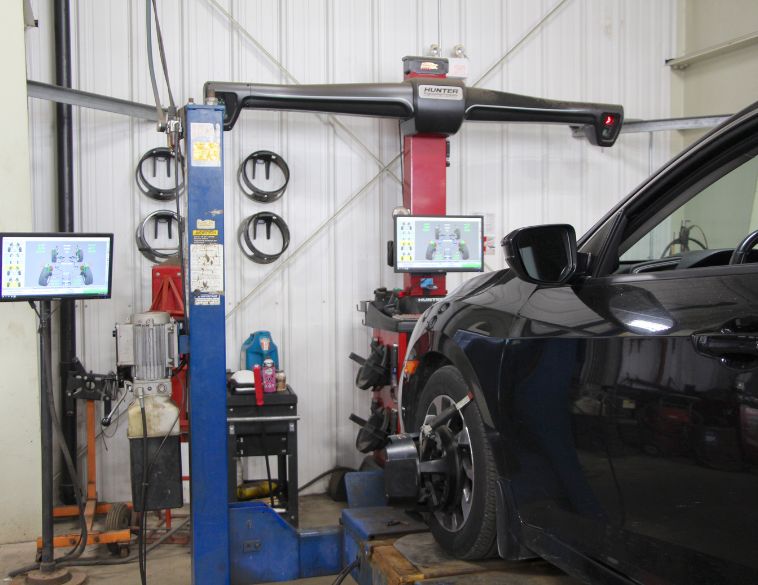
Modern vehicle alignments are complex, requiring calibration and precision adjustments. (Credit : Huw Evans)
It’s no longer a case of performing simple wheel and steering angle adjustments.
Vehicle technology has changed considerably over the last decade, which means automotive service providers have had to change the way they approach the vast majority of maintenance and service tasks. Alignments are a good example.
“Ten years ago, vehicle alignments were still relatively simple,” explains Anil Kumar, who owns and operates Midas Barrie Mapleview in Barrie, Ont. “In most cases the geometric angles were set, and it was relatively straightforward to do alignments.” He notes that today, with late-model vehicles, things are different.

More involved
“Newer cars and trucks have a lot of electronic systems, so it’s not just about setting the angles anymore, you also have to know how to perform calibrations and ensure the sensors relearn where the precise angles are.” He notes that the process is much more involved, and the shop and the technician performing the work needs to ensure that calibrations are accurate, and all sensors are performing as the OEM intended.
Kumar says that in some cases, a modern four-wheel alignment can take up to half a day to perform, and it’s important that customers realize what’s required to properly perform one on their vehicle.
He says that can still prove a challenge, since there is a consensus that performing wheel alignments is a relatively simple (and therefore inexpensive and not lengthy task), when in reality, that’s not the case.
Importance of services
John Baker, Training Specialist, North American Equipment for Snap-On, notes that while today’s consumers tend to be price conscious, service centres need to emphasize the importance of performing services such as alignments. “Improper vehicle alignments can cause many unsafe issues, such as pulls or drifts, and of course, excessive tire wear,” says Baker. Additionally, he notes that those shops that don’t provide proper alignment correction services are also giving away valuable gross profit. “Not only will they make money on the alignment adjustment,” states Baker, “but they will also earn additional income from inspecting the vehicle’s undercarriage, including shocks, struts, springs and all suspension components, as well as brakes, engine/transmission oil leaks etc.”
Baker says that service centres today should perform an alignment pre-check on every vehicle that comes into the shop. He notes that pre-checks, performed by using machines like the John Bean V2380, V3300 and V4400, takes less than 60 seconds and are highly effective at building transparency between the customer and the shop—enabling the service centre to not only educate the customer about the benefits of safety and what can result from premature tire wear due to improper wheel alignment—but also provide the opportunity to increase alignment profit and service retention among its clientele.
Additional tasks
At the shop level, Anil Kumar says that when performing alignments today, there are often additional tasks even beyond fundamentals such as setting the toe angle; camber/caster, and right height. Advanced Driver Assistance Systems (ADAS) are so prevalent on late-model vehicles that, the process of performing calibrations can include tasks such as removing the front bumper and grille assembly to access a radar sensor or front mounted camera. Even something simple, like replacing a headlight can throw off the calibration, requiring the vehicle to relearn the correct positioning and distance. If not, when the customer leaves the shop and drives the vehicle, all sorts of issues can result, potentially endangering them and other motorists, including improper functions of features such as active brake assist or adaptive cruise control.
Customer communication
That’s why he says, it’s imperative the customer understands what’s required to ensure their vehicle is properly aligned and calibrated and the steps the shop needs to take to do the job properly.
Additionally, Kumar says that when a pre-check is performed on the vehicle and wheel alignment is off, an inspection of the chassis and suspension can reveal where some of the issues lie. He notes that if something like a ball joint needs to be replaced, that the customer understands what’s involved, and what it will cost. “A lot of newer vehicles use lighter weight or aluminum control arms,” Kumar explains. “In many cases, if the ball joint is bad, we’ll need to replace the entire control arm, and the customer needs to understand that it’s not the same as it was 20 or 30 years ago where often, you could just remove and replace the ball joint.”
Procuring equipment
Given how quickly automotive technology has and continues to advance, having the right equipment to properly maintain and service today’s vehicles is imperative. Yet there are a range of factors to consider. Anil Kumar notes that, from a shop perspective, it’s important to understand your customer demographic, the types of vehicles they drive and that your shop tends to frequently service. “If you find your clientele drives a lot of relatively newer vehicles, it makes sense to have equipment that can work with these vehicles,” Kumar explains. Not only that, but he says it’s critical that your staff are fully trained to operate it, since the best equipment in the world is useless if you don’t have people who know how it works or how to leverage it to its fullest potential. The equipment and process also need to be fully integrated into shop operations, so service centres can maximize revenue opportunities, as well as ensuring the customer receives timely and easy to understand reports that shows the condition of their vehicle, what needs to be done to it and why.
At Snap-On, Daniel Baker notes that modern alignment systems, like those offered through John Bean, are tied into calibration workflows, or at the very least, equipped to provide ADAS-compatible measurements. Speaking of ADAS, Baker says that different shop layouts, staffing and other factors, will require different alignment systems, so it’s important that service centres purchase the right equipment specifically for their own requirements. “These can vary from wireless drive-through, to tilt-beam, portable units, imaging diagnostic systems, etc., so shops with varying space, volume and personnel skill levels can pick what matches their specific needs.”


JOBS
 |  MONTÉRÉGIE MONTÉRÉGIE Full time Full time |
 | DOLLARD-DES-ORMEAUX Permanent |
 | VAL-DAVID Full time |
 | CHÂTEAUGUAY Full time |
 | LAVAL Permanent |