
Enhancing Fixed Ops
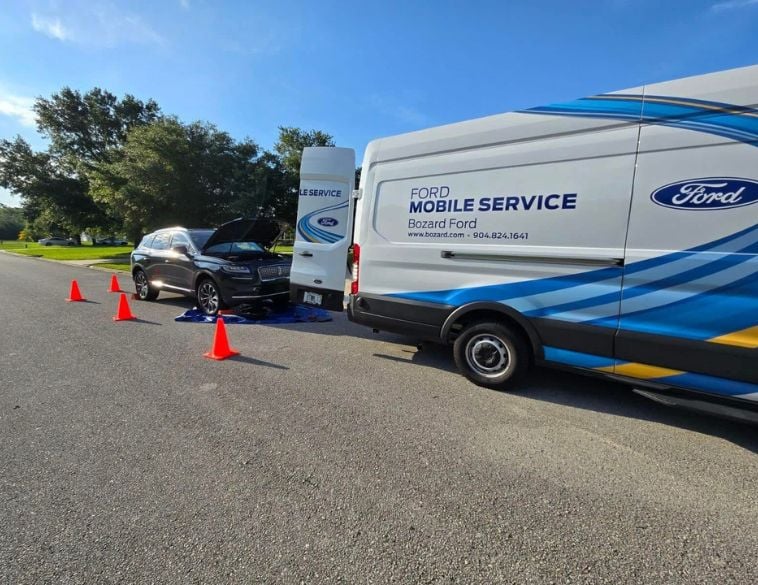
Mobile service can be a game changer for dealer fixed operations, expanding capacity and building retention with customers. Credit: Ford Motor Company
Mobile servicing is a potential game changer for dealers
One of the key questions often facing dealers, is how to enhance fixed operations. As new vehicle sales have become impacted by a range of different factors ranging from the Great Recession, to the COVID-19 pandemic and more recently, tariffs and trade disputes, finding a way to bolster revenues and grow customer loyalty has become ever more paramount.
On the fixed ops side, strategies and tactics that focus on enhancing the customer experience and bolstering retention have become key drivers for many automotiveretailers.
“With mobile service, dealers can offer additional capacity without investing in new or expanding existing brick and mortar facilities.”
– Kim Saylor, Senior Director of Fixed Ops Products Marketing at CDK Global
All-time high
Recently, JD Power released findings from its 2026 Canada Customer Service Index Study. The survey revealed several interesting statistics. One, is that average dealership service spend has risen to an all time high of $566 and that while dealers currently capture 49% of all service visits and 635 of overall vehicle service revenue, actually visit frequency from customers remains unchanged.
One reason for this is a stagnant vehicle parc, which currently, is restricting overall growth in automotive servicing in Canada. J.D. Ney, Managing Director for JD Power in Canada, notes that today, the opportunity in fixed ops is less about relying on market growth but rather, earning customer trust and loyalty through the quality of the service experience.
One way dealers are increasingly doing this, is taking a different approach to fixed ops, such as offering solutions like mobile service. According to Kim Saylor, Senior Director of Fixed Ops Products Marketing at CDK Global, from a customer perspective, “mobile service removes one of the biggest barriers to vehicle maintenance,” —namely the need to schedule a service appointment and drop the vehicle off, frequently during a busy work day or week. With mobile service, that barrier essentially falls away. “Customers can have routine maintenance performed at home or work, eliminating travel time, waiting rooms, and disruptions to their day,” explains Saylor.
Value of convenience
This she says, aligns closely with CDK’s own research, which clearly demonstrates that today, customers place a high value on convenience, transparency and communication throughout the automotive service experience.
She says that with mobile servicing, there’s a real opportunity to strengthen customer retention, increase loyalty within fixed ops and capture work that might otherwise end up in the hands of independent service centres. Saylor also notes that mobile servicing enables dealers to extend their reach beyond the traditional fixed ops realm of physical service bays inside the store. “With mobile service, dealers can offer additional capacity without investing in new or expanding existing brick and mortar facilities,” Saylor explains.
She also says that with mobile service, dealers can offer a robust entry point for building customer relationships that drive future service calls and in turn, that can also lead to future vehicle purchases. “I’ve seen dealers leverage mobile service opportunities by partnering with local used vehicle dealers to complete outstanding vehicle recalls,” notes Saylor. These kinds of tactics not only create incremental service opportunities, but also expand relationships beyond that which can lead to other business down the road.
Highly challenging
While on paper, mobile service represents a great opportunity, the challenge can lie in the execution. “Dealers must in vehicles, tools, and scheduling processes,” she says. And with many dealer service departments currently dealing with technician shortages and often, competing priorities, this can make it highly challenging to dedicate specific resources, particularly for a new and unproven business model.
At JD Power, the recent Canada Customer Service Index Study showed that the most highly ranked and successful brands in the survey did a few fundamental things. Firstly, they have a very consistent process when it comes to the customer experience. Secondly, they execute on the basics very effectively and they do so for EVERY service occasion. “That said,” explains J.D. Ney, “it’s worth noting that the top scoring brand within the entire study is from the aftermarket.”
At CDK, Kim Saylor recognizes that with solutions like mobile service, dealers have a real opportunity to up the game, since this approach can highly personalize the vehicle service experience for customers, which can remove some of the friction and the traditional barriers, that have caused dealer fixed ops departments to struggle on the retention side, particularly once the new vehicle warranty expires.
Postive experiences
“With mobile service, the dealership comes directly to the customer, creating a higher-touch experience that can build trust and strengthen relationships,” says Saylor. She notes that CDK research consistently points to communication, transparency, and customer experience as major drivers of satisfaction and loyalty. “When service is convenient, transparent, and personalized, customers are naturally more likely to report positive experiences.”
So what does all this mean going forward? One that while mobile service definitely presents a big opportunity, it needs to be part of a dealer’s overall fixed ops strategy focused on customer retention, instead of just a standalone program.
Secondly, in order for mobile service to work effectively within that context, it also needs to ensure that technicians that perform this type of work are uniquely trained to do so. “Mobile technicians need a different skill set than traditional shop technicians,” states Saylor. “In addition to technical expertise, they’re often operating independently and interacting directly with customers. That means communication skills become just as important as technical abilities.”
Additionally, dealers also need to carefully consider which services can be effectively performed via a mobile solution. Typically, says Saylor, mobile service tends to work well when technicians are performing things like routine vehicle maintenance, recalls and software updates. Additionally, she has seen dealers effectively leverage mobile servicing by using it as a pre-diagnostic tool. In other words, using it as a platform for technicians to identify issues with the vehicle before it arrives at the dealership’s service department. “This helps reduce time in the service bay, improves repair planning, and ensures any necessary parts can be ordered in advance.”
The communication piece
Along with actual service process itself, clear, concise communication is essential. “Scheduling and communication are equally important,” says Kim Saylor. “Advisors, technicians, and customers must remain connected throughout the process.” She explains that customers need real-time updates, clear expectations, and transparency regarding timing and services performed.
At JD Power, J.D. Ney notes that effective communication and retention needs to start early, when the dealer’s customer brings their new vehicle in for service during their first year of ownership. He says that data consistently points to the fact that the type of experience that vehicle owners receive within that first year tends to influence where they take their car for service and maintenance work. “If you’re waiting for the warranty to expire before you start working on your service retention strategies, you’ve already lost a significant amount of potential business,” he says.
Tags : CDK Global


JOBS
 |  BROSSARD BROSSARD Full time Full time |
 | BLAINVILLE Full time |
| BROSSARD Full time |
 | LAVAL Permanent |
 | MONTRÉAL Full time |