
A Passion for British Beauties
Autosphere » Collision »
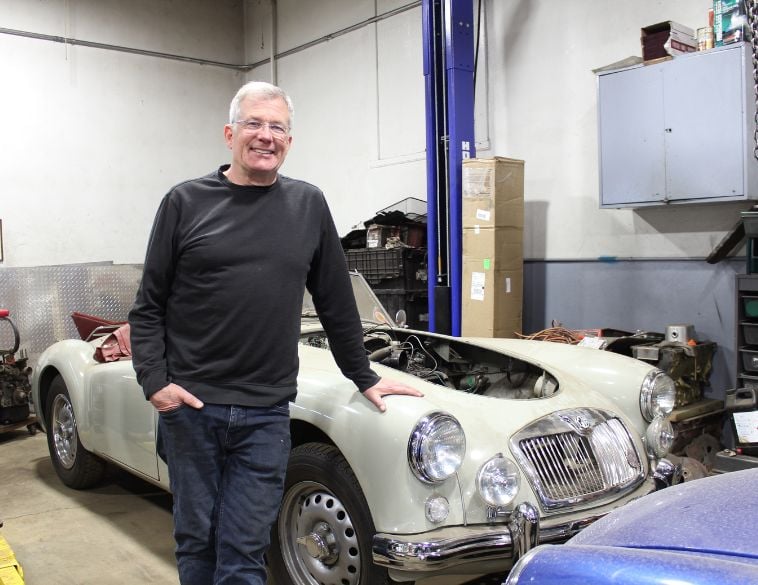
Fifteen years of high-level rallying, from Canadian championships to the X Games. Nichols didn’t just restore cars; he pushed them to their absolute limits. Credit: Isabelle Havasy
Some passions are born in books, while others are forged in the smell of motor oil. Jon Nichols’s passion undeniably belongs to the second category. Now in his sixties, the Lachine-based British car restorer still carries the same quiet smile he’s had for decades, wearing the look of someone who figured out exactly where he belonged early in life, almost by accident.
It all started on two wheels.
Nichols grew up in the West Island before his family relocated to NDG when he was about twelve. To see his friends back in Pointe-Claire, he would hop on his bike and pedal down the old Route 2 along the St. Lawrence River. On one of those trips back and forth, something on 21st Avenue caught his eye. There were MGs, Triumphs, and Jaguars parked all around a small garage, and this sea of rusty metal and tarnished chrome instantly fascinated the young boy.
The shop’s owner was Ron Ward. An older British gentleman and the son of a Royal Air Force mechanic who immigrated to Canada after the war, Ward had practically grown up in automotive shops. He ran a British car dealership until the late 1970s, when the arrival of Japanese imports swept away small independent importers, prompting him to transition into service and repair. A somewhat easygoing character, he liked to take his time, roll in late in the morning, sip his coffee, and host his friends at the shop. His garage was by no means a booming business. But it didn’t matter; it was more of a sanctuary.
Nichols started hanging around. Once, twice, and then regularly.
Where everything goes right
At school, Nichols wasn’t what you would call a good student. Dealing with undiagnosed ADHD and disappointing report cards, his family of engineers didn’t know what to do with the restless boy. “They all looked at me wondering, ‘What are we going to do with him?’ And everything I did was wrong.” In the old man’s garage, it was the exact opposite. “Everything I did was right. I was trying to understand: how is it that over there everything is wrong, but here everything is right?”
Nichols wouldn’t put the answer into words until much later. Ward had empathy. A rare kind of empathy that recognizes a person’s worth before they even see it themselves. Without ever saying it out loud, the quiet mechanic gave this hyperactive young boy what school had denied him: the opportunity to excel at something.
Nichols eventually went to work for him. It wasn’t so much a formal job as it was a steady presence, offering a helpful set of hands through an informal mentorship that stretched over several years. He didn’t finish high school, but when he left that garage at night, he took the language of engines with him, learned straight from the source.
In fact, it was from Ward that Nichols bought his MGB. This car has been by his side through the decades. Forty years later, it’s still on the road. Every year, it goes back on the track and continues to rack up victories, as if time had merely added layers of patina without taking away any of its edge.
Nichols’s career path was driven by resourcefulness and sheer stubbornness. After his time at Ward’s garage, he worked at a Jaguar dealership, followed by an independent shop specializing in British cars. When that shop abruptly closed its doors without warning, a neighboring tenant slipped him a spare key and suggested he retrieve the clients’ cars, which had been left half-disassembled inside the locked building. Nichols was only 20 years old. He had no shop, no money, and no real plan, but he did it anyway without asking too many questions.
He called the clients one by one and tracked down a makeshift space to house their rides. He then opened his own shop in a shed in Sainte-Anne-de-Bellevue. He slept on-site for a year because he couldn’t afford a separate rent, surviving on pizza from the restaurant next door. Later, he found a space in Pointe-Claire, inside an old stable that had once served as a relay station for horses on the road to Toronto. He worked there until 1990.
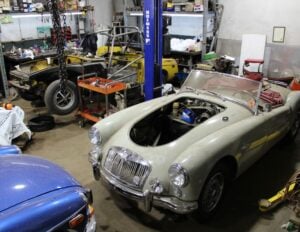
Finding his way
It was there in Sainte-Anne-de-Bellevue, and later at the Lachine shop that Ward handed down to him before officially retiring, that restoration became his true calling. He welded floorboards, prepped bodies for paint, and resurrected cars that nobody else wanted to touch. “I must have restored 50 or 60 of them in those years,” he says. “And the demand was there.”
Today, Nichols operates out of an 1890 red-brick building in Lachine, a property he purchased back in the early 2000s. Restoring old British cars was never a calculated business move. Instead, it was the natural, almost inevitable progression of a journey that began the afternoon a kid on a bicycle spotted some MGs parked on a Lachine avenue and decided to take a closer look.
What Ward passed down to him, beyond welding techniques and the mysteries of the B-Series engine, was a way of approaching a machine. Not from the surface, but from the inside out. “I’ve always built my own cars, which gave me an advantage because I genuinely understand them.”
This knowledge isn’t learned in a manual. It is passed down by an easygoing old Brit in a garage filled with the scent of motor oil and coffee.
Tags : Jon Nichols


JOBS
 |  DORVAL DORVAL Full time Full time |
| ST-HUBERT Full time |
 | MONTRÉAL Permanent |
 | SASKATOON Full time |
| MONTRÉAL-NORD Permanent |