
Planning for the Future
Autosphere » Collision »
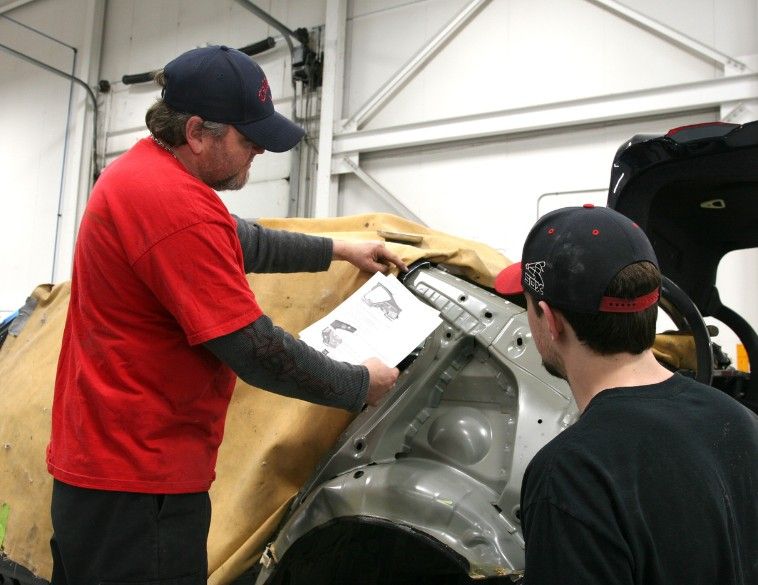
Effective mentorship programs ensure long term success for collision centres. Credit: Huw Evans
Good mentorship programs are one of the keys to long-term success.
In an age of laser focus on shareholder value, mentoring company juniors may seem at times to have taken a back seat, if not entirely falling off the radar. At the same time, a good mentoring program could help secure the very survival of a business.
Ever since the first wave of baby boomers who ran and owned businesses began nearing retirement age about a quarter century ago, the prospect of succession and planning for the future came into increasingly sharp focus for many. Everyone who has given the matter some thought agrees that a strong, comprehensive succession plan brings stability to any business and in the case of collision repair, it’s an essential for profitable continuity.
Critical role
Mentoring new recruits to the business can have a critical role in the process. “When we invest in young technicians, we’re not just filling a position, we’re building the future workplace our shops will rely on. Junior technicians who are supported, mentored and given a clear path for growth often demonstrate exceptional loyalty. When they see that the company is invested in their success, they buy into the culture and stay long-term.
Providing structured training and up-skilling opportunities pays real dividends,” says Jeff Francis, Western Canada Technical Trainer at Fix Network. Besides strengthening overall capabilities of new technicians and their speed and skill levels in a range of shop tasks, structured, quality mentoring boosts their engagement and forms the foundation of an effective retention strategy, Francis says.
Given the potential benefits of mentoring, the value of an approach likely to deliver results is not lost on the industry. Like Francis, Aaron Hebb, Services Consultant, Eastern Canada, at AkzoNobel Coatings Ltd., advocates a structured approach. “The best mentoring is usually structured, consistent and personal. Pairing a new employee with a single mentor tends to avoid mixed messages, while clear 30, 60, and 90-day plans provide direction, accountability and measurable progress. Strong on-boarding is also important to ensure the shop’s culture, standards and expectations are set from day one. From there, real-time feedback and coaching help shape habits quickly, correct issues early and build confidence over time,” he says.
If we fail to properly develop the next generation of skilled technicians and administrative team members, we weaken the future workforce our business will depend on. – Aaron Hebb, Services Consultant, Eastern Canada, AkzoNobel Coatings
Positive experience
A willing senior technician who receives the tools and support needed, can help make the mentoring process a positive experience for both mentor and apprentice. “It’s also important that we don’t place the entire burden on the senior technician. When a new apprentice comes in with no tools at all that can strain the relationship,” explains Jeff Francis. “A practical solution I’ve seen work well is providing the new technician with an entry-level tool box and basic hand tools, with the understanding that they become theirs after a probationary period. It sets them up for success, reduces friction and shows both parties that the company is committed to supporting the mentoring process,” Francis says.
He advocates that as a general rule, it is best that shops don’t assign more than one apprentice or junior technician for mentoring per senior technician.

So how well prepared can a small collision repair shop be for running a successful mentoring process? “A small shop can absolutely mentor up-and-comers. In some ways, a small shop can even offer an advantage to the person being mentored,” Hebb says.
In this scenario, a young apprentice is perhaps more likely to have exposure to various team members across multiple activities and disciplines. Communications tend to more direct and feedback quicker and more consistent. But in a small shop, especially, scheduling mentor and apprentice work sessions together, on an optimal basis, can require some astute and careful navigation. “The challenge is that in many shops, the mentor is one of the main producers. For mentoring to work well, the shop has to be intentional about balancing production needs with the time and attention required to develop the next person properly,” Hebb says.
Dividing the work
One way to do this, in a smaller shop where the senior tech/mentor is also a team leader, he says, is to divide the work on a job for the apprentice and mentor between easier and more difficult tasks, respectively.
Francis is in broad agreement, saying that there really aren’t any limitations on shop size when it comes to mentoring a junior technician. “What matters more is the compatibility or chemistry between the mentor and mentee and the level of patience and support the shop can provide.”
Clearly, the right fit between mentor and apprentice in the shop is important. Not every great technician is going to be a great mentor. Technical ability and teaching, most would agree, are not the same thing. “The wrong mentor can do damage. A new hire can learn bad habits, a poor attitude, shortcuts, or unsafe behaviour just as quickly as good outcomes. Mentoring should include culture, not just craft. It’s all about leading by example. Show up on time, communicate effectively, stay organized, respect OEM procedures, prioritize safety and take pride in the repair. Those are some of the traits that need to be passed on through a good mentorship program. A mentor should be a really good role model.” Hebb says.
Solid outcomes
Francis shares Hebb’s view on the potential role of a good shop culture in fostering good mentoring program outcomes. “Teamwork, rather than individualism, amongst technicians lends itself to the healthy progression of a junior tech’s knowledge. Junior techs need to feel like they are part of the team and not a burden. They will make mistakes, but that’s how we all learn,” he says.
Another challenge to spending the time and money on mentoring is an industry tendency to focus on the immediate, aka short-term, costs of mentoring, including the costs stemming from the probable production loss from instructing and training an apprentice. Those costs are real, but they are only part of the picture, Hebb says. “From both a shop and an industry perspective, we need to look further down the road and understand the much greater cost of not investing in mentorship. If we fail to properly develop the next generation of skilled technicians and administrative team members, we weaken the future workforce our business will depend on. That’s where the true cost lies. When you look at it that way, the upfront costs are significantly less than the long-term costs.”
Looking at the big picture, which includes the short, medium, and long-term, it’s about seeing a mentoring program as an investment instead of just a cost of a doing business.
Common mistakes
In their advocacy of structured mentoring, both Francis and Hebb are strongly in favour of avoiding what Hebb refers to as the “common mistake” of failing to assign one lead mentor to a junior tech but, instead, expect all the staff to do some mentoring in a sort of undefined way—which most would agree sounds like a set-up for mixed results at best.
For those who worry about investing in mentoring because of fears about the cost of turnover, both Francis and Hebb regard mentoring as a retention tool and part of a shop culture that welcomes “Why?” questions, sees mistakes as coaching moments, includes some staff barbecues and free lunches now and again – and enjoys good leadership from the top down. Good mentoring, they suggest, can be a key ingredient in good shop morale.
“In reality, mentoring never truly stops. Even senior techs are continuously learning, expanding their knowledge base, and adapting to new repair methods and technologies. While the junior technician becomes more self-sufficient over time, that ongoing exchange of knowledge remains a core part of the shop’s culture and professional growth,” Francis says.


JOBS
 |  DORVAL DORVAL Full time Full time |
| ST-HUBERT Full time |
 | MONTRÉAL Permanent |
 | SASKATOON Full time |
| MONTRÉAL-NORD Permanent |