
An Automotive Coating That Reduces Heat
Autosphere » Collision » Editorial »
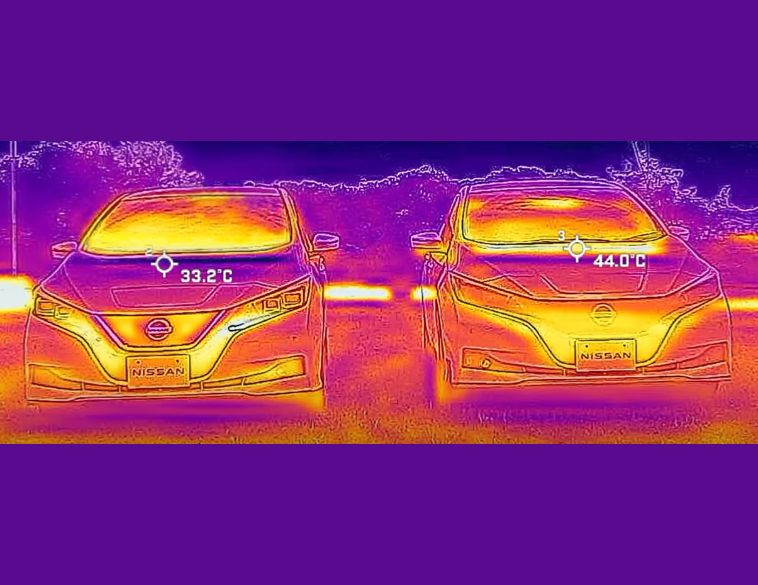
The coating significantly reduces cabin temperature. (Credit : Nissan)
In a previous column, I talked about an experimental Nissan finish that kept a car clean thanks to nanotechnology. By creating tiny particles on the vehicle’s surface, it generated a texture invisible to the naked eye. This process reduced the contact area for contaminants, preventing them from sticking. Nissan is now introducing a finish that helps cool down vehicles.
Working in collaboration with Radi-Cool, a specialist in radiant cooling materials, Nissan recently tested a finish that incorporates synthetic compounds with a structure unlike anything occurring in nature. It is made up of two particles that react to light.
The first reflects UV rays, while the second generates electromagnetic waves that redirect the sun’s energy away from the vehicle. Together, they lower the vehicle’s surface temperature. This type of finish isn’t new in itself, as it is already used in architectural coatings.
However, those tend to be very thick and need to be applied with rollers. They also leave behind a powdery residue to the touch. The challenge was to create a finish that could be applied with a spray gun and then sealed with a clear coat for protection.
A Nissan NV100 van belonging to ANA (All Nippon Airways) was painted white with this new finish and put into service at Tokyo’s Haneda Airport for a 12-month trial. An airport terminal is the ideal place to test the technology, since it offers little shade and consistently high temperatures.
The results were impressive, especially for a vehicle parked in direct sunlight for long periods. The coating reduced the roof temperature of the van by 12°C and lowered the cabin temperature by 5°C compared to another white van parked next to it without the experimental finish.
Beyond a cooler cabin, the reduced need for air conditioning upon startup eases the load on the engine and also slows battery drain in electric vehicles.
The finish was also lab tested and successfully passed tests for saline exposure, chipping, delamination, scratches, chemical resistance, colour retention, and repair feasibility.
The main drawback at this stage is the thickness of the finish (120 microns), which is six times greater than coatings currently on the market. This remains a challenge for large-scale commercial application. The initial target market would be delivery vehicles and ambulances that spend long hours on the road.
Like every other component in modern vehicles, coating technology continues to evolve.
Readers can watch a video on this application at the following address.

JOBS
 |  MASCOUCHE MASCOUCHE Permanent Permanent |
 | GRANBY Full time |
 | RIVE-SUD DE MONTRÉAL Permanent |
| SALABERRY-DE-VALLEYFIELD Full time |
 | ONTARIO Full time |