
China is not the Solution

Peter-James Gregory. Credit: PJG
Assembling Chinese EVs in Canada will not save our auto manufacturing base.
In 2022, President Biden signed the “Inflation Reduction Act” (IRA), providing billions of dollars in subsidies for EVs and the EV supply chain, tipping the scales of North American EV manufacturing in favour of America. Biden’s IRA was designed to bring manufacturing back to America. Biden said “Make more cars and semiconductors in America. More infrastructure and innovation in America. More goods moving faster and cheaper in America … And instead of relying on foreign supply chains, let’s make it in America.”
This ignited a “subsidy war” with the Canadian Government offering billions to keep Canadian auto manufacturing competitive against the hegemonic spending power of Washington and cheaper costs in Mexico. Canada offered huge subsidies to entice auto manufacturers to retool Canadian plants to produce EVs and to entice new EV battery plants to be built in Canada.
Cancellations, delays and bankruptcies
The results? An EV battery manufacturer bankruptcy; cancelled EV battery production at a battery manufacturer; “suspended”, cancelled and “delayed” EV battery plants; “indefinitely suspended” EV auto manufacturing plant; cancelled plant retooling for EV manufacturing; plus “idling” and closure of auto manufacturing plants.
Chasing the “EV future” has cost Canada, and Canadian taxpayers, billions of dollars, weakened our auto manufacturing base, and wiped-out jobs. In effect, Canada paid a lot of money for a big fat failure.
A critical factor in this big fat failure was that U.S. demand for EVs fell dramatically. The predicted acquisition of U.S. market share by EVs did not materialize. Regardless of the type of vehicles produced, Canadian auto manufacturing cannot be viable without sales to America.
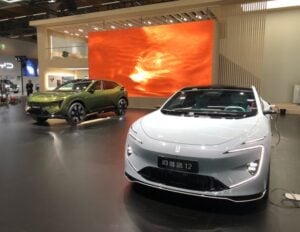
As Chinese EVs are basically banned from the U.S. market, and our domestic market is rather small, why would Chinese EV manufacturers establish factories in Canada? Furthermore, due to the huge subsidies provided by the Chinese Government for EV factories in China, subsidies Western Governments cannot match, there is massive EV manufacturing overcapacity in China. Why would they sit on this overcapacity and establish a manufacturing base in Canada to serve a small market?
Chasing the “EV future” has cost Canada, and Canadian taxpayers, billions of dollars, weakened our auto manufacturing base, and wiped-out jobs.
– Peter-James Gregory
No business case
There is no business case for manufacturing in Canada to service Latin America, as they can do it cheaper in Mexico or Brazil. Also, the product screen for Latin America is significantly different from Canada’s product screen. It leans heavily towards small budget friendly vehicles, sub-compact cars, small SUVs (Google Suzuki Jimny) along with sub-compact and compact pick-up trucks (Google Fiat Strada pickup, the top selling pickup in Brazil).
Brazil’s auto market is roughly 2.55 million vehicles annually versus Canada’s 1.9 million. Brazil’s auto market is growing, +19.5% in 2026 versus Canada at -0.4%. Brazil produces some 2.6 million vehicles annually, more than double the number produced in Canada. Looking at the Brazil scenario, why would any auto manufacturer establish production in Canada to supply Latin America?
Europe is not a viable market. A Chinese manufacturing base already exists, with BYD in Hungary, Chery and Leapmotor in Spain and Xpeng and BAC in Austria. With the EU losing auto manufacturing jobs (planned cutbacks at Volkswagen Group and others), the EU will be protecting jobs, including “replacement” jobs, on home soil. They will not help Canada despite all the talk of an “Associate Membership”.
Chinese EV manufacturers may establish small plants to assemble knock-down kits supplied from their factories in China for Canadian consumption. This will not save Canadian auto manufacturing. It will undermine existing Canadian auto plants and provide very little business, if any, to the Tier 1, Tier 2 and Tier 3 parts and component manufacturers in the supply chain. It will just be another big loss for auto manufacturing in Canada.
Tags : Inflation Reduction Act


JOBS
 |  SAINT-HUBERT  Full time |
 | LAVAL Full time |
 | LAVAL Full time |
 | VAUDREUIL-DORION Full time |
 | SOREL-TRACY Permanent |