
Not a Substitute

Peter-James Gregory. Credit: PJG
The EU will not save Auto Manufacturing in Canada
Auto Manufacturing in Canada is in a precarious position. By now, it should be clear to most that the factories in Canada exist to supply the U.S. market. With some 90% of the production exported to the USA, the loss of duty-free access or low-duty access to the U.S. market will destroy the business case for the continued operation of the existing plants. Without a resolution to the trade issues with the U.S.,, auto manufacturing in Canada (Ontario) may disappear within a decade. The local market is just too small, in both population and disposable income, to support auto manufacturing.
Provisional basis
Under the CETA free-trade agreement, that after 9 years is still only operating on a “provisional basis” (still not ratified by 10 EU members), the EU established a special origin quota allowing 100,000 passenger vehicles built in Canada to enter the EU market tariff-free annually. This is less than the current annual output of Canada’s lowest volume operating auto plant, General Motors’ Oshawa Assembly Plant.
The CETA (Canada-European Union Comprehensive Economic and Trade Agreement), was signed on October 30, 2016, and entered into force provisionally on September 21, 2017. Today, 9 years later, it is still operating on a “provisional basis” as 10 of the 27 EU members have not yet ratified the agreement. This should provide some insight into the “character” of the EU.
Let’s look at how EU auto manufacturers have invested in automobile manufacturing plants in North America.
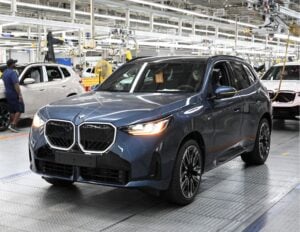
In 1994, BMW opened its first North American plant in South Carolina, USA. South Carolina did not have a major modern automotive assembly plant before BMW opened its plant. The plant is now BMW’s largest factory worldwide and exports approximately 50% of its production to 120 markets worldwide.
“Without a resolution to the trade issues with the U.S.,, auto manufacturing in Canada (Ontario) may disappear within a decade.”
– Peter-James Gregory
Location and global exports
In 1997, Mercedes-Benz opened its first North American plant in Alabama, USA. This was the first major automotive manufacturing location in the State of Alabama. Approximately two thirds of the SUVs produced at this plant are exported to almost every country in the world.
In 2011, Volkswagen opened its plant in Tennessee, USA. This is the second time Volkswagen has opened a plant in the USA, with its previous plant in Pennsylvania operating from 1978 until 1988. While the Tennessee plant was built to primarily supply the USA and Canada markets with market specific models, in its life it has exported vehicles to Russia, South Korea and the Middle East. Volkswagen also has significant production facilities in Mexico. To keep this article concise, I have only listed USA plants and not discussed the Audi plant opened in Mexico in 2016. Also, Mexico has significantly lower operating costs than Canada or the USA.
No previous history
So, despite Canada (Ontario) being an established “auto manufacturing hub” with a long history of large-scale auto manufacturing, none of the major German brands selected Canada for their plants. In fact, two of these manufacturers selected States in the USA with no large-scale auto manufacturing history.
Also, while some 90% of the vehicles built in Canada (Ontario) are exported to the USA, two of the USA plants (BMW & Mercedes-Benz) export a significant percentage of the vehicles they produce to worldwide markets, outside North America. In fact, the BMW plant is the largest USA exporter of vehicles by value.
There is an important story being told here. It’s a true story. It’s an uncomfortable story, but it is reality. If Canada wants to preserve even a part of our auto manufacturing industry (finished vehicles) then we must accept the reality of who we are, and the place we occupy in the “scheme of things” and negotiate and compromise based on this reality.
Tags : CUSMA


JOBS
 |  BOISBRIAND BOISBRIAND Permanent Permanent |
 | DORVAL Full time |
 | LAVAL Permanent |
 | LONGUEUIL Full time |
 | MONTRÉAL Full time |