
The Many Faces of Global Mobility
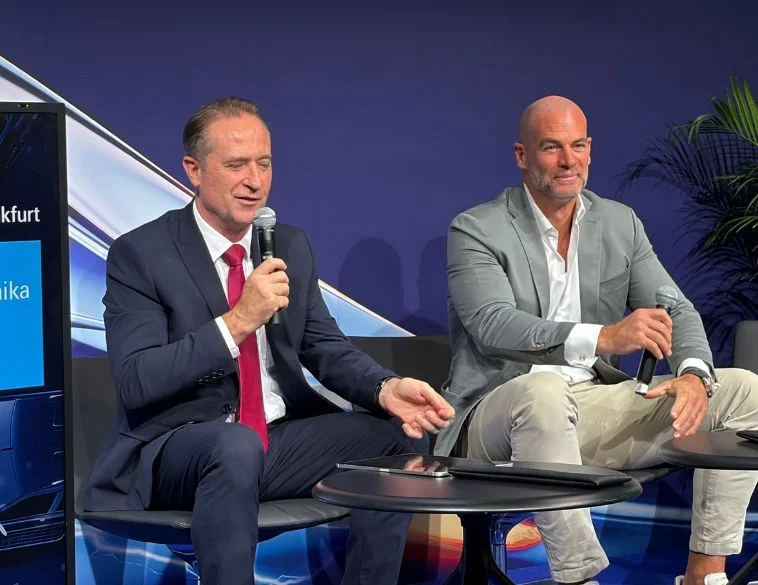
Willem Groenewald of the FIA in conversation with Constantin Gall of Ernst & Young. Credit: Michel Beaunoyer
This past September, a conference at the Automechanika show in Frankfurt examined mobility trends across ten world markets, including North America.
The FIA (Fédération Internationale de l’Automobile) commissioned Ernst & Young to survey ten thousand consumers across ten markets, including North America. The goal was to map out the major global trends shaping mobility today. The FIA is best known for regulating motorsport, but their mandate also covers promoting safe, affordable and sustainable mobility. They carry out this work through a network of two hundred forty-six automobile clubs in one hundred forty-nine countries.
The findings confirm that private vehicles remain the primary mode of transportation. 77% of respondents have access to a vehicle, and 88% use one at least once a month. That high usage rate reflects how people combine different modes of transport: respondents say their choices depend on how efficient, safe and well-suited to their needs public transit actually is. Among those without a vehicle, 55% point to high purchase costs as the main obstacle. Generally, the lower a respondent’s income, the more likely they are to rely on public transit. When it comes to mobility, the study finds that consumers value practical, reliable and safe options over new mobility technologies.
What about electrification?
Ernst & Young estimates that there are currently one point four billion light vehicles on the road worldwide, with electric vehicles accounting for just 8% of that total number. China leads in this category, with EVs making up 21% of its fleet. Their report also found that 35% of battery-electric vehicle owners still own a gas-powered vehicle. “One in two vehicles sold worldwide today may be electric, but the vast majority of vehicles actually on the road still run on gasoline,” says Constantin Gall, from Ernst & Young. He adds that EV adoption rates differ sharply from market to market, largely tracking each government’s political commitment to the green transition.
This transition, he notes, is unfolding more slowly than expected, a pace shaped not only by political will but also by energy availability and infrastructure quality. “Governments looking to encourage EV or hybrid adoption would do better investing in affordable, accessible charging infrastructure than in purchase subsidies,” argues Willem Groenewald, from the FIA.
He also highlights a persistent urban-rural gap: people living outside areas with strong public transit tend to steer clear of EVs, even as they continue to depend heavily on their own vehicles for most of their travel.
Affordability remains the deciding factor
According to the study, the average age of vehicles on the road worldwide has now surpassed eleven years. When it comes time to replace a vehicle, price is still the top consideration, followed closely by brand trust. This explains why buyers often hesitate over lesser-known manufacturers, a hurdle that financial incentives can help clear.
Customers value new technologies but understand they come at a cost, prompting some manufacturers to offer stripped-down models in markets where price outweighs the appeal of extra features. Advanced driver-assistance systems illustrate this tension: most drivers want a safe vehicle, but many are reluctant to pay extra for cutting-edge safety technologies.
Both experts see a mobility market that is fragmenting further. “Ten years ago, everyone predicted the whole planet would be running on electricity by now,” Groenewald recalls. “The reality is far more nuanced. Every market is moving at its own pace, and new solutions keep emerging.”
According to the speakers, this fragmentation will demand real flexibility from automakers going forward. No single vehicle can satisfy every market’s expectations, and what works today may not hold up tomorrow. New players from Asia are only adding to the pressure, reshaping the competitive landscape everywhere.
Tags : Automechanika


JOBS
 |  MIRABEL MIRABEL Full time Full time |
 | STE-JULIE Full time |
| STE-JULIE Full time |
| STE-JULIE Full time |