
The Era of Robotics Takes Root in Collision Repair
Autosphere » Collision »
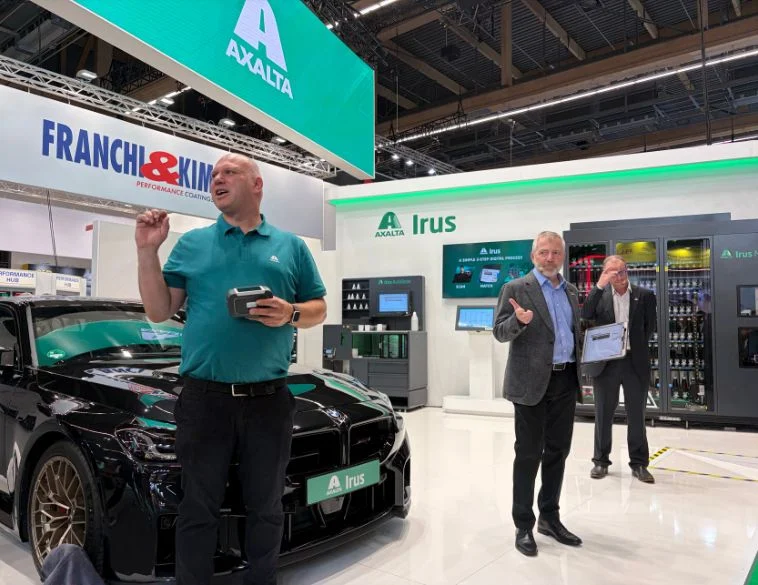
Axalta’s automated paint mixing system during a live demonstration. Credit: Michel Beaunoyer
Invited by Automechanika to its major trade show in Frankfurt this past September, Autosphere observed the key trends driving the evolution of the collision repair sector.
Two major takeaways: labor is scarce and profit margins are slim. Another common observation on the floor at Automechanika is that volumes are down, as is repair severity. Why? Advanced driver-assistance systems (ADAS) are reducing collision severity, when they aren’t preventing accidents altogether. This has eliminated a portion of light repair work on newer vehicles resulting from minor fender benders in commercial parking lots, for example, which used to be bread and butter for collision shops.
The other factor regarding severity involves the sharp rise in repair costs. So much so that a vehicle deemed repairable a few years or even months ago would today be declared a total loss. One German shop owner shared that he rarely uses his frame straightening bench anymore, as vehicles with chassis damage from major collisions no longer make it to the repair stage.
Hello, robot
We have previously covered the gradual rollout of automated systems in collision repair shops. On the show floor at Automechanika, the rapid progress of robots of all kinds was fully confirmed. For now, the solutions offered by equipment suppliers primarily target high-volume shops; the capital investments are substantial and must be offset through optimal utilization.
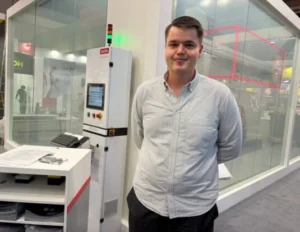
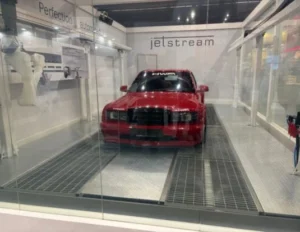
“We estimate the return on investment at about three years,” says David Rau, General Manager of the Automation Division at equipment supplier SATA, during an interview in front of the new jetstream robotic paint booth set to launch on our continent next year. The automated system currently recognizes 4,500 vehicle models, and this database is constantly expanding.
The capabilities of the painter robot are evolving as well, and it will continue learning in order to handle a wider variety of jobs. For now, it cannot handle interior painting or blend work, for example, but software updates will be released as new applications are developed.
“The advantage of this system is its precision and consistency,” Rau explains. “We reduce material waste, whether it’s primer, basecoat, or clearcoat. There is also application consistency, which guarantees identical results every time and avoids re-dos.” Estimates suggest that about a third of shop paint work, from full resprays to individual parts, can be offloaded to SATA’s robotic unit. That figure will rise as software applications expand, allowing shop owners to upgrade the robot’s capabilities simply through software updates.
We asked Rau what a collision refinish technician might think about the arrival of a mechanical replacement. “A replacement? Not really!” he insists. “We look at the scope of application for an automated system like the jetstream . This approach is very attractive to the younger generation of technicians, who are more interested in programming a robot than spending long hours inside a paint booth.”
Addressing the shortage of qualified labor
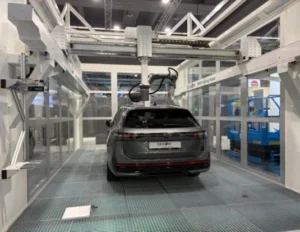
A visit to another supplier revealed that while robotics helps optimize shop operations, it cannot do everything. Nonetheless, German manufacturer SEHON is pressing ahead with projects that pair robotic painters with AI to offset a skilled technician shortage that shows no signs of easing. Even best-case forecasts show that 20 to 30 percent of paint work will still require a human touch.
At SEHON’s booth, representatives added that the automated paint booth is a logical extension of fully automated paint mixing systems.
The right color, every time
Autosphere also had the opportunity to meet with the team from Axalta Coating Systems during a demonstration of their Irus machine. Launched a few years back, the system is now starting to gain traction in shops across the country. Adoption remains selective, however, because the steep initial investment makes it most viable for facilities repairing over 25 vehicles a week.
The paint preparation process takes place in three steps. A spectrophotometer is applied to the vehicle area, matching the color to be reproduced. This measurement is analyzed and cross-referenced with Axalta’s database to identify the corresponding formula. Finally, the recipe required to obtain the desired shade is sent to the dosing machine, which mixes the formula without human intervention. In practice, human expertise is still useful for estimating the volume needed to cover the repair area or panels, even though a digital tool is available to perform the calculation.
Here again, the goal of automation is to free up technicians so they can focus on other tasks while the machine gets to work, reduce waste, and achieve color-matching accuracy that even the most trained human eye would find difficult to match.
The technologies covered in this article align well with a broader consolidation trend across the industry: larger, certified, state-of-the-art facilities or network banners where individual shops focus on specific job types and share advanced equipment to optimize ROI. It is a necessary evolution, especially as repair techniques become more sophisticated and the qualified workforce becomes increasingly scarce.
Tags : Automechanika

JOBS
 |  SAINT-BRUNO SAINT-BRUNO Full time Full time |
 | BLAINVILLE Full time |
 | SAINT-LAZARE Permanent |
 | MIRABEL Full time |
 | STE-JULIE Full time |