
Why Replacement Parts Cost So Much
Autosphere » Collision »
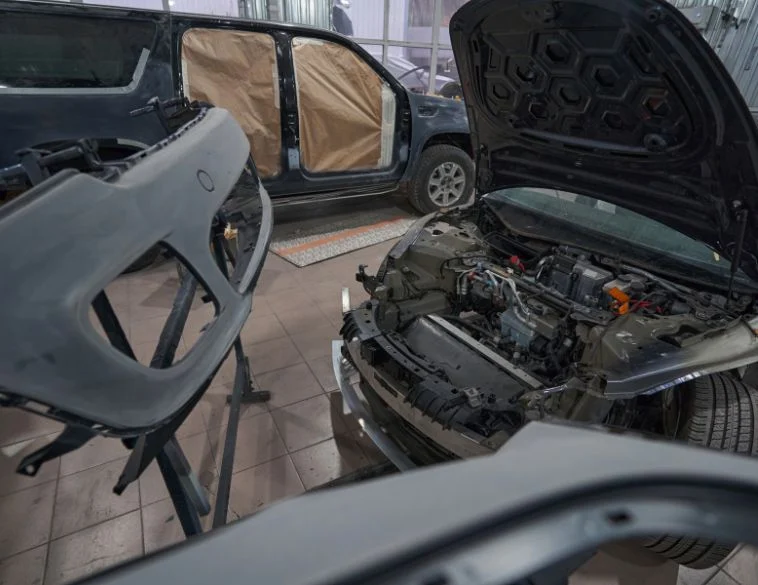
High replacement part costs are impacting the percentage of vehicles deemed total losses following a collision. Credit: Envato
The advanced technology engineered into body parts certainly accounts for their soaring values. However, other factors are at play, and the ripple effects are significant.
Unipièce O.E.M. Backorder Parts Research Manager Patrick Marois is an experienced estimator who is well positioned to witness the dramatic spike in replacement part prices over recent years. He agrees that the increasing complexity of certain components accounts for their rapid price inflation (see our reporter’s article on the subject).
Still, he believes the primary driver behind this sharp price increase is market shifts between supply and demand.
“Twenty years ago, a shop could expect to receive OEM, recycled, or equivalent replacement parts within two or three days. Now, wait times are measured in weeks,” Marois explains. “Warehouses are located further from our market, and inventory levels are leaner. While some parts do come from the United States, what affects collision repair shops isn’t customs duties, but delays.”
He attributes a large portion of the price increases to the pandemic. “There was a sharp rise in the cost of raw materials, particularly everything related to electronics,” the expert points out. And those prices have barely decreased since.
Like our reporter, Marois notes that simple components, such as side mirrors, have become significantly more complex in recent years. Power-adjustable, heated, and equipped with blind-spot sensors, they are no longer the straightforward parts of the past.
While the rise in replacement part costs is understandable, does this reality contribute to the growing percentage of damaged vehicles written off as total losses? “The short answer is yes,” says Sonia Bouthillette, Vice-President of Sales and Operations at Fix Network. “Part costs have a significant impact on repair prices, and consequently on the percentage of vehicles declared total losses.”
She points to modern headlights as an example, which can cost up to $3,500. On a 2025 Hyundai Palisade, for instance, a single headlight can represent roughly 4% to 6% of the vehicle’s market value at the time of loss.
“Additionally, the headlight is rarely the only component affected in a collision. When it needs replacement, there’s often damage to the bumper, fender, mounting brackets, ADAS sensors, cameras, and other nearby components. Once you add parts, paint, electronic calibrations, and labor, what appears to be a minor repair can quickly run into thousands of dollars.”
We also asked Bouthillette to explain why collision repair shops frequently opt to replace parts rather than repair them, despite rising costs.
“While many components can technically be repaired, a mix of OEM restrictions, training challenges, timeline pressures, warranty considerations, and a shortage of skilled labor means replacement often remains the preferred approach across the industry today,” Bouthillette notes.
Tags : Replacement Parts


JOBS
 |  BOISBRIAND BOISBRIAND Full time Full time |
 | TERRITOIRES DE LA MONTÉRÉGIE, ESTRIE, GRAND MONTRÉ Permanent |
 | QUÉBEC Permanent |
 | SAINT-JÉRÔME Full time |