
The ADAS Effect
Autosphere » Collision »
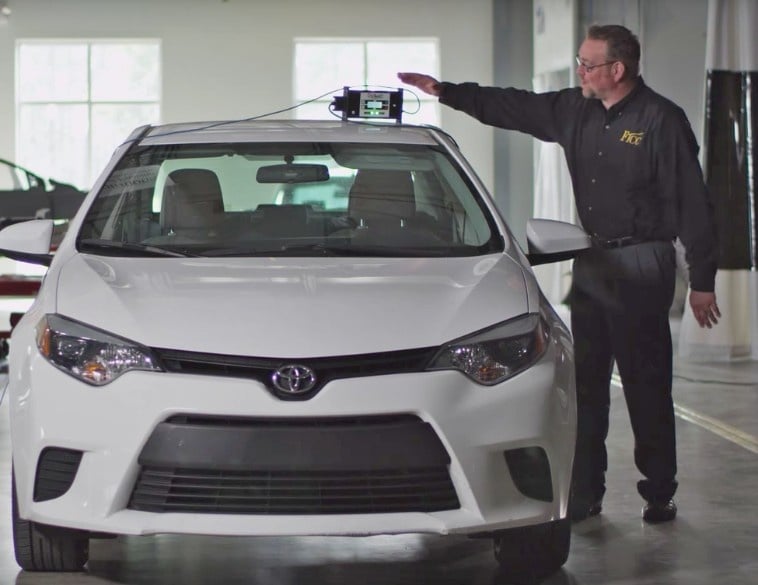
Pre and post-scanning is now a standard procedure in late-model vehicle body repairs. Credit: Repairify
It’s a technology that brings many more things to consider during the body repair process.
With an estimated 98 million vehicles equipped with ADAS on U.S. roads and likely about another 10 million of them on Canadian ones, ADAS is starting to impact every stage of the collision repair process.
The rise of ADAS in the last 20 years has entailed a proliferation of sensor points, cameras, radar and other safety and drive-assist systems whose condition and functionality are often indiscernible with a standard visual inspection, yet potentially damaged in even during minor collisions. The increasingly widespread adoption of ADAS has meant that scanning has become a foundational part of the collision repair process, with pre- and post- repair scanning now standard procedure. An estimated half of all collision repair appraisals in the U.S. now include scanning procedures.
Dramatically different
OEM specs for ADAS vehicles can be dramatically different from one another. This causes a ripple effect that touches just about every aspect of the collision repair process, from the parts supply chain to the necessary experience of the technicians.
ADAS systems are precise and sensitive and tend to operate optimally only when all aspects of system components and their surrounding materials—like top-coat thickness, for instance—fall within some very exacting parameters. “This impacts tolerances and methods for repair and painting,” explained Jamie Shackelford, Vice President, Marketing at Caliber Holdings Corporation, during a recent presentation.
Tolerances for parts of some ADAS systems are being counted or measured in microns – and that means some very small increments to consider. One micron is the same as 0.00003937 inches, or 0.001 of a millimetre. In these circumstances, the technician does not begin the repair until armed with a solid foundation of information from the estimator. “Typically, the estimator will decode the VIN platforms like Tech Advisor, ALLDATA or RepairLogic, which gives us a clear picture of the vehicle’s systems and options. From there, we also rely on more targeted tools—scrubber services such as 1SourceADAS—to drill down into the specific repair area,” says Jeff Francis, Trainer, Western Canada at Fix Network.
He says these resources are essential because they outline what needs to be inspected, reset, or re-calibrated. “The OEM-based reports generated from these systems give us crucial details on sensor alignment, camera, and radar positioning, and whether an additional operation—like wheel alignments, alignment checks, or steering angle sensor resets—are required after the collision. Having this information upfront ensures the repair process is accurate, thorough, and consistent with OEM expectations.”
Capacity and capability
Collision shops and technicians have to consider what new aspects of the repair process stemming from ADAS their particular facility has the capability to complete. Can it do a wheel alignment or wheel alignment check or ADAS calibration? Is the shop equipped to do a 3-D measurement of the vehicle to identify the correct positioning of sensors? Are the required tools for checking sensor position on hand prior to calibration? Or should the shop sublet this work?
The shop management team, ultimately, decides whether the repair is done fully in-house or if some of the ADAS-related work is sublet. Either way, the shop’s key staff need all the relevant information to make the appropriate decision. “Technicians from start to finish must be made aware of the recommended repair procedures of the OEM for the model they are working on,” says Brad Kruhlak, Technical Manager at AkzoNobel Automotive & Specialty Coatings.
He says that OEMs are well aware of the complexities and added costs of ADAS and have tried to reduce some of the challenges. “On a new Buick, there are a lot of sensors behind non-pained parts, some are behind the grill. But if the grill is damaged, it has to be replaced,” he says.
Obviously, not all shops are ready to do the full suite of ADAS-related repair work. But the consensus seems to be that, as the technology evolves and [hopefully], becomes less costly, ADAS will become more prevalent across more models and price points. And ADAS features, which, are today, confined largely to luxury brands will soon trickle down to more mainstream, volume selling models. Adaptive Cruise Control (ACC) with LiDAR, which uses laser pulses to create precise 3-D maps of surrounding traffic, and enables vehicles in cruise mode to adjust speed automatically to traffic conditions, is a good example of this trend, Francis says. “In the early 1990s, Mitsubishi developed the first LiDAR system but it required more driver input. Mercedes-Benz can essentially take credit for the first fully functional system called ‘Distronic’ in 1999. In 2000, Bosch brought systems to market for all manufacturers to incorporate into production vehicles.”
In-house
Given this trend and the desirability of avoiding logistical and quality control issues, it’s no surprise that many shops seem to feel encouraged to keep their ADAS work in-house, along with everything else, if it’s at all feasible.
A host of 3-D surround view ADAS technologies and systems are going increasingly mainstream. Kruhlak says he expects the trend to continue, with these ADAS systems reaching more lower-cost vehicles. One example is called Enhanced Moving Object Detection (MOD). It alerts drivers to the presence of moving objects like deer or other large animals that are outside their field of vision. Not every vehicle on the roads these days is enjoying the benefits of MOD, however. A repair shop in Barrhead, Alberta, recently appraised a series of five vehicles damaged by hitting moose. Some of the five were write-offs.
Deer and moose are in every province and territory of Canada, with a bull moose weighing 1,200-1,600 lbs (550 to 725 kg). A vehicle equipped with technology that reduces the chance of hitting one of these heavyweight ungulates, therefore, looks like a safe bet.

JOBS
 |  DORVAL DORVAL Full time Full time |
| ST-HUBERT Full time |
 | MONTRÉAL Permanent |
 | SASKATOON Full time |
| MONTRÉAL-NORD Permanent |