
Redefined Lubrication
Autosphere » Mechanical »
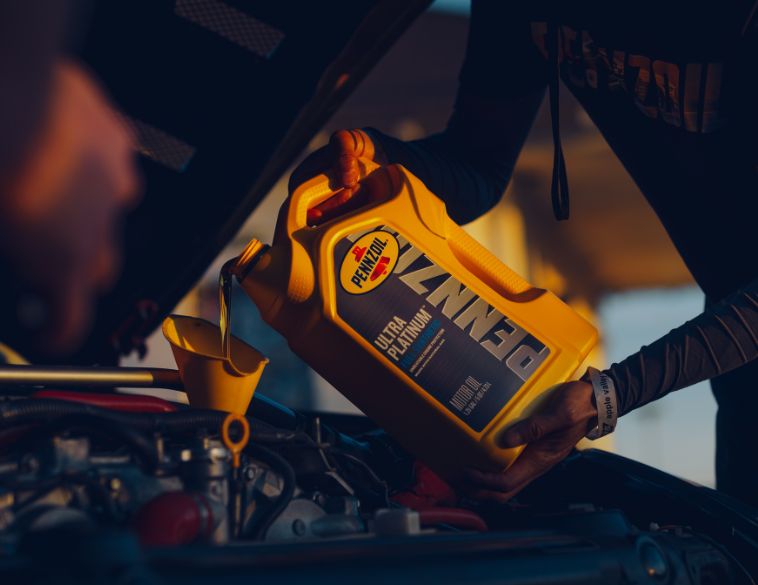
Modern motor oils are designed to deliver maximum protection for today’s complex powertrains. (Credit : Pennzoil)
Motor Oil Technology in the Era of Start-Stop, Hybrids and Ultra-Low Viscosity
In today’s modern engines, motor oil is a precision-engineered fluid designed to protect increasingly complex powertrains operating under tighter tolerances and more aggressive duty cycles.
Downsized turbocharged engines, automatic start-stop systems, hybrids, and low viscosity factory fills have redefined lubrication requirements. In addition, recommended OEM oil drain intervals have increased. Meeting these demands requires coordinated advances in both engine hardware and lubricant chemistry, reflected in the latest ILSAC GF-7 and API SQ specifications.
Here are four critical areas shaping current and future motor oil technology:
- Cold-Start Protection and Rapid Oil Delivery
Despite advances in metallurgy and surface finishes, cold starts remain one of the most wear-intensive phases of engine operation. As temperatures drop, oil viscosity increases, slowing pumpability and delaying lubrication to upper valvetrain components, timing systems, and turbochargers.
Lower viscosity grades, including 0W-20 and 0W-16, are engineered to meet stringent cold cranking and pumpability requirements. These lighter grades are not simply about fuel economy; they are designed to circulate quickly at startup while maintaining adequate high-temperature protection.
Full synthetic oils, such as Pennzoil Ultra Platinum, provide superior low-temperature flow characteristics compared to conventional formulations. Faster oil distribution allows hydrodynamic films to establish more quickly, reducing boundary wear during the first seconds after ignition.
As engines continue to incorporate tighter clearances and more complex valvetrain architectures, rapid oil delivery at startup remains fundamental to long-term durability.
- What Start-Stop Systems Mean for Motor Oil
With automatic start-stop systems now standard on many vehicles, oil films must return quickly across bearings and cam interfaces, sometimes dozens of times in a single commute. This increases:
- Boundary lubrication events
- Thermal cycling frequency
- Shear stress on viscosity modifiers
- Potential fuel dilution in short-trip operation
These conditions place added emphasis on film strength, oxidation resistance, and viscosity stability.
API SQ builds on previous standards with enhanced wear protection, improved deposit control, and performance validation for ultra-low viscosity grades such as 0W-12 and 0W-8. These lighter oils must maintain protection even under repeated restart events and increased thermal stress.
For service providers, the takeaway is clear: start-stop engines demand high-quality synthetic oils such as Pennzoil Ultra Platinum, which is engineered to maintain film integrity and resist breakdown under frequent cycling.
- Hybrid Duty Cycles and Contamination Control
Hybrid vehicles introduce an additional layer of lubrication complexity. Similar to start-stop systems, their engines often operate intermittently, may not reach sustained operating temperature, and frequently start under load.
Lower average oil temperatures and shorter run times can allow fuel dilution and moisture accumulation to persist longer in the sump. Over time, this can accelerate oxidation and viscosity change if the formulation is not robust.
ILSAC GF-7 addresses these realities with improved oxidation stability, enhanced sludge control, and stronger chain-wear protection, all of which are increasingly relevant in hybrid and small-displacement turbocharged engines.
High-performance full synthetics are particularly well-suited for hybrid applications because they offer:
- Stronger resistance to oxidation
- Improved volatility control
- Enhanced deposit management
- Consistent low-temperature performance
With hybrids reaching a record 16.9% market share in Canada in Q3 of 2025, understanding these duty cycles will be critical for accurate service interval recommendations.
- Why Longer Drain Intervals Are Viable
Oil change intervals are now commonly 12,000 to 16,000 km (7,500 to 10,000 miles) or more, the result of simultaneous improvements in engine design and lubricant technology.
On the hardware side, OEMs have introduced:
- Tighter machining tolerances
- Improved piston ring sealing
- More precise fuel injection strategies
- Enhanced crankcase ventilation systems
These advances reduce blow-by, contamination, and deposit formation.
On the lubricant side, ILSAC GF-7 and API SQ require stronger oxidation resistance, improved wear control, LSPI mitigation, and durability across a broader viscosity spectrum, including ultra-low grades designed for modern efficiency targets.
When properly matched to manufacturer specifications, these oils maintain viscosity stability, additive performance, and protective film strength over service intervals.
However, service professionals should still consider operating severity. Short-trip driving, extreme climates, towing, and high idle hours may justify adjusted maintenance recommendations that are less than OEM-recommended intervals.
Conclusion: Efficient Engines Require Robust Motor Oils
Today’s engines are more efficient and more compact, but they are also more demanding from a lubrication standpoint. Frequent start-stop cycles, hybrid operating patterns, turbocharging, and low viscosity requirements require robust motor oils like Pennzoil Ultra Platinum, which provide strong oxidation control, enhanced wear protection, and more durable film strength.



JOBS
 |  RIVE-SUD DE MONTRÉAL RIVE-SUD DE MONTRÉAL Full time Full time |
 | MONTRÉAL Full time |
| MONTRÉAL Permanent |
 | BROSSARD Full time |
 | SAINT-BRUNO Full time |