
Estimate to Excellence: DFE and DFR Part 2
Autosphere » Collision »
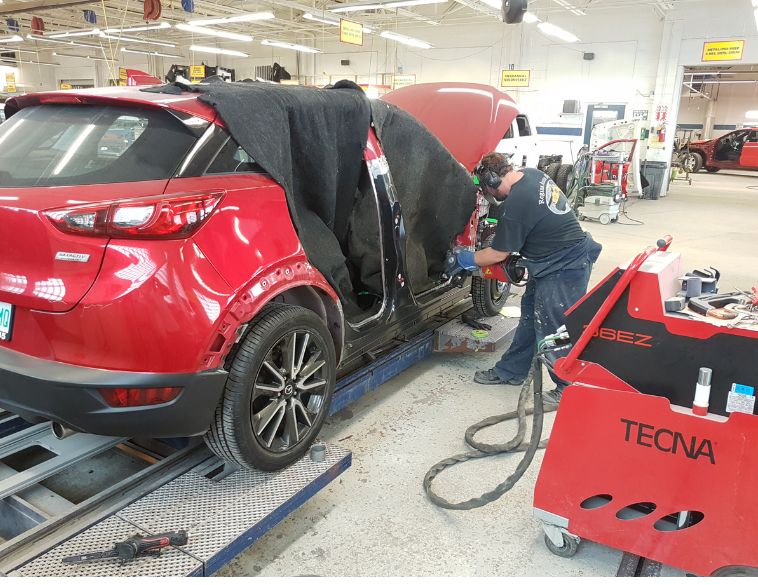
The goal of DFR is to prevent delays during the repair and reassembly processs. (Credit : Regina Auto Body)
When you can accomplish most of the heavy lifting done through a Disassemble for Estimate (DFE) process, a shop is in a better place to have the production space focus on throughput. A full 100% Disassembly is required once the vehicle has arrived for its repair date.
Measuring success
This is also the first stage where you measure success and find areas to improve upon your Disassembly for Estimate process. Using the more thorough Disassembly for Repair (DFR) process to provide positive and constructive feedback to your front-line appraiser is the only way to improve and tighten up on your facilities success. This is the first reminder stage of why you’re implementing these processes. Reducing delays and streamlining communication to increase your throughput and optimize Work in Process.
Disassembly for Repair: The Production Phase
- When does a Disassembly for Repair need to be performed? Every Repair Order needs to have a systematic approach to component removal. Every part that needs to be removed for the repair process needs to be guaranteed to be in good usable order for reassembly. 100%, without exception.
- Documentation accuracy is important at all stages, and it is crucial that any changes in the Repair Plan from the Disassembly for Estimate needs to be documented in all systems and communicated.
- The DFR Stage is also where you ensure all OEM procedures have been shared and understood by the repairing technician, all critical parts are readily available, and a colour verification process is implemented to capture any potential specialty toners.
- Much like the DFE process, the DFR also needs to begin with the end in mind. Organizing for efficient reassembly by labeling and storing fasteners, retainers and re-usable parts in a clear manner will improve the efficiency at the end of the repair.
The goal of the Disassembly for Repair is to have that Repair enter the production phase without having to stop. The only good repair is a completed and billable repair. If you can’t deliver and invoice that Repair Order, it then becomes bad Work in Process (WIP). Investing labour and materials in a job that cannot be delivered or invoiced will have negative impacts on your profitability.
Buy-in considerations
Of course, understanding why disassembly matters is one thing, getting buy-in from the from the production team can be another. Technicians often face real-world pressures that need to be addressed to make sure the benefit outweighs the perceived burden.
Often the rebuttal from a technician is that they transfer the parts over at the time of re-assembly, but picture this: Your technician starts Monday morning on a door replacement. By Wednesday, they’re waiting for a $10 retainer that broke during the parts transfer on reassembly and delivery day. That $5,000 repair now sits in your bay for three extra days because of a part that costs less than a lunch. Does this sound familiar?
Motivational factor
This becomes a case of a nickel holding up a dollar and should be more than enough motivation to take steps to eliminate this problem.
The choice is simple: Continue letting avoidable delays and $10 parts hold up $5,000 repairs or take control of your process today. Start with one vehicle this week. Document everything. Measure the difference. Your bottom line—and your customers—will thank you.



JOBS
 |  RIVE-SUD DE MONTRÉAL RIVE-SUD DE MONTRÉAL Full time Full time |
 | MONTRÉAL Full time |
| MONTRÉAL Permanent |
 | BROSSARD Full time |
 | SAINT-BRUNO Full time |