
Safe and Successful Repairs
Autosphere » Collision »
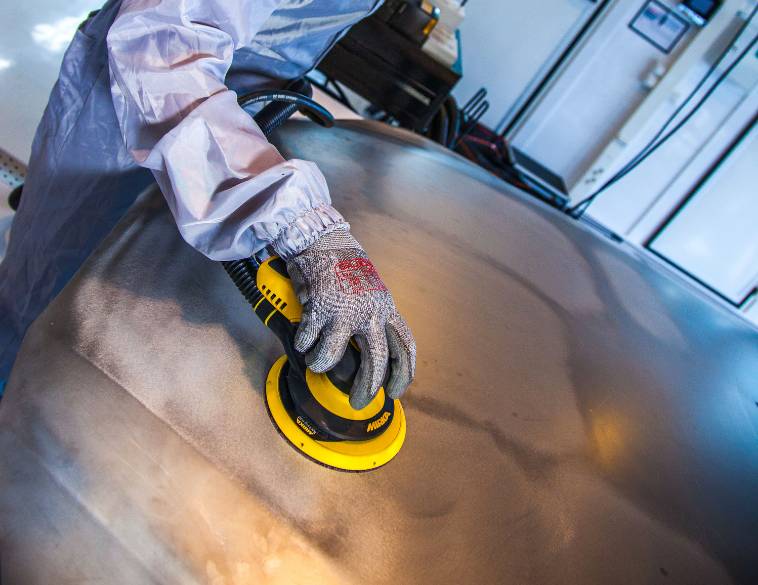
Working with aluminum requires its own special considerations, including sanding techniques and dust extraction. Credit: Mirka
The right procedures, training and tools are essential for working on today’s multi-material vehicles.
Over the last 20 years, vehicle construction and materials have changed radically. Where once upon a time, most cars and trucks were manufactured using mild steel, today, technology and regulatory requirements have resulted in many vehicles that embody a range of different substrates. It’s common today for collision centres to work on vehicles that may have aluminum hoods, fenders, decklids and doors, or in some cases, such as with Ford’s F-Series trucks, the entire body structure is manufactured from aluminum. Additionally, many other vehicles feature high strength and ultra-high strength steel, in their construction, along with panels that can be steel, aluminum or even made from composites.
Major investments
Given that these materials respond differently to traditional mild steel, collision centres have had to make major investments in new tooling and equipment, as well as training for their staff and technicians. So, when repairing multi-material vehicles today, what are some of the tips for doing it successfully?
Dustin King, District Sales Manager with Mirka in Ontario, says that a key one is following the OEM repair procedures for that specific vehicle. “This will help to ensure that the right tools and materials are being selected for the specific areas of the vehicle being repaired,” he says, “which will help to fight against contamination that can be created between different materials.” Additionally, King explains that in order to do so, cleanliness must be a top priority. A good example is effective dust extraction, which not only serves to keep the environment free from contaminants that can damage other materials or present health hazards, but that by having a cleaner environment, the result is also more lifespan for consumable products such as sanding pads, increasing their useful life and cutting down on expenses for the shop.
At CARSTAR Arnprior, in the Ottawa Valley region of Eastern Ontario, Manager Laura Trousdale says that working with steel or aluminum presents its own set of considerations. “Steel has memory and tends to be more malleable, where aluminum is not.”
Separation is key
Additionally, because aluminum can react with materials such as galvanized steel, causing corrosion, having dedicated aluminum repair stations, separate from the rest of the shop is essential. We use a dedicated bay, tools/equipment and a technician for aluminum repairs,” says Trousdale, “which is important to keep in mind for the shop flow and planning. We make sure all of our technicians have the best practices and guidelines available at all times, as well as doing routine safety meetings and checks.”
Like Dustin King, Trousdale stresses the importance of following OEM procedures to ensure the repair is done properly and to spec, ensuring the vehicle can be returned to full functionality. “We have standard operating procedures that include Disassembly for Repair (DFR),” says Trousdale. Additionally, she says that a big benefit for the shop has been working with partners like ALLDATA. “We use ALLDATA to source the OEM procedures required for a specific repair,” she says, noting that even if the shop cannot find the right repair procedure, emailing ALLDATA often provides the opportunity to obtain that information fast and efficiently.
Learning opportunities
When performing repairs on multi-material vehicles, another factor to consider is ensuring the job is being performed by qualified, licensed technicians. At Budds’ Collision Services in Oakville, Ontario, Vice President and Managing Partner J.R. Martino, explains that these kinds of repairs also present an opportunity for newer or less experienced technicians to participate, so they can obtain real hands-on training and learn the skills required, by working alongside senior technicians who are qualified and able to perform multi-material repairs.
Martino also stressed the importance of leveraging the shop’s blueprinting team and estimators by enabling them to access as many repair procedures as possible. He says that by doing so, it provides the opportunity for having more eyes on that specific repair, reducing the risk of any mistakes being overlooked.
Tools and techniques
When working specifically with aluminum, there are a range of factors to consider. These include having the right Personal Protection Equipment (PPE). “Safety glasses, face masks, gloves, and protective clothing, to safeguard against airborne particles and physical injuries during sanding, painting, polishing, or assembly task are need to protect workers from potential hazards,” says Dustin King. Additionally, he stresses the importance of dust control. “Utilizing dust-free sanding systems is crucial,” explains King. “Mirka’s advanced tools and abrasives are designed to minimize dust generation, enhancing air quality and reducing respiratory risks.”
Proper ventilation is also essential, so that any airborne particles can be quickly dispersed, ensuring a safe breathing environment and reducing the risk for any of these particles contaminating or reacting to materials within the shop.
When actually performing work, such as sanding and smoothing panel surfaces, King says that often, using a “crosshatch” approach will keep a consistent scratch profile. Furthermore, he says, using the right tool for the right job is essential in not only performing quality repairs but maximizing touch-time efficiency. On the subject of sanders, King says that “8mm sanders are ideal for the body department,” but “should be exchanged for a 5mm throw sander when moving into prep and paint.” He also notes that the inclusion of an interface pad can make a big difference, especially since grits get finer through the repair process.” Going further, King suggests using products such as Mirka’s Dry Guide Coat, since these can reveal any imperfections and scratches, helping ensure the work is ready to proceed to the next step of the repair process.


JOBS
 |  RIVE-SUD DE MONTRÉAL RIVE-SUD DE MONTRÉAL Full time Full time |
 | MONTRÉAL Full time |
| MONTRÉAL Permanent |
 | BROSSARD Full time |
 | SAINT-BRUNO Full time |