
Tire Recycling Crisis Brewing in Ontario
Autosphere » Tires »

Adam Moffatt, Executive Director, OTDA
Changes to disposal regulations are creating stockpiles and health and safety issues.
In Ontario, there is a growing issue regarding the stockpiling of scrap tires. Changes to regulations have lowered recycling targets, reducing the number of tires that are being collected for disposal, processing and recycling. The issue is becoming serious enough that over one million tires are now stockpiled in the province, with no concrete plan to dispose of them. The stockpiling of tires is impacting every facet of the tire industry in the province, including wholesalers, retailers, haulers, producers and collection sites. To find out more about this pressing issue, Autosphere contacted Adam Moffatt, Executive Director at the Ontario Tire Dealers Association (OTDA), which is at the forefront of spreading awareness about this issue and engaging with various groups, including the provincial government, to help tackle this growing problem.
Autosphere: Can you tell us a little about where things currently stand, regarding tire recycling and disposal in Ontario?
Adam Moffatt: The Ministry of Environment, Conservation and Parks made revisions to the scrap tires regulation, and those revisions ultimately lowered the producer responsibility target thresholds by significant amounts. Prior to these changes, Processors in Ontario were responsible for two main targets, the first target being a 85% collection target, where, based on the weight of the tires they imported into the province, they had to collect 85% of those tires by weight. The reason it was 85% is that, as a new tire goes through its life cycle, the rubber wears off of the tire, so we lose about 15% of the weight of the tire. The second target that they had to achieve was the management or the processing target, which represented all of the tires collected. They had to show that 85% of those tires were recycled by weight. And again, the reason it was an 85% threshold is because of fibrous and other small materials, that, when a tire is recycled, are not considered recyclable materials. The changes that came through in December 2024 [and implemented in January of 2025], effectively combined both of those thresholds, but it lowered the overall target to 65% by weight, which was a significant decrease. At the time, OTDA and other groups raised concerns with the Ontario minister’s office and the RPRA (Resource Productivity and Recovery Authority). Early on, we were concerned that that threshold was going to be lower than the amount of tires that were brought into the province, and that there could be stockpiling issues as a result. At the time, however, there were assurances from the minister’s office that the review was sufficient and any risks going forward were minor. As 2025 progressed, we found that by mid summer, we were receiving notifications from not only members of our association, but tire dealers, automotive mechanical facilities, municipal yards, automotive recyclers and general collection sites, that they were receiving inadequate tire collections. While this is by no means an anomaly, particularly during the summer months when haulers tend to move less volume, toward the end of the summer season it started becoming an issue. In August, one of the Processors announced that, they had reached [and in fact exceeded] their target for processing scrap tires. At that point, alarms started going off since with the “obligation filled,” this Pro began shutting down their operations, meaning they would no longer accept tires and their haulers would no longer be transporting scrap tires to that facility. We began receiving calls from collectors across the province saying “my hauler just informed me that they’re no longer providing service. What are we doing?” As these calls intensified we began engaging heavily with RPRA and the MECP. By the beginning of December, there were announcements from other Pros that they had hit their targets and were instructing their collection divisions, haulers and producers to scale back their operations as well. And at that point, things started spiralling out of control.
AS: What happened then?
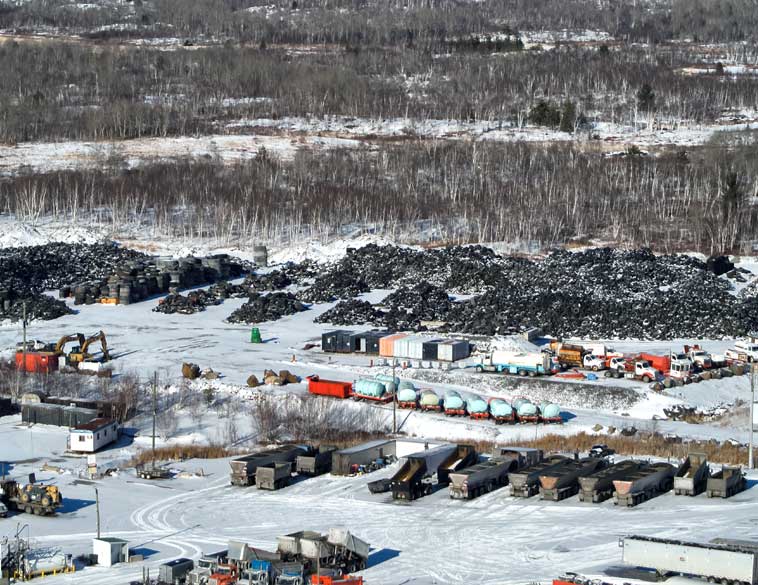
AF: We began seeing the stockpiling of tires at collection sites across the province. It was looking like it was affecting the rural areas more heavily than municipal ones, likely because rural locations tend to have a bit more space for storage, as well as being further away from major urban centres. By the end of December, we were receiving calls from stakeholders across the province of Ontario. Collection sites were informing us that they couldn’t take tires anymore and that some municipal facilities were shutting down tire collections. At this point, it was affecting automotive recyclers and anyone picking up or selling tires in the province. At the end of December we began hearing news concerning massive stockpiles of scrap tires, notably in two locations—one in Stittsville, Ontario, the other near Sudbury. Each of these locations had more than 500,000 tires stockpiled. At that point, the MECP intervened, and issued orders, as well as setting up remediation at these sites. Based on what we knew at the time, this would be ongoing for several months based on the amount of tires that needed to be processed. By the start of January 2026, we had expectations that we would see more active processing and collections. Yet to date, we just haven’t seen that materialize. The Pro that shut down in September is still shut down. Their processing facility still hasn’t restarted and their hauling arm is operating on a very light schedule, performing minimal collections. At the site near Sudbury, there seems to be some precedence in going into some of the recycling facilities, which is offsetting the ability for haulers within the network to pick up at regular collection sites with regular tire generation. They’re not being provided with any adequate amount of processing availability to bring their tires for recycling and we’re still at a bit of a standstill. Today. I’m receiving phone calls ,not only from tire dealers and collection sites that are affected, but also from municipalities that are now affected and shutting down. I’m hearing from landlords who are calling us because, tire collection sites are trying to explain why they have stockpiles of tires, and the landlords are trying to evaluate the situation and potential hazards this might cause [we’ve spoken to at least one or two local fire departments who have concerns]. Additionally, insurance companies are now calling us, asking why these tire stockpiles have been increasing, while at the same time, tire dealers are now having to explain to consumers why they have growing stockpiles of used tires on their property. It doesn’t look good, it’s not environmentally sound and there are health and safety concerns. Not only that, but tire dealers are now having to explain to consumers why they require a $5 processing fee for each tire, but these tires are not being properly disposed of in many parts of the province.
AS: It sounds like this is a very significant and growing problem, can you tell us a little about the potential future ramifications if these issues aren’t addressed?
AF: The biggest challenge right now is the tires that were abandoned in 2025 [and we’re estimating the total is around two million tires], have been brought into 2026 and those tires will be applied to Processor targets for this year. This effectively means two things: Firstly, it means that the pros and the producers they represent will likely hit their targeted thresholds much earlier this year, with the potential of leaving collection sites without collection capability. The second issue, is that those two million tires are going to be added to an estimated two million scrap tires we’ll have to contend with this year and the producer targets have not been increased by the minister’s office. Putting it into context, if we had two million tires abandoned last year, with an additional two million abandoned this year, along with a further two million carried over to tire dealers at the retail level, it becomes a perception problem for the general public. As we’ve mentioned previously, scrap tire stock piles promote health and safety concerns, including the potential of fire risk, such as what happened at Hagersville in 1990. Insurers are, understandably, seeing a good deal of risk right now, as are fire departments. Meanwhile, consumers are still being charged $5 recycling fee for each new tire they purchase at a retailer, and those old tires are not being disposed of, so it’s not a good situation to be in.
AS: Can you tell us a little about the extent of concerns around the gravity of this situation, especially as we head further into spring, including the potential liability?
AF: At OTDA, we are receiving regular calls from landlords. Tire dealers are up against a wall and they don’t know how to explain the problem to them. Getting calls from landlords is something we’ve rarely seen in the past, but they are very concerned about their properties and the growing potential hazards caused by these tire stockpiles. We’re also seeing municipalities right now issuing letters to the Minister of the Environment and to the Premier of Ontario’s office. Right now, we’re heading into our busiest season of the year in the tire industry, and we don’t have any resolutions in how we solve this problem. Furthermore, the spring tire changeover season is likely to further complicate matters.
AS: What do you feel might be some of the potential solutions to combat or at the very least, alleviate the problem?
AF: At OTDA, we’ve been lobbying both RPRA and the MECP for several months asking for some form of resolution and/or relief they can provide. In January we, along with 11 other co-signers, including large tire dealer groups, other associations that are impacted as well as environmental groups, issued a formal letter to the minister’s office. We laid out the concerns that we’ve already talked about, and we did make several recommendations at a high level. One of those recommendations, was to have the minister’s office to step in immediately and assist, such as an order or declaration that notifies both producers and processors that they have obligations, and that the minister’s office needs to force the processors and the haulers back to work. We understand there is an issue around funding and somebody needs to explain how the money is going to flow. That’s the first step, immediate relief. The minister’s office needs to step in and provide that relief by getting people back to work long term, and in order for that to be effective, the issue of recycling targets needs to be addressed. If those targets are increased and a few other regulatory changes are made to close some loopholes, to prevent this from happening in the future, we have a much better chance at holding producers and their processors accountable. We can then clearly lay out that the 65% target is the minimum threshold. However, once that threshold is hit, producers still have an obligation continue collecting tires and recycling them, because they’re still bringing tires into this province and without regulatory reform, there is no clear path on how to correct the issue of growing scrap tire stockpiles.
AS: We’ve already talked about how this issue is impacting tire wholesalers and retailers across the province, but is there anything else specifically you’d like to mention regarding these two groups?
AF: We are working with our members and collection sites across the province to make sure that they’re advocating for themselves. Whether you’re a tire dealer, collection site, recycling yard, etc., if you’re affected, you need to be reaching out to your local Member of Provincial Parliament. You need to be demanding action and that your MPPs come forward and support this issue. We have a real grassroots effort that has to take place here. And same thing can be said from the consumers in the province. If you’re in an area with stockpiling tires and you’re concerned about health and safety issues, including fires as well as general concerns such as why you’re paying for tire recycling and it’s not taking place, you also need to contact your local MPP. We need strong support, and as much as we’re doing at the Association level, in conjunction with the others that have co signed and supported, we need a massive grassroots effort to really get this moving forward. It has been over five months since we started raising concerns and to date, there has been little in the way of actionable efforts from RPRA, the MECP or the minister’s office. It’s a scary thought when you think that more than five months have gone by with no formal actionable plan being brought forward to correct the situation. That needs to change.
AS: Is there’s anything else you’d like to mention about involvement, including advocacy and tackling this urgent issue?
AF: If you’re a tire dealer in the province of Ontario, whether you’re a member of the Ontario Tire Dealers Association or not, reach out to us. Let us know you’re affected. We can help you to put you in touch with your MPP. We can help you with putting together a letter and communications. If you’re not a tire dealer in the province, but you’re a automotive recycler, or municipal yard, or a collection site, reach out to the associations and the groups that you’re working with. All of the major groups are working on this. Whoever you are and however you’re affected, we want to know, and we will help you and provide the support you need to reach out to your local MPP, your mayor and elected officials and legislators. While we are seeing greater awareness regarding the issue of stockpiling scrap tires, more needs to be done, if we are to prevent this issue from becoming a major disaster.



JOBS
 |  RIVE-SUD DE MONTRÉAL RIVE-SUD DE MONTRÉAL Full time Full time |
 | MONTRÉAL Full time |
| MONTRÉAL Permanent |
 | BROSSARD Full time |
 | SAINT-BRUNO Full time |