
Selecting the Right Lubricants
Autosphere » Mechanical »
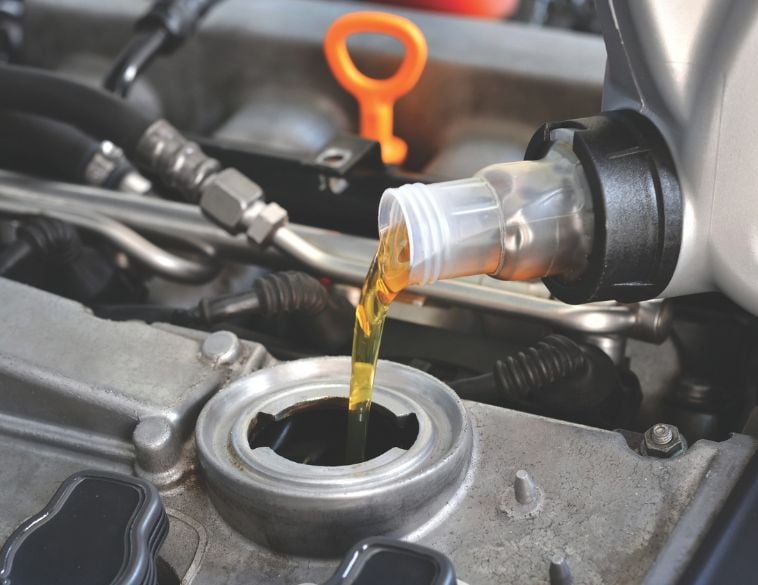
Today’s engine technology and metallurgy requires specific oil formulations to ensure reliability and durability. (Credit : Shutterstock)
Education is more important than ever when it comes to motor oils and your service customers.
Advances in engine technology have changed the game when it comes to lubrication and technology. As vehicle OEMs have looked to push the envelope on both performance and efficiency, new oil formulations have been introduced to ensure that downsized, turbocharged and direct injection engines receive the necessary protection to ensure optimal reliability, fuel economy and consistent performance.
This has also resulted in the introduction of new and revised international performance standards for motor oils, including the American Petroleum Institute (API) SQ and the ILSAC (International Lubricant Standard and Approval Committee) GF-7A/B.
“These standards aim at improving engine performance and reliability while providing optimal fuel economy potential in modern as well as legacy engines,” says Albert Côté-Séguin Technical and Training Director at Total Energies Canada.
Specs and additives
Achieving these objectives however, has required the introduction of new oil specs, including highly refined base oils as well as specific [and more resilient] additive packages. Côté-Séguin notes that this approach helps ensure long-lasting protection of rotating assemblies and other moving parts while enabling lubricant manufacturers to develop lower viscosity oils that are designed to work with modern engines with much tighter tolerances.
These advances in technology mean that when it comes to vehicle servicing, shops need to ensure their customers are properly educated and informed about why their vehicle requires a specific oil.
“Effective marketing comes down to clear communication and instilling customer confidence,” explains Sean Nguyen, Technical Scientist and Automotive Lubricant Specialist at Pennzoil.
He notes that while most drivers today understand that oil changes are important, they still don’t always know why, particularly when it comes to spec oils and certain types of engines.
That’s why, stresses Nguyen, it’s critically important for service centres to explain to their clients how motor oils protect against heat and friction as well as the deposits inside the engine and how lubricants degrade over time.
“This helps customers understand [that an oil change] is an essential part of long-term vehicle care, rather than just routine maintenance,” says Nguyen. Plus as the overall Canadian and U.S vehicle parc continues to age, that emphasis on long term car care and reliability becomes ever more important.
The cost factor
While the concept of the loss leader or bargain oil change still exists, today, the emphasis is different. “These types of tactics work for customers who drive older, out of warranty vehicles,” explains Albert Côté-Séguin. He also notes that they can be an effective marketing tool to upsell these customers on other consumable vehicle products such as wiper blades, filters, tires, belts, hoses and brake pads etc.
Today most service centres have aligned these low price services with the cost and expertise required to maintain today’s more advanced late model vehicles and the lubricants they require.
While in today’s economic climate, many consumers are tightening their belts and looking to ensure their dollars go further, Côté-Séguin says that while a spec oil service on a late-model engine may cost more up front than a traditional 5W30/10W30 mineral oil change and filter replacement, the trade-off is that these new formulations provide solid lubrication and protection over longer intervals, meaning consumers won’t need to visit the shop as often to ensure that peak performance and reliability of their vehicle’s engine is maintained.
Additionally, Sean Nguyen notes that with longer oil change intervals, each visit to the shop becomes a valuable touchpoint. He notes that combining them with vehicle inspections and preventative maintenance checks, gives service centres the opportunity to build transparency and trust with their customers.
“Pairing longer-lasting full synthetic oils with proactive inspections also reinforces the idea that you are focused on the customer’s long-term vehicle health, not just a single transaction, which can help strengthen retention,” says Nguyen.
Distribution and timing
Yet with more and more vehicles requiring specific oil formulations, service centres, as well as lubricant manufacturers and distributors, face additional challenges in ensuring the right oils are available at the right time and in the right quantities.
Managing inventory has become increasingly complex as more engines and transmissions require highly specific fluid formulations,” explains Côté-Séguin. While he acknowledges that there is no “ideal” formula, there are several best practices the aftermarket can employ to ensure service centres are able to maximize efficiency when it comes to providing the right oils to their customers at the right time.
“High-quality synthetic lubricants generally offer broader OEM coverage and can serve both advanced and basic applications,” Côté-Séguin explains, “which helps reduce the number of SKUs needed.” That said, he does note that most independent shops still need to carry a wider range of lower volume products in order to effectively meet customer demand.
Additionally, Côté-Séguin says that shift away from bulk 5W30 which used to cover the majority of vehicles, means that today, service centres are far more likely to stock four to five different 0W20 formulations to properly support modern drivetrains. “This complexity is contributing to a market shift away from bulk supply and toward drums and kegs,” he says.
At Pennzoil, Sean Nguyen explains that today, distributors can work closely with lubricant suppliers to stock products that meet current OEM specifications and industry standards, such as ILSAC GF-7 and API SQ. “Stocking high-quality full synthetic oils helps simplify inventory while still covering a wide range of vehicles,” says Nguyen.
Hybrids
With hybrid vehicles continuing to gain traction in the North American market, more and more are turning up in aftermarket service bays. For parallel hybrids, in which propulsion can be either via an electric motor, an ICE engine or both, there are often special considerations, not only in types of oils required but how maintenance and service intervals are approached. “Diligent follow up is essential,” explains Albert Côté-Séguin. If the hybrid is used mostly in urban driving, there is a chance that the ICE engine is rarely used, meaning that it doesn’t heat cycle properly, causing build up of condensation, which if neglected can reduce performance and reliability. Côté-Séguin says that mileage and timing are essential to document in this case and that the oil is regularly inspected and changed so that oxidation and degradation don’t negatively impact the vehicle and lead to expensive [and avoidable] repairs.



JOBS
 |  DORVAL DORVAL Full time Full time |
| ST-HUBERT Full time |
 | MONTRÉAL Permanent |
 | SASKATOON Full time |
| MONTRÉAL-NORD Permanent |