
Expert Insights on Commercialization of Humanoid Robots
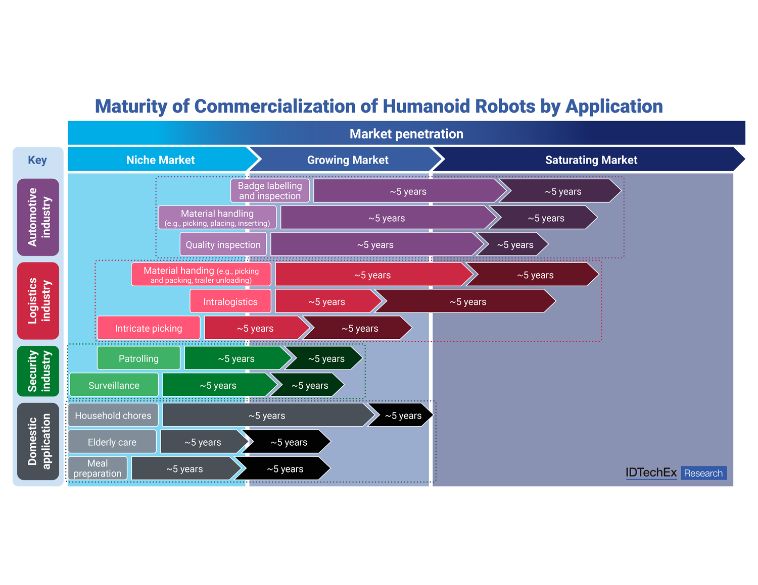
Humanoid Robots to Reach Nearly US$30 Billion by 2036 as Automotive and Logistics Deployments Scale.
Humanoid robots are increasingly viewed less as futuristic prototypes and more as a practical route to bring artificial intelligence into human-designed environments. Over the last 12 months, market activity has shifted from trade-show demonstrations toward structured pilot deployments on production sites, supported by larger and more deliberate investment from both venture-backed startups and established OEMs. With component supply chains gradually stabilizing and early cost reductions emerging, operators are now using real-world deployment data to define which humanoid use cases are commercially viable in the near term, and which remain longer-term opportunities.
According to the new IDTechEx report “Humanoid Robots 2026-2036: Technologies, Markets and Opportunities”, the humanoid robot industry is entering an early commercialization phase, with adoption expected to scale first in industrial environments before expanding into broader commercial and consumer markets.
IDTechEx forecasts the global humanoid robot market will reach approximately US$29.5 billion by 2036, driven by increasing deployments in automotive manufacturing and logistics, alongside ongoing progress in component scaling and platform reliability.
Automotive Manufacturing: The First Scalable Deployment Market
IDTechEx expects automotive manufacturing to be the first sector where humanoid robots scale in meaningful volumes. Compared with open-world environments, automotive plants offer controlled operating conditions, structured workflows, and clearer ROI justification for repetitive labor-intensive tasks. Early deployments are focused on relatively simple but scalable tasks such as material handling, inspection support, intra-factory transport, and basic assembly assistance. As the market transitions beyond proof-of-concept demonstrations, commercialization is increasingly being defined less by “general-purpose capability” and more by reliability, safety validation, maintainability, and predictable uptime.
A key reason automotive manufacturing is emerging as the first scalable deployment market is that many of the most active investors and strategic backers are automotive OEMs themselves. Unlike traditional industrial automation buyers, automotive OEMs have both the capital base and long-term incentive to accelerate humanoid development, particularly as they face rising labor costs, tightening workforce availability, and increasing pressure to improve manufacturing flexibility.
OEM-backed investment also provides immediate access to controlled production environments, engineering validation resources, and real operational datasets that are difficult for startups to obtain independently. In practice, this allows humanoid platforms to iterate faster through reliability testing, safety validation workflows, and maintainability optimization. OEM involvement also increases the likelihood of scaled procurement once a platform meets minimum performance thresholds, reducing go-to-market uncertainty and accelerating supply chain readiness.



JOBS
 |  LASALLE LASALLE Full time Full time |
 | STE-AGATHE-DES-MONTS Full time |
 | SAINT-LÉONARD Full time |
 | MONTRÉAL Permanent |
 | JOLIETTE Full time |