
Terry Maxwell: An Extraordinary Automotive Journey
Autosphere » Collision »
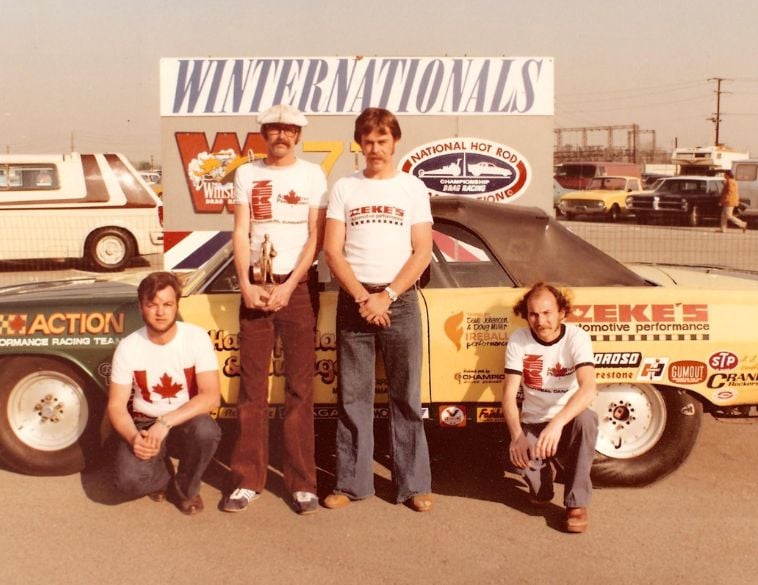
Terry Maxwell (second from left) and his team after winning at the NHRA Winternationals in Pomona, Calif., 1977. Credit : Terry Maxwell
Part 1: Hot Rods, Mechanics, and Racing
Growing up in Montreal in the early 1960s, Terry Maxwell was a car-crazed youth that turned his passion into a truly extraordinary career. Always one to figure out a way of doing something, Terry’s combination of determination, problem-solving and people skills would not only lead him to become a sought after performance and racing mechanic during the golden age of hot rodding and drag racing, but also a second career, in which he and his team transformed a Montreal area speed shop into a specialty performance manufacturing organization, employing hundreds of people and responsible for turning out some of the fastest and most sought after fourth-generation Chevrolet Camaros and Pontiac Firebirds ever built.
Recently, Autosphere had an opportunity to sit down with Terry for a special two-part interview series—talking about his extraordinary career and the people that helped shape this incredible Canadian automotive industry journey.
Autosphere: How did you first get into cars?
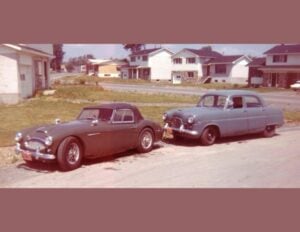
Terry Maxwell: It was around 1964 when I was still in high school. A neighbour of ours had this 1956 Ford Zephyr (a British Ford). It had a big inline six with a three-on-the tree column shifted manual gearbox and wasn’t running. I was able to get it running [it turned out the car needed a new starter] and he gave that car to me. That was really where it all started.
AS: Where did things go from there?
TM: I learned how to rebuild carburetors on my brother’s Austin Healey which had triple SUs on it. By this time, I’d also learned how to power shift a three-on-the tree in my Zephyr. That big old inline six had lots of torque and I was breaking axles regularly. I got tired of doing this, plus replacement axles were getting harder to find at the wrecking yard, so I got rid of the Zephyr and bought a North American 1956 Ford four door, with 272 cubic inch Y-block V8 and an automatic transmission.
AS: After high school, you went to technical school, and from there got into drag racing, tell us a little about that?
TM: I graduated high school in 1965 and took a three-year course in Automotive and Diesel Technology at the Montreal Institute of Technology. I also worked part time at a service station called Laniel’s BA. The owner, Andre Laniel was a great mentor and he taught me how to repair cars in a practical manner, by combining his own experiences in the shop with my knowledge learned from books. It proved very effective, and was invaluable in becoming a mechanic and race technician—skills that would carry me through the rest of my career and beyond.
In 1966, while still in technical school, I bought another ’56 Ford, this time a four-door wagon with an inline six. I took that out and put in a 312 cubic inch Y-block with a Holley four-barrel carburetor on top. With 4.09 gears this thing flew, and it really got me into drag racing. When a friend got back into it, I decided to junk the car (it was filled with bondo, as were many older cars in my area back then), but I took out the drivetrain and put that into a brown, 1958 Ford four-door sedan.
AS: From what we understand that car didn’t fare too well in the end?
TM: There’s an interesting story. One night I was driving and the roads were slick with rain. I was sideways in the car and hit a telegraph pole which took out the right front fender, headlight assembly and grille. The cops ended up taking me in for questioning because one of them found the headlight assembly of my car on the road! Luckily they eventually let me go!
AS: Tell us more about how you became an in-demand mechanic?
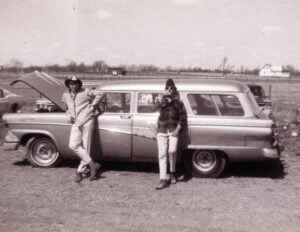
TM: In the late-1960s, I belonged to a couple of local car clubs, The Road Gents and The Wheels of Time. With the skills I’d learned at technical school and at the garage, I was building carburetors, complete engines, differentials, even manual gearboxes. I also went through a bunch more cars, including a very nice 1958 Ford Fairlane 500 hardtop. This one had a FE engine; a 332 with three Holley two-barrels on it and a four-speed Toploader. It was a nice car and the girls loved it, but eventually it rusted out and I bought a ’59 Ford two-door wagon which became my rolling auto shop.
In 1970 a new drag strip, Sanair, opened near Montreal. I was still racing at the time, but quickly realized it was becoming very expensive, so I decided to become a race mechanic instead! I gained a ton of experience and knowledge doing this and worked on many of the quickest cars back then including 383, 426 Max Wedge and Hemi powered Mopars running in NHRA Super Stock, as well as 428 Cobra Jet powered Fords and lots of Chevys. There was also a certain 340 powered Plymouth Duster that belonged to a drag racer named Ed Hamburger, but we’ll get into that later.
AS: How did you get started with your own shop?
TM: In 1971-72 I worked at a shop called Motion Performance in Pierrefonds, Que. The owner, Brian Hay gave all his staff nicknames. Because I was tall and slim, he named me Zeke, after a giraffe in a comic book. By the summer of 1972, I wanted to venture out on my own, and I began by using a corner of a friend’s race shop. I decided to name the business Zeke’s Automotive [it sounded a lot better than Terry’s Garage!] and by 1974, I had my first real shop, a 1,000 square foot facility in Lachine.
AS: Zeke’s quickly expanded during the 1970s, didn’t it? Tell us a little about that?
TM: When we started Zeke’s, there was myself and two employees, John Lepine and Joe Gabriel. Because I’d gained so much valuable experience in rebuilding carburetors, differentials, four-speed gearboxes and building and tuning engines, business quickly took off. We were tuning nearly all the cars in our local clubs including LaSalle 7000 and The Wheels of Time, plus, because I was well known at the track as everybody’s race mechanic, we also got a lot of NHRA drag cars coming in for work.
AS: You really learned how to make a NHRA Super Stock combination work didn’t you, and ended up building some of the quickest cars that ran in those classes, correct?
TM: I think one big advantage we had at Zeke’s was that when we expanded and moved to a new 3,000 square foot building in 1975, we had our own machine shop. I did a lot of honing and ring testing and ended up with a honing system that was second to none, one that would give us perfect ring seal that minimized friction. For high horsepower applications (like drag racing) we developed very low tension piston rings and also made our own windage trays so we could optimize oil circulation. We could run 3 quarts of oil in the engine, and I could turn the whole short block assembly with a six inch ratchet. I made lots of runs at the track and kept records of every single run we did and made adjustments. The end result was some very fast combos at the track.
We also got into building engines for road racing and rallying, particularly Datsuns and Hondas. With work busy at the shop by then, I decided to get back into drag racing with my own car again. So I bought a 1965 Chevy Chevelle Malibu SS convertible, and built it to run in NHRA Super Stock. It had a 327 cubic inch small block V8 bored 0.60-in over, stock Rochester 4GC four-barrel carburetor and a two-speed Powerglide automatic built by Fireball Automatics with a 4,000 rpm stall converter. Under the rules, I could run any camshaft and headers and any gear ratio, so I went with a Competition Cams solid roller camshaft, Hooker 1-3/4-inch exhaust headers, Edelbrock Tarantula intake (which was permitted under the rules), Corvette dual-point ignition and a 5.12:1 axle ratio in the factory GM 12-bolt rear end. I progressively made changes to the car and each time it went faster and faster. In 1977 I won the NHRA SS/NA class at the U.S. Winternationals in Pomona, California and the following year was named NHRA Drag Engine Builder of the Year!
“I think one big advantage we had at Zeke’s was that when we expanded and moved to a new 3,000 square foot building in 1975, we had our own machine shop.”
– Terry Maxwell
AS: Tell us a little about business in the 1980s and early 1990s?
TM: I sold the Chevelle at the end of 1977 but ended up buying it back in 1981. In 1985 we opened a massive 11,400 square foot shop on St. Joseph Boulevard in Lachine, and were busy doing all kinds of work, including street cars, classics, hot rods, drag cars and also stock cars. We built a 355 cubic inch small block Chevy for stock car rookie Gerry Bergeron to run at Deux Montagnes. It was a winner out of the gate and he finished the season by winning the championship and being named Rookie of the Year!
During the 1980s I was also involved in hosting technical seminars, including specialist race technology events and general maintenance and repairs, as well as starting a marketing services business for major aftermarket speed and performance companies, including creating French language ads for big names like Competition Cams, Edelbrock, TRW and Mickey Thompson. In 1990 we did a project for Ecole Polytechnique Engineering in Montreal. It was a new GMC Sierra pickup built for an annual challenge for competing technical schools and universities. Our truck delivered the most horsepower and the best fuel mileage of any vehicle in the competition! A few weeks after celebrating Zeke’s 20th anniversary in September 1992, I got a call from Ed Hamburger, which began a new chapter for me and Zeke’s Automotive, which we’ll share in the next issue…
Tags : Terry Maxwell


JOBS
 |  LAVAL LAVAL Permanent Permanent |
 | MONTRÉAL Full time |
 | LAVAL Full time |
 | JOLIETTE Full time |
 | MONT-ROYAL Permanent |