
The ADAS Advantage
Autosphere » Collision »
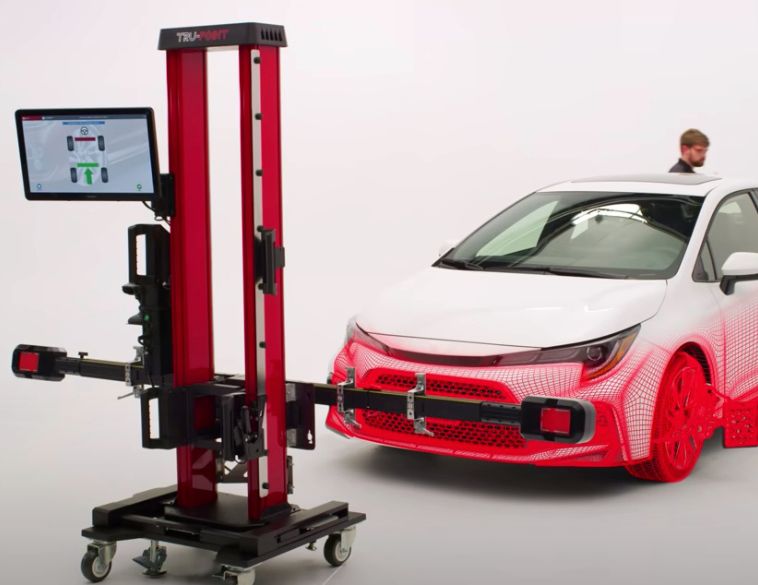
When it comes to ADAS shops need to follow precise OEM information to ensure calibrations are done correctly. (Credit : Snap-On)
Intelligent equipment selection is making all the difference for today’s shops.
Advanced Driver Assistance Systems (ADAS) have shifted from being a growing but often higher-end niche capability to a core operational requirement for collision repair centres. Today, the ADAS calibration market stands at a critical inflection point of growth. “While 86% of auto repair shops now perform at least some calibrations in-house, only 21% report having a fully optimized calibration process. This gap between adoption and optimization represents both a looming challenge and a significant opportunity for the industry,” according to an October 2025 report from Revv, which specializes in providing ADAS-related software support and programs. The report is based on a survey of 300 collision, mechanical and glass repair shops across North America. (Collision 59%, mechanical, 33%, glass 8%)
Cost considerations
No surprise that one of the barriers is cost. Shops report an average initial investment of US $55, 494 with ongoing equipment and tooling costs averaging US $18,773 annually. Also, “training remains a persistent challenge, with 49% citing training costs and time away from production as their biggest concern,” Revv says.
Despite the obstacles, Revv’s report paints an optimistic outlook. It says that shops expect their ADAS work to increase by 30% over the next two years. Many are planning a strategic shift toward more in-house calibration work, moving from 57% in-house today to an estimated 64% within two years.
A report from Market Report Analytics (MRA) forecasts continued rapid ADAS expansion across the world over the next few years, with automobiles—not pickup trucks—driving about 70 per cent of the growth.
Risk, consistency and documentation
Modern motor vehicles require precise calibrations that are sensitive to environmental conditions, alignment accuracy, target placement, and software execution. “What we’re seeing across the industry is that equipment decisions are no longer driven by ‘nice-to-have’ features; they’re driven by risk management, consistency, and documentation considerations. As a result, shops are investing not just to perform calibrations, but to perform them defensibly in a way that supports OEM requirements, insurer scrutiny and ultimately, vehicle safety,” explains Joel Adcock, Director of Strategic Partnerships at Revv.
Across the industry, most ADAS-capable collision repair operations focus on a few foundational equipment categories, Adcock says.
Among the key equipment items are scan tools and diagnostics platforms. “These are the gateway to every ADAS decision. Pre- and post-repair scans determine what systems are affected, whether calibrations are required, and if faults persist after repairs. As vehicles become more software-defined, scan coverage and update cadence matter just as much as hardware capability,” Adcock says.
Ensuring accuracy
Calibration systems and target set-ups are another essential in the equipment line-up for calibrations. They include static calibration frames, targets and supporting hardware. They have a key role in ensuring accuracy and repeatability and in their ability to support multiple OEM procedures. This is critical, Adcock says, adding that shops are increasingly prioritizing systems that reduce setup variability and technician interpretation.
Shops doing ADAS calibrations are adding wheel alignment capability to their operations because even a slight misalignment can invalidate a calibration and compromise vehicle safety, should one leave the shop without the necessary alignment. “As a result, alignment equipment that integrates tightly with ADAS workflows has become a priority investment, not an afterthought,” Adcock says.
Other factors, including the amount of space, level floors and lighting, which are not typically described as equipment, might have to meet specifications that are essential for successful calibration outcomes.
Major ADAS calibration equipment suppliers today include John Bean (Snap-on) Hunter Engineering Company and Autel.
Approach and shop fit
Adcock says that rather than any “stand-out” winner in either product categories or manufacturer, differentiation tends to come down to approach, emphasis, philosophy and shop fit. “Some platforms emphasize integration with alignment systems and highly controlled calibration environments. Others focus on flexibility, broader vehicle coverage and cost accessibility. Some excel in software ecosystems and diagnostics depth, while others shine in physical precision and repeatability.”
Most successful shops tend to evaluate these platforms based on the mix of vehicles they repair, volume expectations, technicians’ skill levels, available physical space and whether calibrations are done in-house or partially sublet. “In other words, the ‘best’ system is often the one that best aligns with a shop’s workflow reality, not just its feature list,” Adcock says.
Some ADAS investments seem better suited for larger shops, but the gap between the big and smaller outlets could narrow. High-volume collision centres and multiple shop operators are more likely to invest in dedicated calibration bays, fully integrated alignment and calibration systems and advanced environmental controls. On the other hand, smaller and independent shops are increasingly participating through hybrid in-house and sublet models, mobile calibration partnerships and targeted investments focused on diagnostics, documentations and compliance. With this in mind, repair strategy, as much or more than shop size, could be the factor determining how much ADAS calibration work a repair facility participates in.
OEM specifications
Calibration for ADAS involves tasks such as setting Lidar, radar, cameras and targets to perform alignments and ensure that the ADAS suite of functions operate effectively and safely. It is essential that OEM specifications are followed and that calibrations conform to tolerances that meet OEM specs.
Software can provide a valuable assist to ADAS calibrations. “Hardware enables the calibration, while software enables consistency, compliance and confidence. At Revv, our focus has been on helping collision repairers answer three fundamental questions: What does this specific vehicle require? How do we prove we did it correctly? How do we document and bill it clearly?” Adcock says.
He notes that Revv’s software supports: VIN-specific ADAS research tied to OEM requirements, diagnostic and calibration pathways based on actual vehicle configuration, documentation that supports insurers, auditors and internal QA, and a structured way to justify and bill for ADAS-related operations. He says, “Rather than replacing equipment or technicians, the goal is to connect the dots—linking diagnostics, calibrations, procedures and paperwork into defensible workflow.”
What can be done
ADAS-related radar, which might need calibration in the event of a collision, is mostly found on bumpers, grille assemblies and mirrors. “Working on a vehicle with ADAS, a shop needs to know exactly what can and cannot be worked on. All the information is from the OEM. Some manufacturers state that the bumper must be replaced in the event of a certain level of collision damage,” explains Brad Kruhlak, Technical Manager at AkzoNobel Automotive and Aerospace Coatings.
An expensive mishap illustrates the point. Kruhlak notes one example where, “in the case of a bumper being repaired, a shop applied too much paint and the ADAS didn’t work. As a result, it was necessary to buy a new bumper for a Porsche Panamera. The shop had to eat the cost as they hadn’t done their homework. The cost was over $7,000.”

JOBS
 |  DORVAL DORVAL Full time Full time |
| ST-HUBERT Full time |
 | MONTRÉAL Permanent |
 | SASKATOON Full time |
| MONTRÉAL-NORD Permanent |