
In-House Auto Glass
Autosphere » Collision »
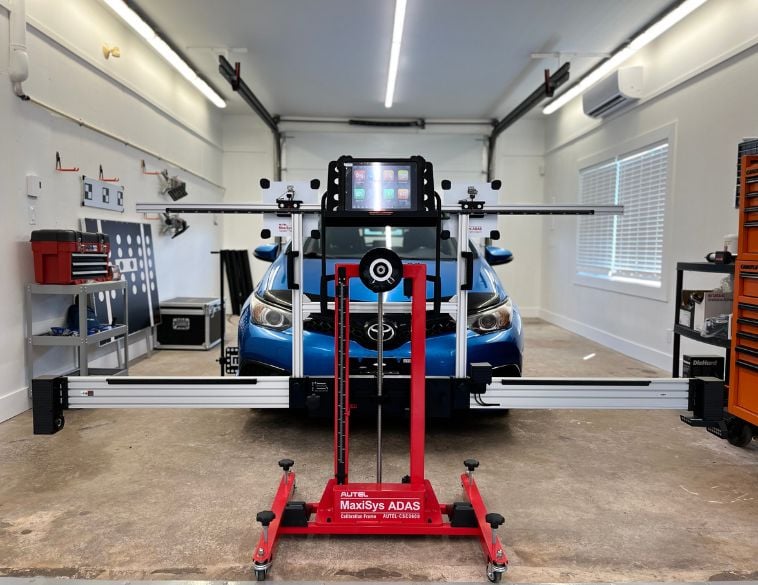
Required ADAS Calibrations mean performing auto glass repair/replacement in-house is becoming the norm, rather than the exception. (Credit : Fix Network)
ADAS seems poised to produce a variety of arrangements and configurations. It has long been recognized that distracted driving is a major cause of motor vehicle collisions. This has led to a range of technologies supported by ever more advanced computer and software systems.
Steady progression
A little over a decade ago, Advanced Driver Assistance Systems (ADAS) on North American vehicles were mostly found on higher-end European and Japanese imports.
They included systems like adaptive cruise control and automatic braking. We’ve since seen the ADAS suite of features further expand to include others, such as lane departure warning, lane keep assist, cross traffic alert, and self-parking features. Additionally, these features have migrated down from luxury vehicles to mainstream, bread-and-butter cars and trucks.
The proliferation of smart, software-supported ADAS using cameras, radar and LiDAR technologies has already forced change in the way collision repairs are performed, adding complexity to operations on everything from rear bumpers to windshields. The need for calibration scans no longer applies to just safety and drivetrain electronics, but also to the array of ADAS technologies, to make sure they function properly.
In house solutions
The collision repair industry is at a pivotal crossroads. As vehicle technology advances, and customer expectations shift, traditional business models are being challenged. Forward-thinking collision shops are responding by diversifying their services—integrating auto glass repair, calibration, and advanced diagnostics into their core operations. This evolution is not just about staying competitive; it’s about future-proofing the business and unlocking new revenue streams.
For years, most collision repair shops have sublet windshield replacement and auto glass work to specialists. However, the widespread adoption of ADAS technologies has fundamentally changed the landscape. According to industry data, over 89% of 2023 and newer vehicles require ADAS calibration after windshield replacement, due to government mandates. These systems rely on cameras and sensors mounted on or above the windshield, making calibration an essential part of the repair process.
Zakari Krieger, Vice President, Prime CarCare at Fix Network – Canada notes, “Glass replacement now includes dealing with ADAS. Since shops in many cases have technicians in-house to perform calibration scans, it makes sense to bring windshield removal and installation into the body shop.” Modern collision centres, with their level floors and advanced equipment, are well-suited for both static and dynamic calibration procedures, he says. This integration not only streamlines workflow, but also keeps calibration technicians fully utilized, especially in high-volume shops, and supplements those skills and internal services into expanding their reach to consumers for auto glass services.
Pre-Scan Strategy
The benefits of in-house glass and calibration services extend beyond operational efficiency. Windshield repair and replacement services have grown by 4.5% annually, with the replacement market expected to expand by 10.7% per year.
Unlike collision repairs, which are often insurance-driven and infrequent for individual customers, glass work is a more retail-driven business. This creates more opportunities for customer engagement, and increases the shop’s share of wallet, if, firstly, an individual who has visited a collision shop for a claim has a need for glass service, and, secondly, is already familiar with that repair facility.
Offering multiple services boosts repeat business by up to 30%, as customers can return for a wider range of needs.
NOVUS Glass, part of Fix Network, is focused on this strategy with their “Shop of the Future” program. This model empowers collision shops to diversify and grow by integrating glass and calibration services. Shops receive comprehensive training, proprietary equipment, and operational support, including advanced diagnostic tablets, calibration frames, and custom targets. The program also offers mobile service capabilities, enabling shops to expand their reach and convenience.
Banding together
While it is likely that some collision repair shops will import more in-house glass work, others might band together, creating their own small networks of three to four facilities, with one specializing in glass repair/replacement.
Another variation in arrangements between the auto glass and collision repair functions is in place at Grove Collision Repairs Ltd. in Spruce Grove, Alberta. The firm, which has two shops (one about 13,000 sq. ft., and the other about 5,000 sq. ft.), is not replacing windshields, but does some work, “if necessary, based on cycle time,” on quarter glass and rear windows, says Nicholas Robin, General Manager. “We also perform ADAS calibrations in house,” he adds.
Robin cites key reasons for continuing to sublet windshield removal and installation. “We want to support another small business in the community while ensuring our body technicians do what they do best: performing body repairs rather than fixing or replacing glass.”

JOBS
 |  DORVAL DORVAL Full time Full time |
| ST-HUBERT Full time |
 | MONTRÉAL Permanent |
 | SASKATOON Full time |
| MONTRÉAL-NORD Permanent |