
Higher Quality, Better Efficiency
Autosphere » Collision »
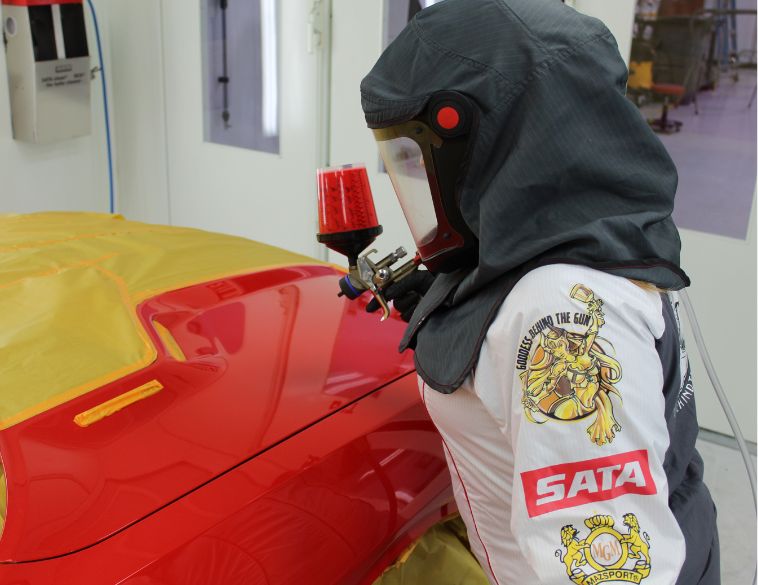
Modern advancements in paint and vehicle technology are changing the automotive refinish process. (Credit : SATA)
The twin demands of clearing worker safety hurdles and accommodating modern vehicle designs that are marked by the proliferation of sensors, ADAS, and more complex palettes, have been key factors in the development of new paint products and processes for collision repair.
No surprise, the quest for a perfect paint match and refinish, at or even surpassing new car showroom standards remains an abiding priority, driving innovation.
Growing popularity
Both quality work and health and safety concerns have helped account for the growing popularity of High-Volume Low Pressure (HVLP) during the 1990s.
In order to reduce VOC (volatile organic compound) emissions and create a better working environment, new trajectories were envisioned and HVLP spray guns became the preferred choice, according to a statement by Lak Gruppen, a Danish chemical and automotive paint distribution company.
HVLP systems rely on a higher volume of air at a lower pressure than traditional guns. This enables finer paint atomization, improving control and coverage to achieve a better finish, as well as better transfer efficiency—meaning more paint gets to the surface and less is wasted.
Recommended application
“HVLP is recommended for application of base coat because it offers maximum transfer with minimal material consumption. It is also suitable for water-based base coats and provides a great spray of metallic colours,” according to Lak Gruppen.
Lak Gruppen recommends SATA’s RP (reduced pressure) spray gun technology for clear coat and 2K work since the application rate is higher. Lak Gruppen also recommends tje RP for high solid and polyurethane applications. The RP spray gun system entered the market in the early 1990s.
Around the same time, an important innovation occurred in the development of non-solvent, waterborne base coats. According to the American Coatings Association, “the chemistry of these base coats can vary from water-reducible acrylics and polyesters, to acrylic latexes, to polyurethane dispersion, but the common factor is the use of water as one of the main volatile components.” Typically, the motive to use waterborne technology is to obtain lower VOCs and reduce the environmental footprint of the coating process, but that is not the only benefit of using waterborne base coats in automotive. It turns out that waterborne automotive base coats, given their lower formulated solids and unique rheology profiles, can often provide improved appearance and metallic effects.
In some ways, the move to waterborne base coats in automotive can be thought of as a return to the low-solids acrylic lacquer topcoats of the 1950s.
Increased durability
For top (or clear) coats, in the last two decades, there has been a focus on developing coatings of increased durability and appearance with the help of “cross-linking” chemistry.
In automotive refinish circles, the widening spectrum of colours and unique pigments appeals to more discriminating consumers but can add some complexity to paint booth operations. “Special pigments and effects in some OEM (original equipment manufacturers) colours require detailed application techniques that must be followed for success. Mazda 46G and Mazda 51 K are good examples,” explains Brad Kruhlak, Technical Services Manager, Canada for AkzoNobel. “These colours and others require their own TDS (technical data sheet) laying out the step-by-step application procedure to match the OEM colour and effect.” Explains Kruhlak. Also popular are matte finishes and pastel colours. “Both require special attention, planning and specific application techniques,” he says. “No special equipment is needed, but the process indicated by the supplier is important.”
Directions must be followed
The TDS specs and directions must be followed to a T, otherwise there will be consequences, warns Kruhlak. Cutting corners could be tempting, however, especially if pressed for time. With the above-mentioned Mazdas, for instance, doing the job as per TDS directions can add an extra 30 to 45 minutes to the process. But, he says, “follow the directions, and you’re rewarded with a perfect match, first time out.”. Once familiar with this specific Mazda paint recipe, the time it takes will be in line with most three-stage paint jobs or tri-coat.
Another important consideration in achieving the desired refinish appearance involves the condition of paint booth tools. “Poorly functioning or poorly maintained equipment can have a major impact on the quality of the result. If regular maintenance isn’t performed, the equipment will schedule it for you, usually at a bad time, costing the shop time and lost revenue,” Kruhlak says.
Following TDS recommendations for paint guns and tip sizes can be crucial for the desired result. Kruhlak says this applies to spray equipment for primer or sealer, where the wrong gun or tip size could also compromise the result.
Added complications
Radar sensors for advanced driver assistance systems (ADAS) can add some complication to the collision repair and paint process. “Collision centres and technicians must be aware of the OEM recommendations when applying coatings to the radar area. The wrong thickness or some fine metallic finishes are more likely to block signals for ADAS causing a safety issue,” Kruhlak says.
Along with matte and pastels, OEMs continue to compete by introducing new colours, including white, red, blue and even pastel tri-coats. The emphasis seems to be on increasingly vibrant colours. Also, within a colour, there can be as many as a dozen or more variants.
Addressing the growing complexities of paint colours and colour schemes, several major paint suppliers offer spectrophotometers that measure colour precisely.
In 1994, AkzoNobel introduced digital colour measurement for collision centres with the introduction of the Gretag Macbeth Color Checker. Since then, Axalta, PPG and Sherwin Williams have also begun selling spectrophotometers. Recently, all four companies have been competing with new offerings for a potentially lucrative market with “at least 25,000 body shop customers,” according to Netherlands-based Color Technology Consultancy.
More precision
“The use of spectrophotometers has removed a lot of the guess work to getting the colour to a blendable match the first time,” Kruhlak says. He notes that other amenities and tools that are making a difference today include digital mixing scales and computer-supported mixing systems “that can correct over-pours,”
Although today’s increased use of non-solvent waterborne primer and base coat paints is often associated with environmental and workplace safety benefits, they can increase paint booth productivity when wet-on-wet techniques are applied. Wet-on-wet is not restricted to water-based paints, as solvent-based wet-on-wet systems are available. But the double benefit of more environmentally friendly waterborne base coat paint coupled with the paint booth productivity boost of wet-on-wet has made a winner out of these types of waterborne base coats. “Lots of businesses are recognizing the wet-on-wet advantages. It has high hiding power and is quick to achieve coverage. In the old system, you might need up to five coats, blow dry each coat before the next coat. With this wet-on-wet, coverage can be achieved in a coat and a half,” says Tony Tombesi, Field Technical Analyst at CSN Collision.
Besides lower VOC emissions and higher productivity, another possible attraction of wet-on-wet water-based base coats could be their looks—if not today, exactly, then soon. Some of the major paint manufacturers have introduced waterborne coating systems that aim at closing the appearance gap with solvent-based coatings. These include PPG’s Envirobase High Performance system for the refinish market; Axalta’s 2-Wet Monocoat System, a two-coat, single bake process; and Sherwin Williams’ Ultra 9K Waterborne Basecoat System, designed for consistent performance across various climates and precise colour matching for both OEM and refinish work.
Promising future
Despite such challenges as humidity, the efficiencies and reduced VOCs of water-based coatings are expected to attract further investment, which should help with any remaining appearance deficits. The future looks promising for the waterborne coatings sector. The global waterborne coatings market is expected to grow from US $7.5 billion in 2025 to US $13.4 billion in 2035, according to a report from Future Market Insights Inc.
Innovations in other areas are also boosting paint booth productivity and enhancing refinishes. “In addition to PPG’s OVM base coat technology, UV-cured materials continue to gain traction. Primers, sealers, repair compounds and putties—any materials in the value chain that speed curing, improve re-coat times or simply surface prep – also make a real impact on shop productivity,” says Steven Matthews, PPG Technical and Training Director, Americas, for PPG’s automotive refinish business.


JOBS
 |  DORVAL DORVAL Full time Full time |
| ST-HUBERT Full time |
 | MONTRÉAL Permanent |
 | SASKATOON Full time |
| MONTRÉAL-NORD Permanent |