
Creating a Win-Win
Autosphere » Collision »
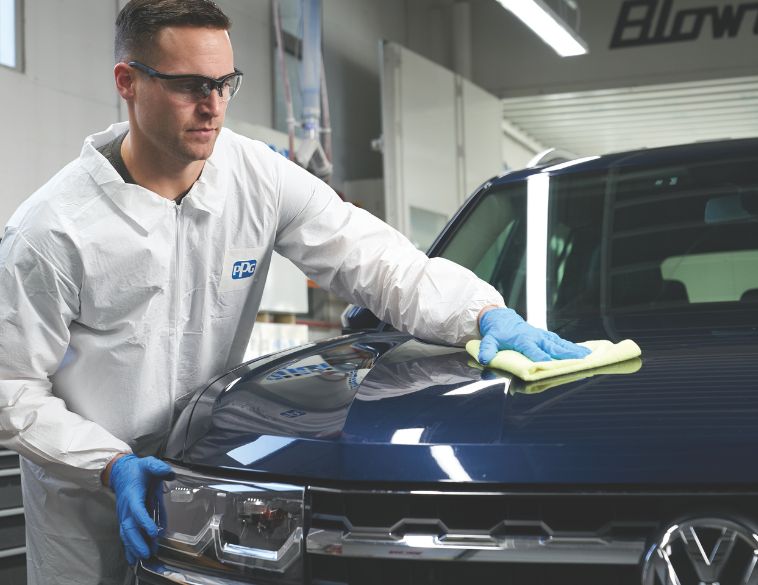
Effective performance partnerships between refinish suppliers and collision centres can lead to huge benefits for both sides. (Credit : PPG)
While the ideal relationship between an automotive paint company and its collision shop customers (ranging from small independents to banner networks), might look unusual in a business world that often sounds guided by the sole principle of competition, specialists from both the shop and paint supplier sides interviewed by Autosphere seem agreed that collaborative partnership between the two is the way to go in creating a win-win for each party. “There should be a performance partnership between the collision repair shop and the paint company,” says Aaron Hebb, Services Consultant with A-Coat Canada at AkzoNobel. “Leveraging some of the new technologies can help in this process. And with the shop’s success, this is to the benefit of the paint company and helps with its success.”
Consistency and sustainability
Noting that consistency and business sustainability are priorities in collision shop operations, Hebb sees both artificial intelligence (AI) and big data having tremendous potential for speeding things up and improving accuracy. “Right now, estimating is the low hanging fruit for AI. The technology is more advanced there. With estimating, AI is at about 80% of what humans can do. But what it does is done immediately,” he says.
With the crucial role of estimating at the start of the collision repair process, cutting corners is hardly an option. And with the time involved in estimating and then parts ordering measured in hours, AI is already poised to make a difference, despite current limitations. With AI, a significant portion of the estimating can now be done as fast as someone can key in the data.
In addition, AI can already assist with scheduling repairs on simpler, basic claims and handle after-hours phone calls and inquiries.
Increasing role
Hebb expects that big data, as more of it is captured, stored and made accessible to shops, will have an increasing role in estimating and other shop functions where information is processed. Capturing data as easily as possible, without inputting, is likely to be a focus of research. Another concern, he says, is that with so many systems currently in use, integrating them into some sort of seamless web is bound to be welcome.
On the paint booth front, digital tools like AkzoNobel’s “Digital Cloud” can help with colour matching. Enhancing shop-level digital literacy is likely to be a focus of training across the collision repair sector.
AkzoNobel currently offers a total of about 20 training programs, in two main areas: business services training, which includes estimating, repair planning and production management; and technical training, which includes programs in tinting and digital colour, etc. “Training is a huge opportunity for helping with collaboration and developing the partnership between the collision shop and the paint supplier. Joint performance reviews with paint companies and collision shops, along with collaboration in workplace analysis can also improve the partnership as well as the sustainability of both parties,” Hebb says.
The right amount
On the other side of the aisle, Tony Tombesi, Field Technical Analyst at CSN Collision Centres, has some observations that are very much in line with Hebb’s. “Paint suppliers want collision centres to profit in business. So, there’s no over-selling. The suppliers want their customers to use the right amount of the right blend of paint as per the repair order or R.O.”
Like Hebb, Tombesi sees collision shop sustainability as a key part of a win-win scenario for both shop and paint supplier. A former collision shop manager, he says paint suppliers are in a position to help make this happen. Paint suppliers typically deal with large numbers of collision shops, so they tend to have a good overview of a shop’s performance and insight into why a shop is doing well—or not. Tombesi says that shops can benefit from running claim statistics and numbers on shop operations by the supplier to identify key areas for improvement. “Part of the role of the paint supplier is that of a go-to for information,” he says.
Besides AI and information technology or IT, other technical innovations are helping to improve collision shop productivity and refinish quality.
UV and 2K primers
UV primers are not suited for every primer application and 2K primers are still seen as the best choice for larger filler repairs and batch priming, but UV primers are making inroads in the collision shop refinish sector, Tombesi says.
It’s not hard to see why. With a conventional 2K primer, air drying can take up to an hour “and even with a heated booth may require a 30-minute bake cycle. Single component (1K) primers dry faster, but they still take at least 10 minutes to dry and are more prone to shrinkage,” according to ProXL, a collision shop supplier
UV primers, on the other hand, are formulated to remain in a liquid state until they are exposed to ultraviolet radiation. “The time required for the liquids to evaporate will depend on the strength of the light source, but curing will be complete after about 60 seconds, after which it is ready for sanding or painting,” the ProXL website states. Besides time savings, the site lists several other helpful attributes of UV primers, including environmental ones.

Spectrophotometers
Spectrophotometers and automated mixing systems are also making a difference, especially in larger shops. Although cost puts these technologies out of reach of many smaller shops, they can afford UV primers, and they are switching to UV in growing numbers. “UV primers are showing great promise,” Tombesi says.
Refining some aspects of the business side of operations can also improve profitability with the help of AI. The technology can be used to get a more granular picture of a shop’s workflow, revenues, etc. “AI could evaluate how much revenue in sales each week and how much each tool or system is used,” Dominic Prochilo, COO at Simplicity Car Care, says.
Based on data collected over time, realistic sales and production goals for each week of the year could keep inventory—and the related costs—right down to the level for an efficient just-in-time schedule. “Reduce materials by one per cent and save $30,000 on $3 million in sales,” Prochilo says.
Cross-linking costs
Cross-linking critical and ongoing costs that are related to production over a given time period – a month, for instance—is another way of getting more precise unit production costs. “On the 28th of each month, the shop sends a request to the paint company to credit the shop with the amount not used. Then on the first of the month, the same credit is received by the shop as an invoice from the paint company,” Prochilo says.
Measures like this help track unit costs and profitability with as close to 100% accuracy as possible. A principle here is that a sharp eye on financials keeps shop management planning on the right track and informed of the state of play – and helps avoid nasty surprises.
Another key goal of this and other initiatives is keeping franchisees happy and profitable. With this in mind, Prochilo welcomes what he describes as “the value-adding programs” that paint companies continue to provide.

JOBS
 |  VAL-DAVID VAL-DAVID Full time Full time |
 | SAINTE-AGATHE-DES-MONTS Permanent |
 | LAVAL Permanent |
 | BROSSARD Full time |
 | ST-HUBERT Full time |