
Lessons From The Road
Autosphere » Tires »
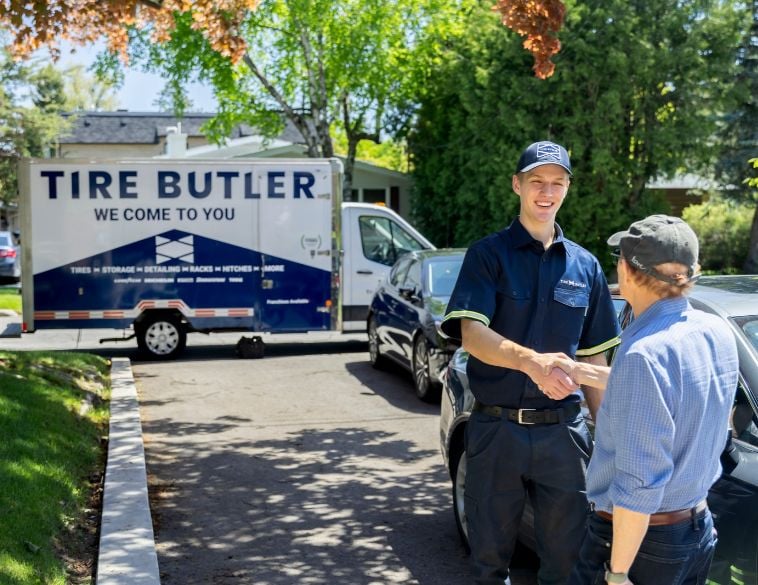
Launched in 2010 with a single truck, Tire Butler pioneered mobile tire service in Canada—a doorstep convenience model that is more relevant than ever today. Credit: Tire Butler
Tire Butler’s experience offers valuable lessons for tire businesses considering offering mobile service.
When Tire Butler first launched in 2010 with a single truck, mobile tire service was still largely novel in Canada. The idea behind the business, however, was simple: Why should customers have to rearrange their day to visit a tire shop when the tire shop could come to them?
Sixteen years later, that premise is more relevant than ever. Consumers have become accustomed to having a growing number of goods and services delivered to their homes and workplaces.
Tire Butler President Jack Benzacar believes that this trend represents an opportunity for tire shops willing to rethink the traditional customer experience. His mobile tire service company has grown into a multimillion-dollar operation serving residential customers, businesses, commercial fleets and dealerships.
“I think the automotive industry has traditionally underestimated the value of a customer’s time,”
– Jack Benzacar, President, Tire Butler
Selling time
Benzacar says that the most important thing he sells is time. “I think the automotive industry has traditionally underestimated the value of a customer’s time,” he says. “When someone goes to a traditional tire shop, there’s a cost that never appears on the invoice. It’s the time spent travelling, waiting, arranging transportation and disrupting their schedule.”
Mobile service changes the equation by allowing the customer to remain at home, at work or wherever the vehicle is parked. “We’re saving people and businesses time,” says Benzacar. “In many cases that time is worth significantly more than the cost of the service itself.”
The old saying that time is money takes on new meaning with mobile tire service. By eliminating the travel, waiting and scheduling hassles associated with a trip to a tire shop, mobile service can deliver value that goes well beyond the tire service itself.
Benzacar argues that comparing the cost of a mobile tire change with the invoice from a conventional tire shop misses an important part of the equation. That’s because the customer isn’t simply buying a tire change. They’re buying back the time that would otherwise be wasted. “The tire is a commodity. The customer’s time isn’t,” he says.
Looking beyond the truck
Tire Butler’s more than 12 mobile service vehicles, operating in the Greater Toronto Area, are professional mobile tire service centres equipped with tire mounting and balancing equipment, compressors, lifting equipment, specialized tools and onboard power systems.
The company provides a broad range of services including new tire sales, seasonal changeovers, mounting and balancing, repairs, TPMS services, wheels, tire storage and flat repairs.
“We also provide vehicle accessories and related services, including basic automotive maintenance and interior detailing,” Benzacar adds, “and we continue to expand the products and services we can offer customers.”
The physical equipment, according to Benzacar, is actually one of the easier parts of the business to replicate. The bigger challenge is making each truck productive.
Unlike a conventional tire shop, where customers bring their vehicles to a fixed location, a mobile operation has to coordinate technicians, vehicles, equipment, inventory, traffic, geography and appointment windows. That makes logistics central to the business model, and this is where Tire Butler has invested heavily.
The company developed proprietary software and operational processes to coordinate appointments, technicians, inventory and customer locations. The objective is to make a complicated operation look simple from the customer’s perspective.
A customer can book online, provide vehicle information, select a location and choose an available appointment. Behind that straightforward experience, however, the company has to determine how to get the appropriate technician, equipment and products to the right location at the right time.
“The trucks deliver the service,” says Benzacar. “The software and systems make the business work.”
Don’t make it seasonal
Seasonal tire changeovers are an obvious application for mobile service, particularly during the intense spring and fall rushes. However, Tire Butler has deliberately built its business with a bigger picture in mind.
“Seasonal tire changeovers are an important part of our business, particularly in Canada, but we’re not simply a seasonal tire-changing operation,” says Benzacar. “Our broader goal is to make vehicle ownership and automotive service more convenient throughout the year.”
The key to success, he explains, is building a mobile operation that can serve a range of customers and applications, generating revenue and keeping equipment productive throughout the year.
One of the key markets for Tire Butler is fleet vehicles. Mobile tire technicians work around a fleet’s operating schedule and service vehicles where they are already parked. For businesses that depend on keeping vehicles productive, reducing downtime can be more valuable than simply finding the lowest-cost tire service.
Tire Butler is also developing white-label services for automotive dealerships, allowing dealers to offer mobile service without having to build their own infrastructure.
Scale the system, not just the fleet
Looking ahead to the next few years, Tire Butler is focused on three complementary growth opportunities: expanding their own mobile service operations with residential customers, commercial fleets and automotive dealerships; bringing their technology to a much larger market through MobileTire.com, which they’re preparing to introduce in the United States as a Software-as-a-Service platform for the mobile tire industry; and franchising.
“For 16 years, we’ve been figuring out how to make mobile tire service work at scale,” says Benzacar. “We started by building a mobile tire company. Over time, we realized we were also building the operating system for an industry.”
The goal, he explains, isn’t simply to put a tire technician on the road. It’s to rethink where the service happens, how the customer experiences it and what benefits they see.
For Benzacar, the tire itself is increasingly just a commodity. “We sell the time and throw in the tires for free,” he says.
It’s a provocative way of describing the business, but it speaks to a reality that is becoming increasingly important. In a world where convenience is valued more than ever, one of the most valuable things a tire company can give its customers is something that never appears on an invoice: their time.
Tags : Tire Butler


JOBS
 |  TROIS-RIVIÈRES  Full time |
 | VAUDREUIL-DORION Full time |
 | ST-BRUNO Permanent |
 | ESTRIE ET ENVIRONS Full time |
 | TERREBONNE Full time |