Safety in the Spray Booth
Autosphere » Collision »
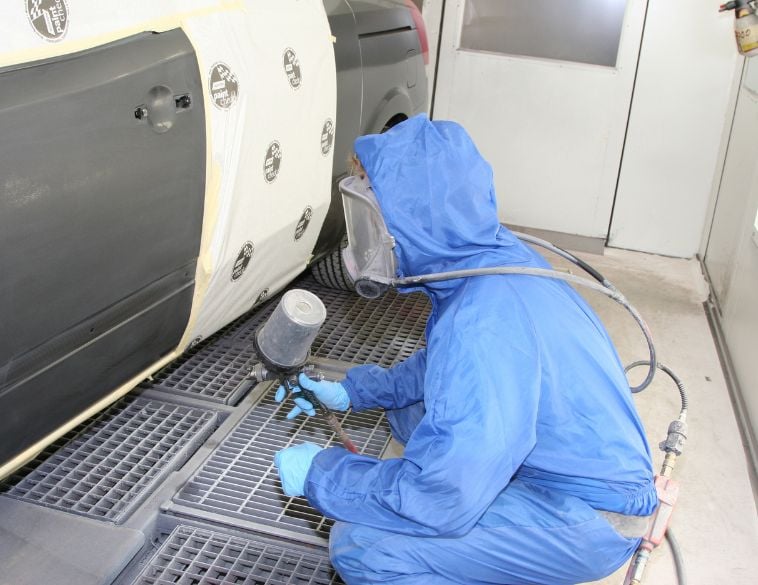
Proper ventilation and PPE equipment is essential when working in a modern refinish department. Credit: Huw Evans
Proper filtration and maintenance means healthy staff and better refinish results
Depending on the specific workplace issue or hazard under review, along with local and current standards, the importance attached to safety has waxed and waned over time. These days, however, when it comes to motor vehicle paint booths, the priority given to safety is on the rise—and with good reason.
There’s no question that modern coatings have transformed collision repair. “They provide faster processes, better appearance, stronger chemical resistance and longer-lasting finishes. The respiratory hazards involved in applying those coatings, however, demand more than the habits that were common in body shops in the past,” says Mike Murphy, Business Development Specialist at SATA Canada.
“The cleaner the air around the technician, the better the conditions are for avoiding VOCs and isocyanates attaching to the technician.”
– Les Pawlowski, National Sales Manager, SATA Canada
Old methods no longer effective
Murphy notes that although many facilities have invested in modern spray booths, training and supplied air equipment, “Others still rely on rules of thumb: a cartridge mask for one coating, supplied air for another, or protection chosen by what feels convenient.”
Such hazard assessment-free approaches, he suggests, are dangerous. “The simple principle is this. The product or coating label, safety data sheet, exposure assessment and applicable regulation must determine the protection. The name of the coating layer cannot do that on its own.”
When isocyanate-containing hardeners became more commonplace, they helped deliver the durability and finish quality that the market demanded, but they also rendered obsolete any earlier approaches to safety and spray booth breathability—those that relied on old-school methods such as a sense of smell, or “gut instinct.”
Isocyanates are highly toxic chemicals that are now commonly used as hardeners. They can be found in clear coats, primers and pigmented polyurethane enamels. Inhaling their vapours or mists irritates the nose, throat and lungs and can cause irreversible isocyanate asthma. Also, once a person becomes allergic to isocyanates, microscopic amounts can trigger a severe or even fatal asthma attack. Even when not fatal, exposure to these VOCs, can result in career-ending illnesses for spray booth technicians.
Dangerous exposure
If performed without proper PPE and booth-wide vacuum and ventilation systems operating at or above required standards, ordinary, everyday paint booth activities—including spray application, mixing paints and cleaning spray guns—involve a high risk of dangerous exposure to one or other members of the isocyanate family of toxic chemicals.
“Spray booth technicians should wear full face fresh air supply helmet respirators as per all TDS (technical data sheets) for all our products. It’s also the law,” says Brad Kruhlak, Technical Manager, Canada, at AkzoNobel Vehicle Refinishes.
He says that although paint booth safety is being given increased priority across Canada, what are called, “activated charcoal half-masks” are still in widespread use. In Kruhlak’s view, only one manufacturer of these devices is really crystal clear about their limitations.
Even with adequate disclosure from the manufacturer, the use of these charcoal filters is inherently risky. “Although charcoal filters can work for up to eight hours, in any given situation, you can’t tell how long the charcoal is effective. You don’t know at what speed the charcoal will break down. Technicians should make sure they observe approved CSA or OHSA standards,” Kruhlak says.
Maintenance matters
Kruhlak urges the use of a full-face pressurized helmet—so “nothing gets in.” Although it seems to be happening less frequently than it used to, he also warns that filtration systems are sometimes insufficiently maintained, and notes that they depend on a properly operating and maintained compressor.
The modern spray booth involves the use of three air systems: the ambient air in which the work of spraying, mixing paint, etc. is done, ultra-clean compressed air that pressure-fills the technician’s helmet for breathing, and a vacuum system for dust and spray removal. “Each serves a direct and shared purpose and understanding all three is critical in body shop environments,” says Les Pawlowski, National Sales Manager at SATA Canada.
Efficient airflow in the spray booth contributes to cleaner work, higher quality results and more efficient production. “Also, the cleaner the air around the technician, the better the conditions are for avoiding VOCs and isocyanates attaching to the technician,” Pawlowski says.
The onsite vacuum arrangement, he says, whether a vacuum sanding system or an air extraction one for grinding/welding fumes and/or light spraying/sanding environments, also assists in protecting the technician and improving efficiency and production results. “Either serves to control dust, VOCs and vapours in ambient air. Definitely health related.”
The third air system, compressed air, is used for spraying, pneumatic tools and equipment—and breathing. “Clean, dry air is important for pneumatic tools, but critical for spraying and breathing. Using a proper three-stage filtration system ensures contaminant-free spraying, with fewer defects and rework, and healthy air for the operator. So while we’re concerned about the painter’s health, part of the cost of proper filtration system goes to ensure contaminant-free paint spraying,” Pawlowski says.
Health considerations
Pawlowski and others interviewed for this article emphasized the absolute importance of regular, scheduled maintenance and testing for all air systems. This is not just product quality, but someone’s health, since both this, and their ability to work —could depend on it.
A new kit from SATA can help cut the cost of testing air compressing equipment, and making sure its filtration is working to the required standard. Instead of a testing facility staffer visiting the shop to gather samples, etc., a shop technician can remove the one-time-use kit from its box, obtain samples, put the kit back in its box and mail to a lab that is accredited for this type of testing. “The cost includes a test report and addresses and meets the standard of the latest edition of CSA Z180.1 for compressed breathing air and systems,” Pawloski explains.
The flow and cleanliness of air within the paint booth workspace get plenty of attention from Symach, a Bologna, Italy-based provider of body shop process and layout systems. “Safety ventilation is not only about moving enough air through a paint booth, explains Osvaldo Bergaglio, founder, CEO and designer of Symach’s systems and products. “The air must be distributed uniformly around the vehicle, extracted uniformly through the floor, and that condition must remained controlled as the filters progressively load with over-spray,”
The ambient airflow uses a “specifically-designed internal distribution to balance the air flow before it passes through the ceiling filters,” the purpose of which is to provide a uniform air flow across the working area. “We apply the same principle to extraction through the floor,” says Bergaglio. “Calibrated, perforated panels balance the extraction across the floor area, with a space between the filters and the balancing system that allows the airflow to redistribute before extraction.”
Automatically controlled
Bergaglio notes that this system provides a reserve ventilation capacity that automatically helps control air supply and extraction so that filter loading (from over-spray) does not result in deterioration of booth airflow performance. Sensor readings displayed on a touch screen enable the operator to observe and react promptly when necessary.
With over 20 years in business, Symach operates in about 200 collision repair locations worldwide. The proposition behind the Symach system is that most other body shops are designed around stand-alone equipment, vehicle handling between phases, annoying bottlenecks and waiting around. Instead, Symach’s system, which is mostly for large independent body shops, dealers that do collision repair, and multi-shop-operators, is designed to create an efficient, seamless workflow. Given that time seems to become an ever more precious commodity, finding ways to save within the collision repair process can make a big difference, particularly in the long term.


JOBS
 |  BOISBRIAND BOISBRIAND Full time Full time |
 | TERRITOIRES DE LA MONTÉRÉGIE, ESTRIE, GRAND MONTRÉ Permanent |
 | QUÉBEC Permanent |
 | SAINT-JÉRÔME Full time |