
Smooth, Efficient Repairs
Autosphere » Mechanical »
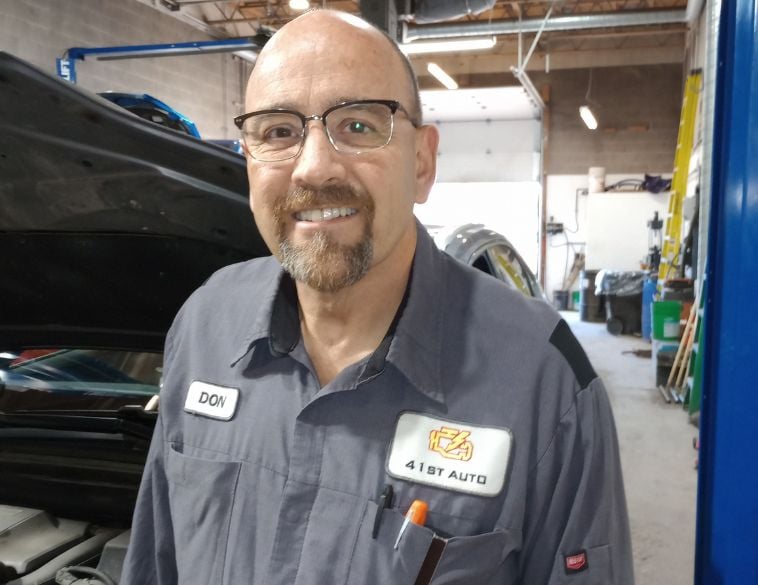
Don Jardine, Owner Operator, 41st Auto, Calgary, Alta. Credit: Don Jardine
New technologies, software tools and a client-focused approach are making this not only possible – but significantly easier to achieve
In an automotive repair shop, asking the right questions and actively listening to your customers is absolutely critical because it directly dictates the accuracy of the diagnostic process, prevents expensive misdiagnoses, and builds long-term business trust.
The importance of a good intake process is underlined by the fact that the auto repair industry as a whole tends to structure its workflow around the intake Q & A between the technician and customer through a framework called the three Cs – the concern stated by the customer, the cause of the problem diagnosed/verified by the shop and the correction achieved by the repair.
Providing a voice
Hearing the customer’s concern(s) and asking well-targeted follow-up questions don’t just help in pinpointing both intermittent and non-intermittent issues, they also reassure the customer that their concern will be addressed and add to their comfort level by giving them a voice in the vehicle process. This helps ensure that the work done on the vehicle aligns not only with what is actually needed before the vehicle is back on the road but also with any specific longer term plans the customer has for that vehicle. Does the customer want the bare minimum done prior to trading it in next week or major re-conditioning to prep the vehicle for a series of cross-country road trips?
Today, in order to diagnose a modern vehicle quickly and eliminate wasted time, a repair technician relies on a highly structured multi-stage process assisted by OEM software, connected hardware, and cloud-based intelligence networks. Data gathered in the process can often identify a system failure down to the exact component, wire or sensor. Tools like Shop-Ware or Tekmetric deliver digital vehicle inspections (DVIs) directly to the technician’s tablet. Modern vehicle modules behave erratically under poor voltage, and verifying a clean power supply prevents wasting hours chasing “ghost” fault codes. So, connecting a dedicated battery tester to confirm stable voltage is typically a short but potentially critical stage in the diagnostic process.
“Hearing the customer’s concern(s) and asking well-targeted follow-up questions don’t just help in pinpointing both intermittent and non-intermittent issues, they also reassure the customer that their concern will be addressed and add to their comfort level by giving them a voice in the vehicle process.”
– Don Jardine
Digital snapshot
The vehicle’s computer networks are targeted to generate a digital snapshot of system health. Intelligent scan tools are used and technicians plug professional, multi-system scanners \such as Snap-on Zeus or Autel MaxiSYS into the vehicle’s OBD-II port. Technicians look at Freeze Frame Data—a software snapshot capturing the exact engine RPM, vehicle speed, temperature, and sensor parameters at the millisecond the fault occurred. To avoid hours of manual troubleshooting, technicians can now query massive repair databases.
Programs like Mitchell 1’s ProDemand or ALLDATA provide the exact manufacturer repair wiring diagrams and system descriptions. Software like Identifix Direct-Hit or Snap-on’s Intelligent Diagnostics crowdsource real-world fix data. They analyze tens of thousands of recorded repairs for that specific vehicle make, model, and code, instantly ranking the most likely fixes and Technical Service Bulletins (TSBs) to cut down research time from hours to seconds.
Post-repair verification
The diagnosis should complete with a post-repair verification routine to ensure accuracy. Technicians use their scan tools to force specific components (like a fuel pump, cooling fan, or EGR valve) to cycle on and off manually. This verifies the control circuit responds appropriately to commands.
Source all known required parts prior to the start of repairs, using the VIN whenever feasible. Open and match arrived parts against the old units before installation.
During the repair process, digital vehicle inspections (DVIs) and real-time SMS updates are increasingly the industry standard. Backed by photographic evidence where possible, repair status updates assure customers that the work is on track and alerts them of anything requiring a decision. Also, technicians with smartphones or tablets can attach notes and photos and avoid paper clutter and miscommunication – thereby improving the workflow.
Final report
After the physical repair is made, the technician clears the faults, completes a dynamic road test, and runs a final system health report. They capture the exact live sensor data that initially failed, matching it side-by-side with the new data to objectively prove the problem is resolved.
SMS updates on repair status do more than reassure an anxious client. Surveys are showing that shops using DVI and visual evidence report significantly higher approval rates – up to 20 to 40% increases – and higher average repair orders. Who could have a problem with that?
Bio: Don Jardine is a long time automotive technician who owns and operates 41st Auto in Calgary, Alta., an independent service centre that specializes in Japanese and Korean vehicles.
Tags : Urban Automotive



JOBS
 |  RIVE-SUD DE MONTRÉAL RIVE-SUD DE MONTRÉAL Full time Full time |
 | MONTRÉAL Full time |
| MONTRÉAL Permanent |
 | BROSSARD Full time |
 | SAINT-BRUNO Full time |