
CIBC: Building a Sustainable Automotive Finance Ecosystem

Stephanie Stenton, Senior Director of Product Management and Client Solutions at CIBC Auto Finance. Crédit : CIBC
Embedded ESG, customer convenience, transparency and affordability are key factors says Stephanie Stenton.
In today’s business environment, sustainability has become a key priority for not only organizations but their key stakeholders and customers. In the automotive retailing space, financing is becoming an area where sustainability practices are delivering meaningful results. At CIBC Auto Finance, this represents a long term commitment to dealers and their customers, as well as OEMs and other key stakeholders. Yet building and executing a successful strategy requires employing several key pillars, to ensure that not only are Environment and Sustainable Governance (ESG) practices at the heart of automotive financing, but that they still represent an practical and affordable option for environmentally conscious consumers. To gain further insight, Autosphere interviewed Stephanie Stenton, Senior Director of Product Management and Client Solutions at CIBC Auto Finance.
Autosphere: What do you feel is key to building a sustainable financial eco-system around EVs in Canada today?
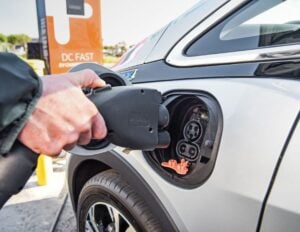
Stephanie Stenton: That’s a great question. Going back several years, some of the key factors would have been removing barriers such as range anxiety, and/or educating people on the savings benefits of an EV. Today, clients are more educated in the EV space and tend to be less worried about range anxiety. Additionally, we have seen infrastructure built up across Canada and also globally. So, if we were to look at specifics right now, I would say affordability is top of mind for many consumers. It can be difficult for customers to see the long term benefits in owning an EV, especially with inflation and higher sticker prices on new vehicles, but now, with rising fuel prices and the return of federal government incentives, the idea of owning an EV is becoming more attractive again.
AS: Can you tell us a little about CIBC’s approach regarding ESG principles and how that extends into lending and financing practices?
Stephanie Stenton: At CIBC we have a broad approach toward ESG that’s focused on helping create a more equitable, inclusive, and sustainable future. For example, we have a $300 billion sustainable finance goal by 2030 that will contribute to environmental and social progress across Canada and globally. We also support practical client and dealer solutions like our Green Vehicle Program, which is one example of how our ESG priorities are shaping and showing up in our everyday banking. Another would be our New to Canada program which qualifies buyers who have lived in Canada for five years or less, and who can purchase a new or used vehicle without any Canadian credit history. At the end of the day, we play a relatively small role in the car buying journey, but that role is to help remove the affordability pain points. While our role is small within the larger purchase journey context, it is nevertheless, a very important one.
AS: If applicable can you tell us about CIBC’s approach to financing, including the Green Program aimed at battery electrics, plug-ins and hybrid vehicles and if there are any specifics to consider when it comes to catering to buyers of these type of vehicles?
Stephanie Stenton: When many consumers look at purchasing a vehicle, it’s often more than just a transaction. There tends to be a lot of emotion involved and in many respects when you buy a vehicle, you’re purchasing it to not only fit your needs in your day-to-day life, but also buying it to fit your personality. Within that context, it’s a lot more than just simply looking for something to take you from point A to point B. When we look at those shopping for EVs, Plug-in-Hybrids or Hybrids they tend to be looking beyond basic transportation and so our Green Vehicle Program, is aimed specifically at these types of buyers. We’ve partnered with 3,400 dealers across Canada and what we’ve done is create a program that caters toward Battery Electric Vehicles (BEVs) plus, Plug-In Hybrids, Hybrids and also Fuel Cell vehicles. This means that no matter where you are on the spectrum of considering a “green” vehicle and shifting toward helping the environment and lowering your emissions, there is an option for you. At the same time, clients can also finance the cost of a home EV charging station within their vehicle loan, giving them an all-in-one solution, without having to add on that expense, since the focus is on affordability and convenience. Additionally, we’ve added in a $25 donation to the Nature Conservancy of Canada for every eligible green vehicle funded through this program, which also helps in contributing toward conservation and environmental preservation across the country. Besides new EVs, we’re also seeing growing interest in pre-owned models, and so, for the Green Vehicle Program we have adjusted our model years to make sure that we can finance used EVs and low emissions vehicles as well. This will help ensure that these vehicles are accessible to a broader range of Canadians, adding additional options for those that are considering a low emission or zero emission vehicle.
We need to consider the full customer journey around purchasing an EV, and ensure the entire process, from start to finish, is easy, seamless and ultimately a good buying experience.
– Stephanie Stenton, Senior Director of Product Management and Client Solutions at CIBC Auto Finance.
AS: Going forward, are there any specific market trends you’re seeing emerge in both the EV and auto finance space, and if applicable, how is CIBC positioning itself to ensure a winning outcome for all key stakeholders?
Stephanie Stenton: Going back to our first question, affordability does continue to be one of the biggest conversations across both automotive retailing and financial services. Consumers are very focused on weekly and monthly payments, as well as interest rates. While we have seen interest rates come down, they could rise again and that is something to watch. And then of course, there are the long-term ownership costs and overall value of vehicles, which are also becoming a key focal point in the vehicle purchase process. While that represents the leading trend here in Canada, another to look out for is the global competition we’re increasingly seeing in the EV space, with new vehicles slated to come to market here in Canada. There are more conversations happening around lower-cost international EV manufacturers, which would essentially change the current supply chain dynamics. We’ll see greater competition, but that can help improve accessibility and accelerate innovation across the industry. That being said, bringing new vehicles into our market is no easy feat, and there are security concerns and economic risks, as well as fear of the unknown. A third trend revolves around digital expectations within the retail automotive process. Expectations continue to rise and consumers want financing experiences that are fast, seamless, transparent, and essentially digitally enabled, including the ability to sign documents online. Another factor is digital ID verification. In order for the industry to protect themselves, this needs to become the norm, and it’s starting to show up with government permit regulation as well.
AS: Is there anything else you’d like to mention?
Stephanie Stenton: One thing I would say, is that EV adoption is no longer viewed just as a niche. According to Statistics Canada, there were 21,574 new zero-emission vehicles (ZEVs) sold in March 2026, an increase of 74.7% from one year earlier. New ZEVs comprised 12.2% of total new motor vehicles sold, compared with 6.5% in March 2025. It’s becoming more mainstream and a significant part of the automotive industry’s future. From the perspective of a financial institution, we need to consider the full customer journey around purchasing an EV, and take steps to remove barriers so that that the entire process, from start to finish, is easy, seamless and ultimately a good buying experience for the consumer.
Tags : CIBC


JOBS
 |  ETOBICOKE ETOBICOKE Full time Full time |
 | SAINTE-JULIE Permanent |
 | LAVAL Full time |
 | LACHINE Full time |
 | L'ASSOMPTION Full time |