
Mindset Matters
Autosphere » Collision »
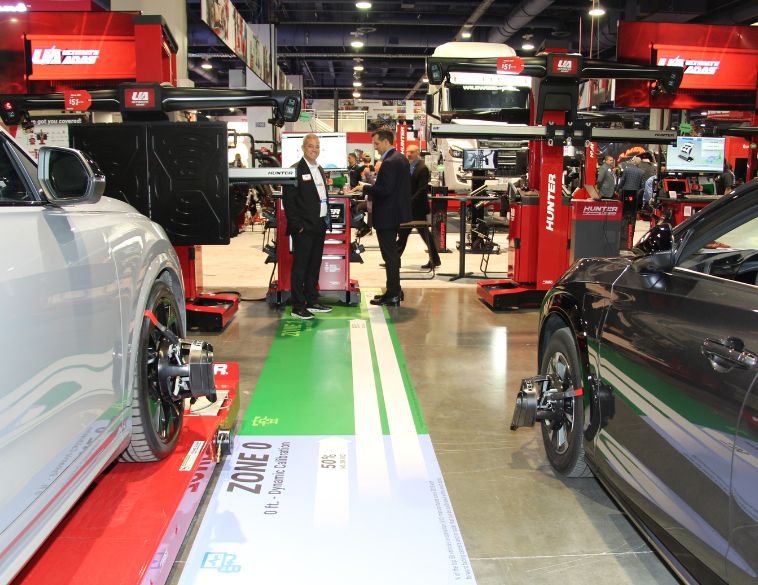
Hunter’s Ultimate ADAS allows shops to add features over time. (Credit : Huw Evans)
It’s the approach to ADAS calibrations that is the ultimate key to success.
At present there are an estimated 70 million motor vehicles on North American roads that are equipped with some level of Advanced Driving Assistance Systems (ADAS). Several industry sources in the U.S. and elsewhere are confident that the market for ADAS-equipped vehicles—and collision (and some mechanical) repairs that will involve ADAS calibrations— will continue to grow for the next few years. Also, “a growing number of drivers have never driven a vehicle without ADAS,” says Ross Iacobellis, Technical Sales and Training Manager at Hunter Engineering Company.
Key trends
The growth expectation is based on some observable trends. According to a survey of 300 facilities across North America—collision (59%), mechanical (33%) and glass (8%) repairers— “shops reported that currently 44% of vehicles they service are equipped with ADAS systems requiring potential calibration, and this percentage continues to rise as older vehicles age out and newer vehicles with standard ADAS equipment make up an increasing share of repair volume.”
The October 2025 report on the survey, published by Revv, a software company, notes that collision shop average initial investment in ADAS was US $55,494. Currently, the average shop generates $21,509 in ADAS revenue with a 9%net profit margin.
It is no surprise then, that despite substantial upfront equipment costs and training challenges, the option of optimizing shop capacity for ADAS has its advocates. “The correct strategy is to embrace the ADAS marketplace by bringing calibrations in-house. This gives your repair facility full control over the service being delivered and helps ensure that vehicle cycle time remains manageable,” says Chris Sobieski, ADAS and North America Special Projects Manager at Snap-on Equipment.
Flexibility counts
Although he notes that the size of the shop will influence the percentage of calibrations that can be performed internally, he recommends being flexible with the available shop space and allocating specific times for calibration work. “This allows you to expand capability even when space is limited. Understanding the limitations of your facility is essential, including knowing when a calibration must be sublet to an OEM dealer or another repair facility,” he says.
Aside from environmental factors like neutral-coloured walls, good lighting and control of external and ambient light, equipment requirements tend to depend on the manufacturers being serviced. But there are some essentials for properly-executed calibrations, Sobieski says. “Core components include a high-quality calibration frame that offers ease of use, uncompromising accuracy and alignment with OEM procedures for calibration target placement, such as John Bean Tru-Point, which uses exclusive 3D imaging technology to ensure targets are positioned correctly and fully documented.”
Other essentials Sobieski points to include a high-quality power supply capable of delivering more than 100 amps of clean power, a subscription to reliable OEM service information such as Sun Collision, and an ADAS-capable scan tool offering the widest possible coverage, “supported by an OEM source for GAP coverage when a vehicle is not yet supported in the tool.”
The business plan
Les Pawlowski, general manager for the U.S. and Canada at Symach Innovative Bodyshop Solutions, while pointing to the reports, data and forecasts for ADAS growth, nonetheless says that a shop’s strategy for ADAS ultimately depends on the owner’s business plan. Direct and opportunity costs have to be weighed against potential revenue, he says.
Like others interviewed by Autosphere about ADAS, Pawlowski says that if a shop is doing in-house calibrations, it should have in-house wheel alignment capability—and technicians properly trained in alignments. He sees a growing demand for those with high-tech skills. “A lot of shops are hiring young people who are computer savvy. I know a shop in the U.S. that hired a19-year-old and in four months, he became the top calibrator there.”
Some, but not all, body repair work is affected by ADAS. But the repair requirements to OEM specs that specific parts of a vehicle, like bumpers, tend to have because of embedded ADAS components, mean that those repairs must be done with absolute adherence to OEM specs.
If the customer wants ADAS on the bumper to work properly after it leaves the shop, “You must use the correct amount of the specified paint on a bumper or someone might have to spend $2300 on a new bumper instead of $85 in a fixit shop,” Pawlowski says.
OEM requirements essential
Clearly, ADAS calibrations add a minimum of one extra step to the collision repair process and understanding OEM requirements is essential. “When managed correctly, the additional time is minimal. Most vehicles can be re-calibrated in less than a few hours. Costs have increased due to ADAS components, but in many cases, ADAS systems help reduce collision severity by identifying hazards and reducing vehicle speed before impact,” Sobieski says. Shops are typically responsible for their calibrations, whether done in-house or sublet. Sobieski says that at the very least, shops should perform their own dynamic calibrations (on the road instead of static calibrations done in the shop’s controlled environment) to maintain control over cycle time and calibration quality. “This approach often leads to expanding into static calibrations later. One other critical step that shops should consider is having reports providing proof of proper procedures to reduce comebacks and potential liability,” he says.
Besides the on-site equipment needed, shop lighting and other conditions required for a static calibration can be detailed and specs can include tire pressure, a full tank of gas and tire pressure, among others, Iacobellis says.
Systems for calibrations are available from Hunter Engineering, he says, in various configurations and options, including the company’s Ultimate ADAS, which has wheel alignment and is an a la carte system where options can be added over months or years. This product sounds like a good fit for owners with deep enough pockets but who want to expand their ADAS participation incrementally, adding to the shop’s capabilities as the owner and technicians improve their skills and understanding of the ADAS environment.
Other decision factors
Closer to the other end of the financial spectrum, an owner or shop operator may want to defer that reported average US $55,494 initial investment in ADAS calibration equipment prior to getting a better idea of the ADAS-related revenue generating potential of their shop in its specific location with its unique clientele, etc. Using the services of a mobile calibration company would be one way to retain or attract clients whose newer vehicles have been in a collision despite the embedded ADAS. The shop gets to service customers with newer cars, gets its feat wet in the ADAS world and over time, the owner (hopefully) acquires some data that helps with a decision about investing in ADAS equipment.
Joel Adcock, Director, Strategic Partnerships at Revv, has some thoughts on keys to success with ADAS. “ADAS is not a single tool, brand, or purchase decision. It’s an evolving operational capability. The shops that are succeeding aren’t necessarily the ones that bought the most equipment. They’re the ones that invested intentionally, aligned tools with process, and built repeatable workflows around safety and accountability. That mindset, more than any individual product, is what will define long-term success in ADAS-enabled collision repair.

JOBS
 |  DORVAL DORVAL Full time Full time |
| ST-HUBERT Full time |
 | MONTRÉAL Permanent |
 | SASKATOON Full time |
| MONTRÉAL-NORD Permanent |